Breath & Digital Stress: How Screen Time, Blue Light, and Indoor Air Shape Your Breathing Health
Modern life changes more than our attention span. It changes the way we sit, sleep, recover, and even breathe. If you spend long hours at a desk, bounce between tabs and messages, and unwind under bright screens at night, your breathing pattern may quietly shift toward something faster, shallower, and more stress-driven. Add indoor air that is dry, stale, dusty, or polluted, and it becomes easier for your body to stay in a low-grade state of irritation instead of settling into calm recovery.
The tricky part is that these effects often build slowly. You might not notice them as a breathing problem at first. Instead, it may show up as tight shoulders, a chest that feels slightly restricted, restless sleep, a sense of being wired but tired, or the feeling that you cannot fully switch off. Understanding the link between digital stress, light exposure, posture, and indoor air can help you make small changes that support better breathing and better recovery.
Why Digital Life Is Changing the Way We Breathe
Breathing is automatic, but it is not isolated. It is closely connected to your nervous system, your posture, and your environment. When you are focused on screens for long stretches, your attention narrows, your body often stills, and your breath commonly becomes quieter and less expansive. Many people begin breathing mostly into the upper chest instead of letting the diaphragm do more of the work.
That matters because shallow breathing is often associated with stress activation. When the body senses pressure, deadlines, notifications, and mental overload, it can stay in a mild fight-or-flight mode. Over time, that can reinforce a pattern of guarded breathing. The result is not just less efficient respiration, but also a feeling of tension that makes it harder to relax, concentrate, and sleep well.
The Screen Time-Stress-Breathing Connection
There is a reason many people feel more tense after long screen sessions. Screens demand sustained attention, quick reactions, and constant cognitive switching. That can increase sympathetic nervous system activation, especially when breaks are rare. A commonly described pattern called screen apnea or email apnea refers to unconsciously holding the breath or breathing very shallowly while intensely focused on a screen. That breath-holding habit can increase fatigue and make the body feel more stressed overall.
When breathing becomes shallow, the chest and neck muscles often take on more of the workload. This can contribute to a cycle where the body stays braced, shoulders creep upward, and the breath never fully drops into the abdomen or lower ribs. In practical terms, that means the nervous system gets fewer signals of safety and recovery during the day.
A simple first step is to notice your breath during common digital tasks. Are you holding it while reading email? Are you breathing more rapidly during meetings? Do you sigh or yawn once you step away from the computer? These clues can help you identify where your daily stress response is showing up physically.
Blue Light, Sleep Disruption, and Nighttime Respiration
Light exposure is one of the strongest signals that tells your body what time it is. Blue-enriched light in the evening can disrupt circadian rhythms, suppress melatonin production, and shift the timing of internal body processes. Research on blue-enriched LED light has shown effects on cardiovascular circadian rhythms and melatonin suppression, which helps explain why late-night screen use can leave people feeling alert when they should be winding down. Source: https://pubmed.ncbi.nlm.nih.gov/35366294/
Why does this matter for breathing? Sleep and respiration are closely linked. If your circadian rhythm is disturbed, the quality of sleep recovery can suffer. That may affect nighttime breathing comfort, autonomic balance, and the body’s ability to settle into deeper rest. In a randomized crossover trial, living in evening blue-depleted light environments for 5 days advanced circadian phase, increased REM sleep duration, and reduced REM sleep fragmentation compared with normal indoor lighting of similar brightness. Source: https://pmc.ncbi.nlm.nih.gov/articles/PMC9130237/
The same logic applies to screen use before bed. A large longitudinal study of about 350,600 nights found that screen use in the hour before bedtime was inversely associated with sleep quality, with more pre-bed screen time linked to lower sleep scores across matched nights. Source: https://www.medrxiv.org/content/10.64898/2026.05.08.26352708v1.full
Even moderate ambient light during sleep can be a problem. Leaving lights on in the room has been associated with autonomic activation, elevated heart rate, and impaired glucose regulation the following morning. That means the body may not fully downshift overnight, which can influence how refreshed and comfortable you feel when you wake up. Source: https://www.nm.org/healthbeat/healthy-tips/light-and-sleep-effects-on-health
For people who struggle with sleep or stress, reducing blue light before bedtime may help. A systematic review and meta-analysis found that blue light reduction interventions, including blue-blocking glasses or lenses, produced small to moderate improvements in sleep efficiency and total sleep time, with larger improvements in self-reported sleep quality among people with sleep or psychiatric disorders. Source: https://pmc.ncbi.nlm.nih.gov/articles/PMC10127364/
How Posture and Sedentary Work Encourage Shallow Breathing
Posture has a direct effect on how freely the ribs, diaphragm, and abdomen can move. Forward head posture, rounded shoulders, and a slouched upper back make it harder for the chest to expand comfortably. Over time, that can encourage chest breathing over diaphragmatic breathing and may reduce how fully you use your lungs.
This is one of the reasons long desk sessions can leave people feeling oddly tired even when they have not physically moved much. The body is not necessarily at rest just because it is still. If you are bracing through the neck, upper back, and ribcage while staring at a screen, your breathing muscles may be working in a less efficient pattern all day long.
The fix does not have to be complicated. A few posture resets can help: raise the screen to eye level, keep feet grounded, let the ribs stack above the pelvis, and take short movement breaks before stiffness sets in. Even brief posture changes can help restore a more natural breathing rhythm and reduce the sense of compression through the chest.
Indoor Air Quality: VOCs, Dust, Mold, and Urban Living
Indoor air can be a major hidden factor in respiratory comfort. In homes and apartments, indoor particulate matter often comes from cooking, heating, and outdoor air infiltration. Fine particles such as PM2.5 have been linked to asthma exacerbations, reduced lung function, respiratory inflammation, poorer COPD outcomes, and other lower respiratory tract damage. Source: https://www.ncbi.nlm.nih.gov/books/NBK600065/
Volatile organic compounds, or VOCs, are another concern. The EPA notes that indoor VOC concentrations are often 2 to 5 times higher than outdoors, and exposure is associated with irritation of the eyes, nose, and throat, breathing difficulty, and worsening asthma and COPD. Some VOCs also carry longer-term health risks. Source: https://www.epa.gov/indoor-air-quality-iaq/volatile-organic-compounds-impact-indoor-air-quality
Human exposure studies support what many people feel in real life. In one controlled crossover trial, exposure to indoor VOC mixtures caused increased respiratory symptoms, especially in people with atopy, and higher exposure reduced small airway function. Source: https://pubmed.ncbi.nlm.nih.gov/10637531/
Dust, mold, and poor ventilation can add more irritation, especially in smaller urban spaces where air exchange may be limited. When the air feels stuffy or chemically heavy, your body may respond with congestion, throat irritation, coughing, or a subtle increase in breathing effort. That can make it harder to stay calm, focused, and comfortable during the day.
Why Poor Air and Digital Overload Can Amplify Each Other
Digital overload and poor air quality do not just stack up separately. They can reinforce each other. A stressful workday often means more screen time, fewer movement breaks, less attention to ventilation, and more time indoors. At the same time, stale air or irritants can make the body feel more fatigued and less resilient, which makes stress feel even harder to handle.
When the nervous system is already activated by deadlines and screens, even mild airway irritation may feel bigger. You may notice you are more sensitive to odors, more likely to yawn or sigh, or less able to take deep comfortable breaths. That does not necessarily mean there is a serious respiratory disease, but it does suggest that the environment is pushing your body toward strain instead of ease.
Signs Your Environment May Be Affecting Your Breathing
There are a few common clues that digital life and indoor conditions may be interfering with breathing health. These include frequent upper chest breathing, breath-holding during concentration, shoulder tension, dry throat, morning grogginess, trouble winding down at night, waking unrefreshed, and feeling better once you step outside or away from screens.
Other signs can include headaches after long indoor days, eye or nose irritation, coughing in certain rooms, worsened symptoms near cleaning products or new furnishings, or increased sleep disruption during periods of heavy evening screen use. If these patterns are consistent, your body may be asking for better light, better air, and more breathing space.
Best Breathwork Patterns for Digital Overstimulation
When you are overstimulated, the goal is not intense breathing. Fast or forceful breathing can sometimes cause lightheadedness or make stress worse. The better approach is gentle, rhythmic, and comfortable patterns that lengthen the exhale or create a smooth, steady cadence.
Cardiac coherence is a useful place to start. A calm pattern such as breathing in for around 5 seconds and out for around 5 seconds can support a steady rhythm and help the nervous system settle. This is especially helpful when you feel scattered, tense, or overloaded after a long stretch of screen time.
Box breathing can also be useful for focus and control, especially during the workday. A simple 4-4-4-4 rhythm may help create mental structure without forcing the breath. If you are feeling tired or wired at night, a relaxation breath with a slightly longer exhale can be more appropriate than a stimulating pattern.
The key is comfort. Your breathwork should feel smooth and sustainable, not exaggerated. If you become dizzy, tight, or anxious, shorten the count, slow down, or return to natural breathing. Gentle consistency is more effective than intensity.
If you want support with structured breathing sessions, visual pacing, and reminders throughout the day, a tool like Just Breathe: Relax Daily can make the habit much easier to maintain. It offers guided breathing patterns, calming animations, ambient sounds, and tracking features that fit naturally into a screen-based routine: https://findthe.app/just-breathe-ujhm1e
Simple Light Hygiene Habits to Protect Sleep and Respiration
Light hygiene is one of the simplest ways to improve nighttime recovery. Try to get more bright natural light earlier in the day, then reduce harsh blue-enriched light in the evening. Dim the room, shift devices to warmer settings, and avoid using screens directly before sleep when possible.
You do not need perfect habits to see benefits. Even small adjustments can help. For example, using lower brightness after sunset, switching to warmer bulbs, and keeping the sleeping area dark can support a more stable circadian signal. That may make it easier for the body to relax, breathe more evenly, and move into deeper sleep.
If you work late on screens, schedule a wind-down window of at least 20 to 30 minutes before bed without high-stimulation content. Use that time to stretch, breathe slowly, or read something low effort. The point is to give your nervous system enough contrast between work mode and recovery mode.
Practical Air Quality Fixes for Home Offices and Apartments
Improving indoor air does not always require a full renovation. Start with ventilation. Open windows when outdoor conditions allow, especially after cooking, cleaning, or using products that release odors. Use exhaust fans in kitchens and bathrooms to remove moisture and pollutants at the source.
Filtration is another high-value step. A quality air purifier can help reduce particles such as dust and PM2.5 in bedrooms and home offices. Regularly changing HVAC filters, cleaning vents, and keeping spaces uncluttered can also make a noticeable difference. If mold is suspected, address the moisture source quickly, because no amount of breathwork can replace proper remediation.
It also helps to be mindful of VOC sources. Paints, fragrances, air fresheners, cleaning sprays, and some new furnishings can all contribute to indoor irritation. Choosing low-emission products when possible and airing out new items may reduce the burden on your airways.
A Daily Reset Routine for Remote Workers and Heavy Screen Users
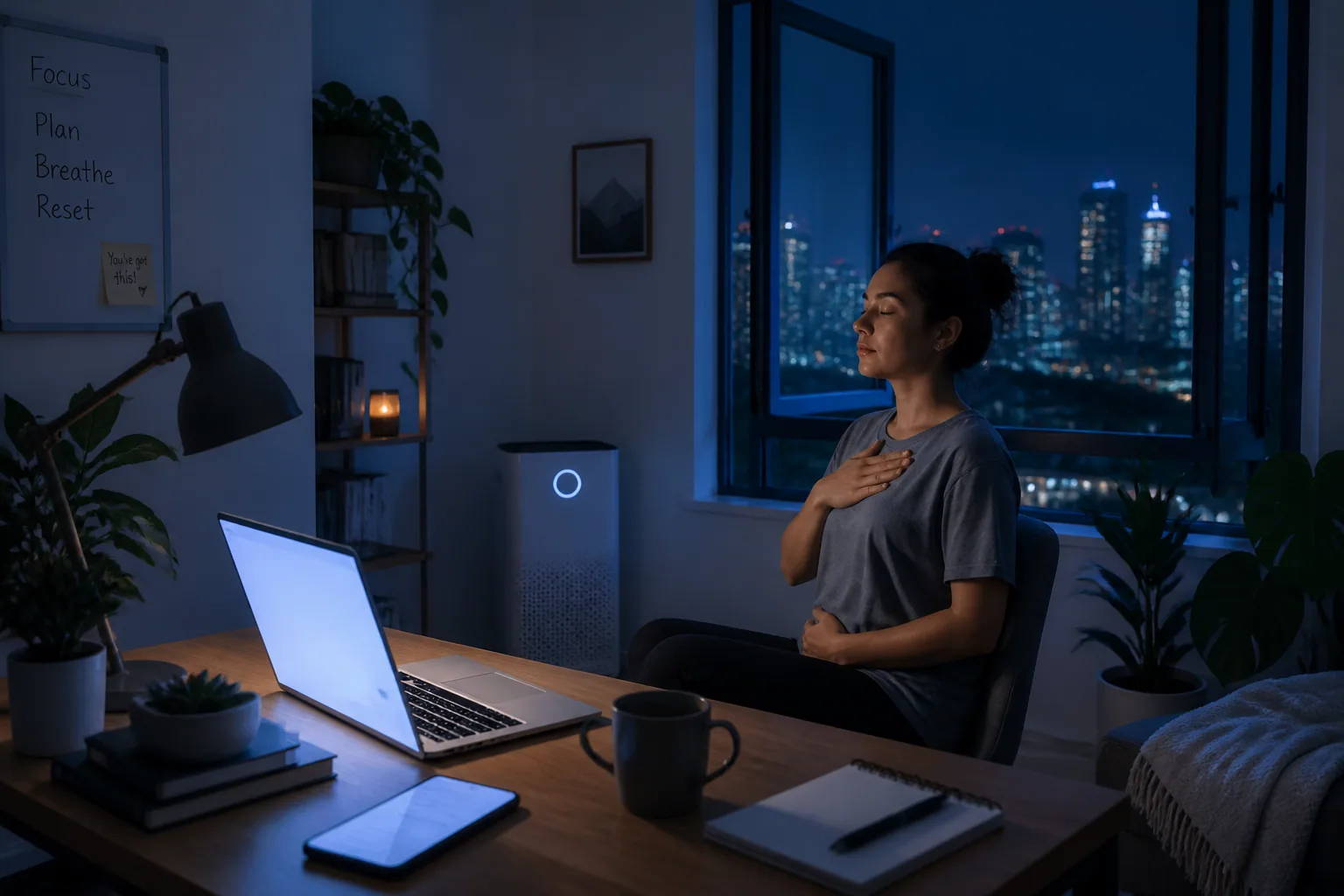
A practical routine can help break the cycle of digital stress and shallow breathing. Begin the morning with a few minutes of natural light and gentle movement. During work, stand up every 45 to 60 minutes, roll the shoulders, and take 3 to 5 slow breaths with a longer exhale. This interrupts both posture collapse and breath-holding.
Midday is a good time to check your environment. Is the room stuffy? Are you overusing caffeine because you feel mentally drained? Is your breathing short and upper-chest dominant? A short reset of fresh air, water, and a few minutes of calm breathing can help your body recover before stress piles up.
In the evening, lower your light exposure and reduce screen intensity. Set a digital cutoff if you can, or at least create a buffer where you switch to lower-stimulation activities. Then use a short breathing session to signal that the day is ending. Even 5 minutes of coherent breathing or relaxation breathing can become a reliable bridge into sleep.
When to Seek Help for Persistent Breathing or Sleep Issues
Lifestyle changes can help a lot, but they are not a substitute for medical care when symptoms persist. If you have ongoing shortness of breath, chest pain, wheezing, frequent nighttime waking, loud snoring, pauses in breathing during sleep, or symptoms that worsen despite environmental improvements, speak with a healthcare professional.
The same is true if you have asthma, COPD, allergies, or repeated sinus and throat irritation that seems to be triggered by your home or work environment. A clinician can help identify whether there is a respiratory condition, a sleep disorder, or an environmental exposure that needs a more specific treatment plan.
The bigger takeaway is simple. Breathing health is shaped by more than the lungs themselves. Screens, light, posture, stress, and indoor air all send signals to the body every day. When you improve those signals, even modestly, breathing often becomes easier, sleep becomes deeper, and recovery feels more natural.