Breath & Ergonomics: How Better Breathing Improves Posture, Relieves Pain, and Restores Energy
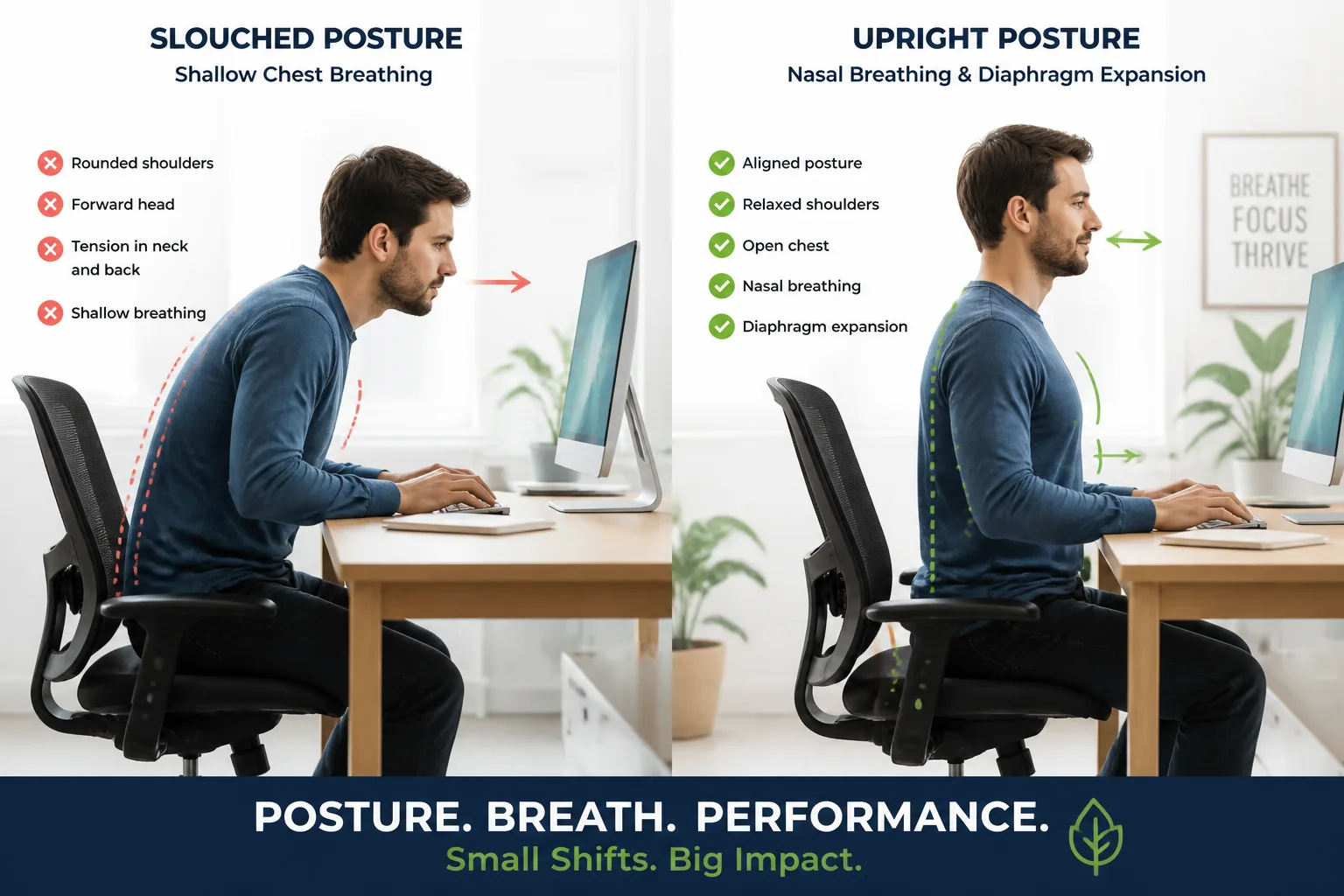
If you spend most of your day sitting, your breathing and your posture are probably influencing each other more than you realize. A forward head, rounded shoulders, and a collapsed chest do not just look slouched. They can change how your rib cage moves, how well your diaphragm works, and how much tension you carry in your neck, shoulders, and back. At the same time, shallow breathing and constant chest breathing can reinforce that same posture pattern, making it harder to feel relaxed, upright, and energized.
The good news is that this loop can also work in your favor. Small changes in breathing mechanics, paired with simple posture and mobility habits, can help restore rib cage movement, improve core support, and reduce the sense of strain that builds up during desk work. This article breaks down the science in practical terms and shows how to use breathing as part of a real-world ergonomic reset.
Why Your Breath and Posture Are More Connected Than You Think
Breathing is not just an automatic function happening in the background. It is a movement pattern driven by the diaphragm, rib cage, abdominal wall, neck muscles, and spinal position. When your head drifts forward and your upper back rounds, the whole system has to adapt. Your chest often becomes more compressed, the lower ribs lose some of their ability to expand, and the neck muscles begin to assist breathing more than they should.
This matters because posture is not only about standing tall. It is about giving the lungs, diaphragm, and trunk muscles enough room to work efficiently. If you feel stiff, tired, or tight at your desk, breathing mechanics may be part of the reason your body feels “stuck” even before you notice pain.
The Posture-Breathing Feedback Loop: What the Science Shows
Research increasingly shows a two-way relationship between posture and breathing. People with forward head posture often have lower forced vital capacity and lower forced expiratory volume in one second than people with neutral head posture, which suggests reduced respiratory function. In other words, the way your head and upper spine are positioned can measurably affect how well you move air in and out of the lungs. Source: PMC https://pmc.ncbi.nlm.nih.gov/articles/PMC4755989/
Other studies have found that in chronic neck pain with forward head posture, forward head translation correlates negatively with maximal expiratory pressure, while cervical alignment also relates to multiple lung function measures. That pattern suggests that postural strain is not just a comfort issue, but part of a larger breathing and muscle-performance problem. Source: PubMed https://pubmed.ncbi.nlm.nih.gov/32760893/
The reverse is also important. In healthy adults, adopting a forward head posture was shown to expand the upper thorax while reducing lower thorax mobility during deep breathing, along with drops in inspiratory and expiratory reserve volumes. That means poor posture can directly restrict the parts of the rib cage that should be moving most during relaxed, efficient breathing. Source: PMC https://pmc.ncbi.nlm.nih.gov/articles/PMC6348172/
So the loop goes both ways: posture changes breathing, and breathing habits can reinforce posture. That is why lasting relief usually requires addressing both at the same time.
How Desk Posture Disrupts Diaphragm Function and Rib Cage Movement
Desk posture tends to encourage a flexed trunk, a forward head, and a rib cage that stays in a slightly collapsed position for long periods. This can limit diaphragm excursion, especially if the lower ribs are compressed and the abdomen is braced all day. The body then compensates by using more upper chest movement, more accessory neck muscles, and often more mouth breathing.
When that happens repeatedly, the diaphragm does less of the work it is designed to do, while the neck and upper shoulders become overworked. The result is often a feeling of shallow breathing, upper body tightness, and low-grade fatigue that worsens across the day.
This is especially relevant if you spend hours typing, looking down at a laptop, or joining back-to-back meetings without movement breaks. A static seated posture can quietly train the body into a less efficient breathing pattern, even if you are otherwise healthy.
Signs You’re Stuck in Shallow Chest or Mouth Breathing
Many people do not realize they are mouth breathing or chest breathing most of the day because it feels normal. Common signs include elevated shoulders while breathing, frequent sighing, a tight jaw, dry mouth, feeling unable to take a satisfying deep breath, and a tendency to breathe high into the chest instead of letting the lower ribs expand.
You may also notice that your breathing gets noisier, faster, or more effortful during concentration, stress, or while sitting still. Some people feel as if they have to “force” a deep breath, but true efficient breathing should feel smooth and unstrained. If you constantly feel the need to inhale deeply, it can be a sign that your resting breathing pattern is too shallow or too rapid.
Shallow breathing can also show up as tension headaches, upper back stiffness, rib tightness, or a sense of being wired but tired. These are not always breathing problems alone, but breathing is often part of the picture.
How Better Breathing Can Reduce Neck, Shoulder, and Back Tension
When breathing becomes more efficient, the neck and shoulders do not need to assist as much. That can reduce unnecessary muscle guarding through the upper trapezius, scalenes, and chest muscles. A calmer respiratory pattern can also help decrease the stress response that often drives tension in the first place.
Evidence supports the value of breathing-focused rehab when it is combined with posture work. A systematic review and meta-analysis found that rehabilitation programs including diaphragmatic breathing, respiratory muscle training, or feedback breathing produced a moderate improvement in craniovertebral angle in people with forward head posture and chronic neck pain, though the evidence for pain and disability improvements was limited and rated very low certainty. Source: PMC https://pmc.ncbi.nlm.nih.gov/articles/PMC12467365/
That means breathing alone is not a magic fix, but it can be a meaningful piece of a broader recovery strategy. It is often most effective when combined with mobility, strengthening, and ergonomic changes.
Diaphragmatic Breathing Basics for Sedentary Bodies
Diaphragmatic breathing, sometimes called belly breathing, is really about 360-degree expansion through the lower ribs and abdomen, not about pushing the stomach out forcefully. For people who sit a lot, this pattern can be a useful way to restore rib mobility and reduce unnecessary effort in the neck and upper chest.
To practice it, sit or lie down comfortably and place one hand on your lower ribs or belly. Inhale slowly through the nose and let the lower ribs widen gently in all directions. Exhale without tension and feel the ribs soften back inward. The goal is not maximum depth, but ease, rhythm, and symmetry.
If your neck or shoulders tense up as you breathe, try shortening the inhale, relaxing the jaw, and focusing on the lower rib cage. For many desk workers, the first step is simply noticing where the breath is happening, then gradually shifting it lower and slower.
Using Longer Exhales to Improve Core Support and Calm Stress
Longer exhales are one of the simplest ways to encourage a steadier breathing rhythm and improve the sense of core support. A slower exhale helps the ribs come down, the abdomen engage gently, and the nervous system move away from a stressed state. This can be especially helpful if you tend to hold your breath while typing, thinking, or sitting in a tense meeting.
You do not need to force long pauses or extremely slow breathing. Even a modest change, such as making the exhale slightly longer than the inhale, can be enough to create a calmer pattern. For example, you might inhale for four counts and exhale for six.
A trial that added active core stabilization to postural correction and diaphragmatic breathing found greater improvements in craniovertebral angle and pulmonary function in adults with forward head posture and poor breathing patterns. Source: KCI https://www.kci.go.kr/kciportal/ci/sereArticleSearch/ciSereArtiView.kci?sereArticleSearchBean.artiId=ART003376397
This is a useful reminder that breathing and core support are linked. A controlled exhale can help the trunk stabilize without excessive bracing.
Buteyko-Style Nasal Breathing and Gentle Breath Holds: What to Know
Buteyko-inspired breathing focuses on nasal breathing, reduced overbreathing, and gentle breath awareness. The basic idea is to breathe quietly through the nose, keep the breath smooth, and avoid the habit of taking repeated oversized breaths that can leave you feeling light, tense, or overactivated.
Gentle breath holds are sometimes used in this style, but they should always remain mild and comfortable. The goal is not to push through discomfort or create air hunger. Instead, it is to notice your natural breathing rhythm, reduce unnecessary overbreathing, and let the body settle into a calmer baseline.
For some people, nasal breathing can also encourage better jaw posture, less mouth dryness, and a more stable breathing rhythm during low-intensity work. If you have nasal congestion, significant anxiety, or a medical breathing condition, it is better to start gently and consult a professional when needed.
Micro-Movements That Pair with Breath to Restore Alignment
Breathing drills work even better when paired with small movements. Gentle neck lengthening, shoulder rolls, spinal extension, and rib cage expansion can help the body feel the difference between a collapsed pattern and a more open one. These should feel easy, not corrective in a painful or aggressive way.
A simple approach is to inhale while lengthening through the spine, then exhale while softening the shoulders downward. You can also pair the exhale with a light abdominal engagement and the inhale with a sense of widening through the side ribs.
These micro-movements help teach the nervous system that upright posture does not have to feel rigid. The most effective posture is often the one that is dynamic, not the one held in one perfect position for hours.
Thoracic Mobility, Rib Expansion, and Core Activation Drills
The thoracic spine needs to extend and rotate well for breathing to feel open. If your upper back is stiff, your ribs may not expand well, and your diaphragm may lose some of its mechanical advantage. That is why thoracic mobility drills are so useful for people who sit a lot.
Try gentle chest-opening movements over a chair back, wall angels, or thoracic extensions with a foam roller if they feel comfortable. Combine each movement with slow nasal breathing and a long exhale. The breathing pattern helps the body learn the new position instead of locking into it.
An exercise program combining thoracic extension and scapular stabilization in elementary school teachers with forward head posture improved posture, breathing ability, neck pain, and cervical range of motion. Source: KCI https://www.kci.go.kr/kciportal/ci/sereArticleSearch/ciSereArtiView.kci?sereArticleSearchBean.artiId=ART002845517
That kind of result makes sense clinically. The ribs, thoracic spine, scapulae, and breathing muscles work as one unit, so improving one area often helps the others.
Ergonomic Fixes That Make Healthy Breathing Easier at Your Desk
Good ergonomics can make healthy breathing far easier. If your monitor is too low, your head will drift forward. If your chair collapses your pelvis, your trunk may round. If your keyboard setup forces you to reach, your shoulders may stay lifted and tense. All of these positions interfere with breathing mechanics.
A better setup usually means the screen is high enough that your gaze is more level, your feet are supported, your hips are stable, and your elbows rest comfortably by your sides. The goal is not a rigid posture, but one that reduces the constant work your body has to do just to stay upright.
If you want an easy way to support the breathing side of ergonomics, pairing desk breaks with guided breathing can help you remember to reset before tension builds. One simple option is Just Breathe: Relax Daily, which offers guided breathing patterns, smart reminders, and progress tracking to help make the habit stick: https://findthe.app/just-breathe-ujhm1e
Breath Cues for Typing, Meetings, Walking, and Screen Breaks
The best breathing habits are the ones you can use in real life. While typing, try noticing whether you are holding your breath during concentration. During meetings, soften the shoulders and let the exhale lengthen slightly before you speak. While walking, allow the rhythm of the steps to create a natural, easy breath pattern.
Screen breaks are a great time for a quick reset. Stand up, roll the shoulders, take a few nasal breaths, and let the exhale be a little longer than the inhale. This does not need to take more than 30 to 60 seconds, but repeated often, it can interrupt the build-up of tension.
A good cue is to connect breathing to transitions, not just to formal exercise. Start of a call, end of an email, standing up for water, and opening a new document are all opportunities to check posture and breathing at the same time.
Creating Daily Reminders So Good Breathing Becomes Automatic
Habits become automatic when they are tied to context. If you only practice breathing exercises once a day, you may feel better for a moment but still drift back into old patterns. Instead, use reminders that fit naturally into the workday.
You can set a timer, use app-based reminders, or attach a breathing reset to recurring events. For example, every hour, take three slow nasal breaths before returning to work. The point is consistency, not intensity.
Over time, your body begins to associate certain cues, like sitting down at your desk or opening your laptop, with a more relaxed breathing pattern. That is how breathing practice becomes less of a task and more of a default state.
When Pain, Misalignment, or Shortness of Breath Needs Professional Help
Breathing and posture work can be very helpful, but they are not a replacement for medical care when symptoms are significant. If you have ongoing shortness of breath, chest pain, dizziness, numbness, severe neck pain, or symptoms that worsen with activity, you should speak with a medical professional promptly.
If your posture-related pain is persistent, a physical therapist or posture specialist can assess whether there are mobility limits, strength deficits, breathing dysfunction, or other factors contributing to the problem. A combined approach can matter. In one study of people with chronic neck pain, cervical spine and diaphragm manual therapy plus breathing re-education produced greater improvements in cervical range of motion and posture than manual therapy alone or conventional physiotherapy, with gains maintained at three-month follow-up. Source: PMC https://pmc.ncbi.nlm.nih.gov/articles/PMC12295102/
That does not mean everyone needs hands-on treatment. It does mean that if self-care is not enough, getting individualized help is a smart next step.
A Simple Daily Breath-and-Posture Reset Routine
Here is a practical routine you can use each day, especially if you sit for long periods. Start with 1 minute of tall sitting or standing. Gently lengthen the spine, soften the shoulders, and bring the chin slightly back without forcing it. Then take 5 slow nasal breaths, making the exhale slightly longer than the inhale.
Next, add 30 seconds of thoracic movement. You can reach the arms forward and then open the chest, or gently extend over the back of a chair. Keep breathing smoothly throughout. After that, do 3 to 5 more breaths with a soft abdominal wall and relaxed jaw.
If you want a final reset, stand up and walk for a minute while keeping the breath quiet and easy. That small sequence can help you leave the desk with less stiffness, better rib mobility, and a calmer nervous system.
Breathing and posture are not separate projects. They are two sides of the same movement system. When you improve one, the other usually improves as well, and that is one of the simplest ways to build more comfort, better focus, and more energy into a sedentary day.