Breathe Through the Change: How Breathwork Can Ease Menopause Symptoms Naturally
Menopause and perimenopause can feel unpredictable. One day you may be managing a hot flash, the next you are dealing with irritability, anxious thoughts, or a night of broken sleep. While every woman’s experience is different, one thing is common: the nervous system often feels like it is working overtime. That is where breathwork can be surprisingly useful. It is simple, free, portable, and gentle enough to fit into daily life. More importantly, it can help you shift from stress mode into a calmer state, which may make symptoms feel more manageable.
This is not about forcing yourself to breathe perfectly or talking yourself out of symptoms. It is about giving your body a practical signal to slow down. Techniques like diaphragmatic breathing, equal inhale-exhale patterns, longer exhales, and cooling breaths can support relaxation, improve regulation, and offer a steady tool you can return to during the hormone changes of midlife.
Why Breathwork Matters During Perimenopause and Menopause
Perimenopause and menopause often bring a cluster of symptoms that seem to feed into each other. Hot flashes can disrupt sleep. Poor sleep can make mood swings worse. Stress can increase the intensity of symptoms. When the body is running on tension, even small discomforts can feel bigger. Breathwork matters because it works with the body’s regulation systems, not against them.
The good news is that vasomotor symptoms are very common, and you are not imagining how disruptive they can be. Research has shown that 75% to 85% of women report hot flashes and night sweats during menopause, and around 50% may still experience symptoms four years after their final menstrual period. That makes low-risk support tools especially valuable, particularly when you want something that can be used quickly in real life and not just in a clinical setting.
Breathwork fits that need well. It does not require equipment, special clothing, or a long time commitment. You can use it before bed, in the middle of the day, or the moment you feel heat or anxiety building. And because breathwork can be repeated often, it becomes a way to practice calming your nervous system before symptoms become overwhelming.
The Science: How Breathing Affects Hot Flashes, Stress, and Sleep
Breathing is one of the few body functions that is both automatic and consciously adjustable. That matters because it gives you access to the autonomic nervous system, the part of the body that regulates stress responses, heart rate, and recovery. Slow, controlled breathing can stimulate the parasympathetic nervous system, which helps shift the body out of fight-or-flight mode and into rest-and-digest mode. The VA notes that diaphragmatic breathing can reduce anxiety, lower blood pressure, improve heart rate variability, and support parasympathetic activation (https://www.va.gov/WHOLEHEALTHLIBRARY/tools/diaphragmatic-breathing.asp).
For menopause, that matters in several ways. Stress and anxiety can intensify the sense of heat during a hot flash. A calmer nervous system may help you respond differently to that surge. In addition, sleep is often disrupted during the menopausal transition, and slower breathing before bed has been linked with better self-reported sleep duration and quality in many studies when practiced regularly for 28 to 30 days. The evidence on objective sleep measures is mixed, but the direction is promising for women who want a simple bedtime ritual that supports relaxation.
There is also useful research specifically around paced respiration for hot flashes. In one study, women practicing paced respiration at 6 to 8 breaths per minute with deep abdominal breathing, twice daily for 15 minutes and at the onset of hot flashes, had about 38% achieving at least a 50% reduction in hot flash frequency by 8 weeks, compared with 29% in breathing control and 22% in usual care. Another 9-week trial found hot flash reductions of 52% with twice-daily paced breathing, 42% with once-daily practice, and 46% in a usual-breathing control group. These findings suggest that structured, consistent practice may matter, even when the exact mechanism is still being studied.
Researchers also continue to explore why longer exhales can be calming. In a randomized trial of people with chronic pain, breathing patterns with longer exhalations relative to inhalations improved vagally mediated heart rate variability, increased positive mood, and reduced arousal. That is useful for menopause because irritability, anxiety, and bedtime restlessness often reflect a body that is simply too activated.
Diaphragmatic Breathing for Calm and Nervous System Support
Diaphragmatic breathing, sometimes called belly breathing or deep abdominal breathing, is one of the best starting points. It encourages the diaphragm to do more of the work, which can help make breathing slower, fuller, and more efficient. This style of breathing is often associated with reduced stress and a greater sense of groundedness.
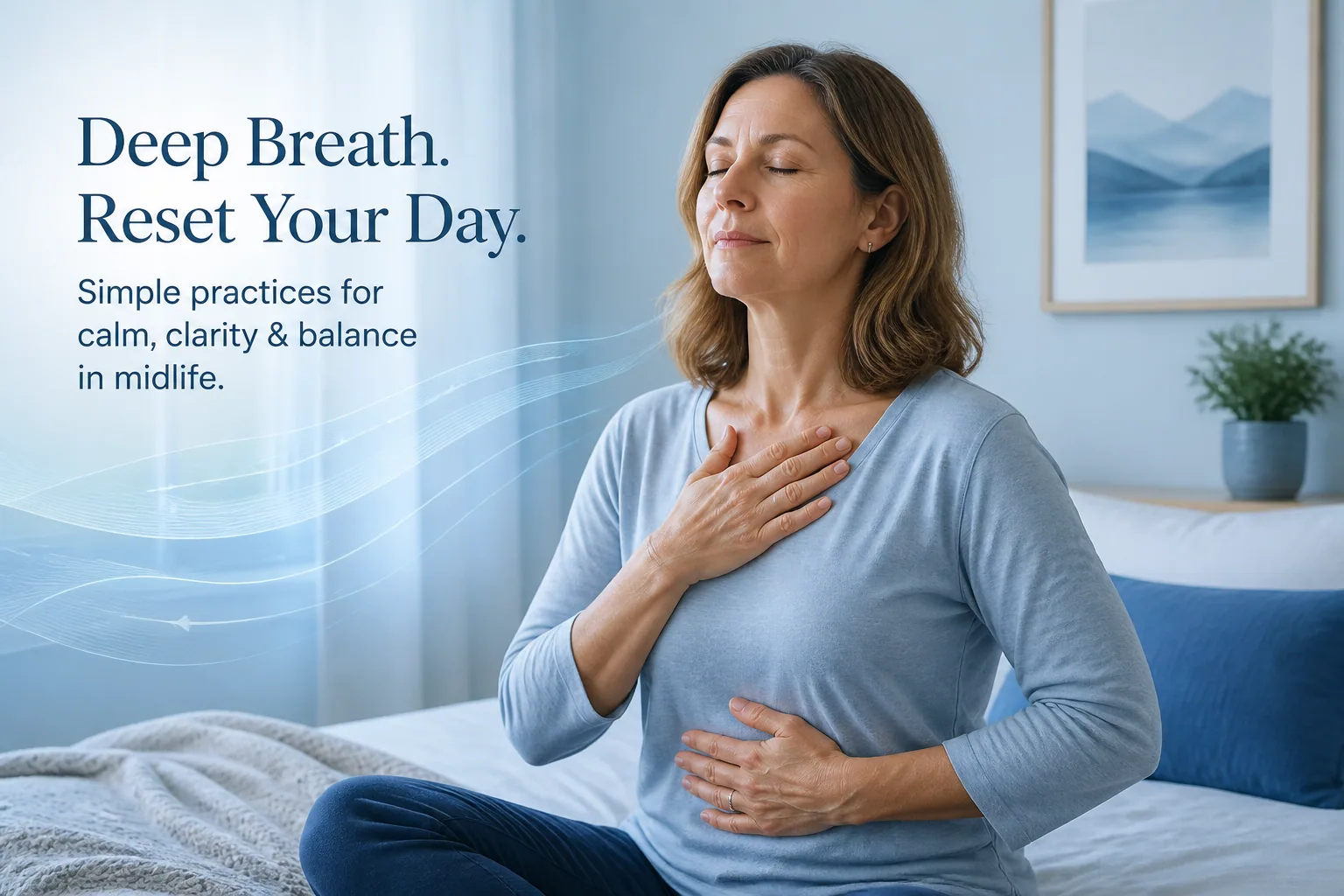
To try it, sit or lie down comfortably. Place one hand on your chest and the other on your belly. Inhale slowly through your nose and let the belly rise gently under your hand. Try to keep the chest relatively quiet. Then exhale slowly through the nose or mouth and let the belly fall. Continue for several rounds, noticing whether your shoulders soften and your jaw relaxes.
You do not need to breathe deeply to the point of discomfort. In fact, forcing extra-large breaths can make you feel lightheaded. The goal is smooth, steady breathing that feels easy enough to repeat. This technique can be especially helpful when you first notice tension, before a stressful meeting, or any time you feel that internal buzzing that often comes with perimenopause.
A practical benefit of diaphragmatic breathing is that it can become a foundation for other methods. Once you are comfortable with belly breathing, it is easier to add a rhythm, extend the exhale, or pair the breathing with a visualization for additional calming effect.
Cooling Breath Techniques to Try During Hot Flashes
When a hot flash starts, many women want something immediate. That is where cooling breath techniques can be useful. Practices such as Sheetali and Sheetkari pranayama are often described as cooling breaths, and they are commonly mentioned as ways to direct attention away from the sensation of heat while creating a soothing rhythm. In addition, equal inhale-exhale patterns like box breathing can offer a stable structure when you feel suddenly overwhelmed.
If you want to try a cooling breath, choose a quiet moment first so you can learn the pattern before you need it. With Sheetali, the tongue is rolled into a tube if you can do that comfortably, and you inhale through the mouth in a cool, sipping way before exhaling through the nose. With Sheetkari, the teeth are lightly parted and the breath comes in with a soft hissing sound. If either technique feels awkward, simply return to slow nasal breathing with a longer exhale. The purpose is to create a cooling, calming experience, not to make the breath complicated.
Some people also find box breathing helpful during a hot flash. Inhale for a count, hold gently, exhale for the same count, and hold again before repeating. The balanced rhythm can give your mind something simple to track while the wave of heat passes. For many women, the combination of focus and steadiness is almost as helpful as the breathing itself.
If you prefer a more visual practice, guided animations or ambient cues can help you stay with the rhythm. That is one reason tools like Just Breathe: Relax Daily can be helpful for some people, especially when you want a clear pattern to follow during symptoms or before sleep. You can explore it here: https://findthe.app/just-breathe-ujhm1e
Equal Breathing for Emotional Balance and Mental Clarity
Equal breathing, sometimes called sama vritti or a box-style rhythm, means inhaling and exhaling for the same amount of time. It is one of the most approachable breathwork styles because it feels structured without being intense. For menopause, that balance can be especially useful when emotions feel uneven or your mind is scattered.
To practice, inhale through the nose for a count of four, then exhale for a count of four. If that feels comfortable, you can gradually move to five or six counts as long as the breath remains smooth. The aim is not to maximize the count but to create steadiness. Equal breathing is often helpful during the workday, after an argument, or any time you want to regain a sense of control without needing to step away for long.
This style is also a good choice if you are new to breathwork. It is easy to remember, easy to measure, and easy to repeat. That simplicity matters because consistency is often what makes breathwork useful over time. A short practice done regularly is usually better than an elaborate session you only do once in a while.
Longer-Exhale Patterns for Anxiety, Irritability, and Bedtime Relaxation
If your symptoms tend to show up as anxiety, irritability, or a mind that will not switch off at night, longer-exhale breathing may be especially helpful. The basic idea is simple: let the exhale last a little longer than the inhale. This can encourage a calmer physiology and a more relaxed mental state.
One easy pattern is to inhale for four counts and exhale for six. Another option is to inhale for five and exhale for seven. The exact numbers matter less than the ratio. Research on longer exhalations has shown benefits for vagal activity, mood, and reduced arousal, which is a nice fit for those evenings when your body feels keyed up even though you are tired.
Before bed, this can become part of a wind-down routine. Lie down, dim the lights, and breathe slowly through the nose. Let the exhale feel soft and unforced, as if you are gently releasing the day. If your thoughts are busy, count the breaths or repeat a simple phrase like rest or soften on the exhale. This can help anchor attention without creating pressure to fall asleep immediately.
The value of this technique is that it does not just distract you. It changes the pace of the body itself. For women dealing with nighttime waking, temperature shifts, or a racing mind, that kind of gentle downshifting can make bedtime feel more manageable.
How Visualization Can Make Breathwork More Effective
Visualization can make breathing exercises feel more vivid and easier to sustain. Instead of counting mechanically, you can imagine the breath as cool air entering the body or tension draining away with each exhale. This can be especially helpful during a hot flash, when the sensation of heat is so strong that it dominates attention.
For example, you might picture a cool wave moving in on the inhale and a warm wave leaving on the exhale. Or you might imagine each breath creating more space around the tension in your chest, neck, or face. The point is not to perform visualization perfectly. It is to give your mind a softer place to land while your breathing does its work.
Some women prefer visual breath pacing tools because they reduce effort and remove the need to count. A breathing app with a clear visual rhythm can make practice feel more natural, especially when your mind is already overloaded. If that sounds useful, a guided tool such as Just Breathe: Relax Daily can support consistency with animations, ambient sounds, and reminders that make the practice easier to keep up with.
When to Practice: During Symptoms, Before Bed, and in Your Daily Routine
The best time to practice breathwork is the time you will actually use it. That might be during a hot flash, before bed, after waking in the night, or as a scheduled part of your day. Breathwork is flexible enough to fit all of these moments.
During a hot flash, keep the practice short and simple. Aim for slower breathing, a longer exhale, or a cooling pattern you already know. When symptoms are intense, you do not want to have to think too much. Familiarity is helpful here. The more you practice when you are calm, the easier it will be to use the technique under stress.
Before bed, choose the most relaxing style you have. Slow diaphragmatic breathing, longer-exhale breathing, or a guided relaxation pattern can help prepare the body for sleep. In the daytime, equal breathing or paced respiration can be useful as a reset between tasks, after caffeine, or before stressful interactions.
A daily routine is often the missing piece. Research suggests that twice-daily paced breathing may produce stronger results than once-daily practice in some cases. Even if you only have five minutes, doing it consistently may help train your nervous system toward a calmer baseline.
Safety Tips, Modifications, and When to Talk to a Healthcare Provider
Breathwork is generally gentle, but it should still feel safe. If you are new to it, start slowly and keep the breaths natural. Avoid large, forceful inhalations, breath holds that make you uncomfortable, or any pattern that leaves you dizzy or strained. Breathwork should create ease, not effort.
If you have asthma, COPD, panic disorder, high blood pressure, pregnancy-related concerns, or another respiratory or medical condition, it is wise to check with a healthcare provider before starting a new breathing practice, especially one involving longer holds or more advanced techniques. Modifications are often easy. You can shorten the counts, avoid holds, breathe through the nose only if mouth breathing feels irritating, or simply practice diaphragmatic breathing without a fixed rhythm.
If breathwork ever triggers lightheadedness, tingling, chest discomfort, or increased anxiety, stop and return to normal breathing. Sit down, notice your environment, and let your breath settle. It can also help to practice with support first, such as a guided audio or a simple timer, so you are not trying to remember instructions while already stressed.
Also remember that breathwork is a support tool, not a replacement for medical care. If hot flashes are severe, if sleep disruption is intense, or if mood symptoms feel unmanageable, talk to a clinician. Breathwork can fit into a larger plan, but it does not need to carry the whole burden alone.
Pairing Breathwork With Sleep, Nutrition, and Stress-Lowering Habits
Breathwork tends to work best as part of a broader routine. Sleep habits, nutrition, movement, and stress management all influence how menopause feels day to day. Think of breathing exercises as one lever you can pull, not the only lever available.
For sleep, keep your bedroom cool, reduce late-night screen exposure, and create a consistent wind-down ritual. A few minutes of slow breathing before bed may be more effective when paired with a predictable routine that tells your body it is time to rest. For nutrition, stay mindful of triggers that worsen hot flashes for you personally, such as alcohol, spicy foods, or too much caffeine. Hydration and balanced meals may also support steadier energy and mood.
Movement matters too. Gentle exercise, walking, yoga, or strength training can help regulate stress and support better sleep. If you are active during the day, breathwork can become the quiet complement that helps you transition from doing mode into resting mode. And for ongoing stress, it may help to set reminders for short breathing breaks so you are not waiting until you are overwhelmed to begin.
That is another place where a structured tool can help. An app like Just Breathe: Relax Daily can make it easier to build consistency with guided patterns, calming sounds, and smart reminders. For many people, the biggest challenge is not learning the breathing method, but remembering to use it enough to feel the benefit.
A Simple 5-Minute Daily Breathwork Routine for Menopause Support
If you want a routine that is easy to repeat, try this five-minute sequence. It is simple enough for beginners and flexible enough to use in the morning, midafternoon, or before bed.
Minute 1: Sit comfortably and place one hand on your belly. Take slow diaphragmatic breaths, letting the belly rise on the inhale and soften on the exhale. Do not force depth. Just settle in and notice your body.
Minute 2: Move into equal breathing. Inhale for four counts and exhale for four counts. Keep the breath smooth and quiet. If four counts feels too long or too short, adjust slightly until it feels natural.
Minute 3: Shift to longer exhales. Inhale for four counts and exhale for six. Let the exhale be soft and complete, as if you are gently releasing tension from the shoulders, jaw, and belly.
Minute 4: Add a visualization. Imagine the inhale bringing in cool, calming air and the exhale carrying heat or irritation away from the body. If you prefer, use a visual guide or ambient sound to stay focused.
Minute 5: End with two or three rounds of calm, natural breathing. Notice whether your pace has slowed, your shoulders have dropped, or your mind feels a little clearer. That small shift is enough. Over time, these short sessions can become a dependable way to support your nervous system through perimenopause and menopause.
The goal is not to eliminate every symptom. The goal is to feel more equipped when symptoms arise. Breathwork gives you a practical way to respond with steadiness, and that alone can make this stage of life feel a little more navigable.