Breathing Through Long COVID: How Resonant and Diaphragmatic Breathing Can Restore Autonomic Balance
Long COVID can feel confusing because the symptoms are not only about lungs or endurance. For many people, the real issue seems to be a nervous system that has lost its usual rhythm. Breathlessness, racing heart, lightheadedness, poor sleep, anxiety, weakness, and brain fog can all show up together, and they often point to autonomic dysregulation. In other words, the body can get stuck in a state where the sympathetic system is too active, while the parasympathetic system is not doing enough to restore calm and recovery.
That is one reason breathwork is getting so much attention. It is low exertion, easy to adapt, and can be done in very small doses. For people who feel wiped out by conventional exercise-based recovery, breathing practice may offer a more gentle starting point. It will not replace medical care, but it may support regulation, reduce symptom intensity, and create a better baseline for healing.
What Long COVID Looks Like When the Autonomic Nervous System Is Involved
When Long COVID involves the autonomic nervous system, symptoms can feel random even though they are often connected. A person may notice orthostatic intolerance, tachycardia, labile blood pressure, breathlessness, weakness, or a sense that the body is constantly overreacting. The research suggests that these symptoms may stem from immune-mediated disruption of autonomic nerves, brainstem signaling issues, and even small fiber neuropathy, which helps explain why recovery can feel so inconsistent https://pmc.ncbi.nlm.nih.gov/articles/PMC11272651/
This matters because the usual advice to simply move more can backfire if the nervous system is already overloaded. If standing, walking, or structured workouts trigger more fatigue or flares, the problem is not a lack of willpower. It may be that the body is asking for regulation before conditioning.
Why Traditional Rehab Can Feel Too Demanding for Post-Viral Recovery
In many recovery plans, exercise is treated as the main path back to health. But for people with post-viral symptoms, especially those who experience post-exertional symptom exacerbation, this approach can be too intense too soon. Even a light session may lead to delayed crashes, increased breathlessness, sleep disruption, or a spike in fatigue the next day.
That is why self-management strategies are often emphasized in clinical guidance. The WHO post-COVID condition living guideline and the Stanford Long COVID Clinical Toolkit both include breathing training, such as nasal breathing and paced breathing, as part of symptom management for breathing impairment, fatigue, sleep, anxiety, and PESE https://www.who.int/teams/health-care-readiness/post-covid-19-condition and https://med.stanford.edu/content/dam/sm/long-covid-care-reach/Stanford_Long_COVID_Clinical_Toolkit.pdf
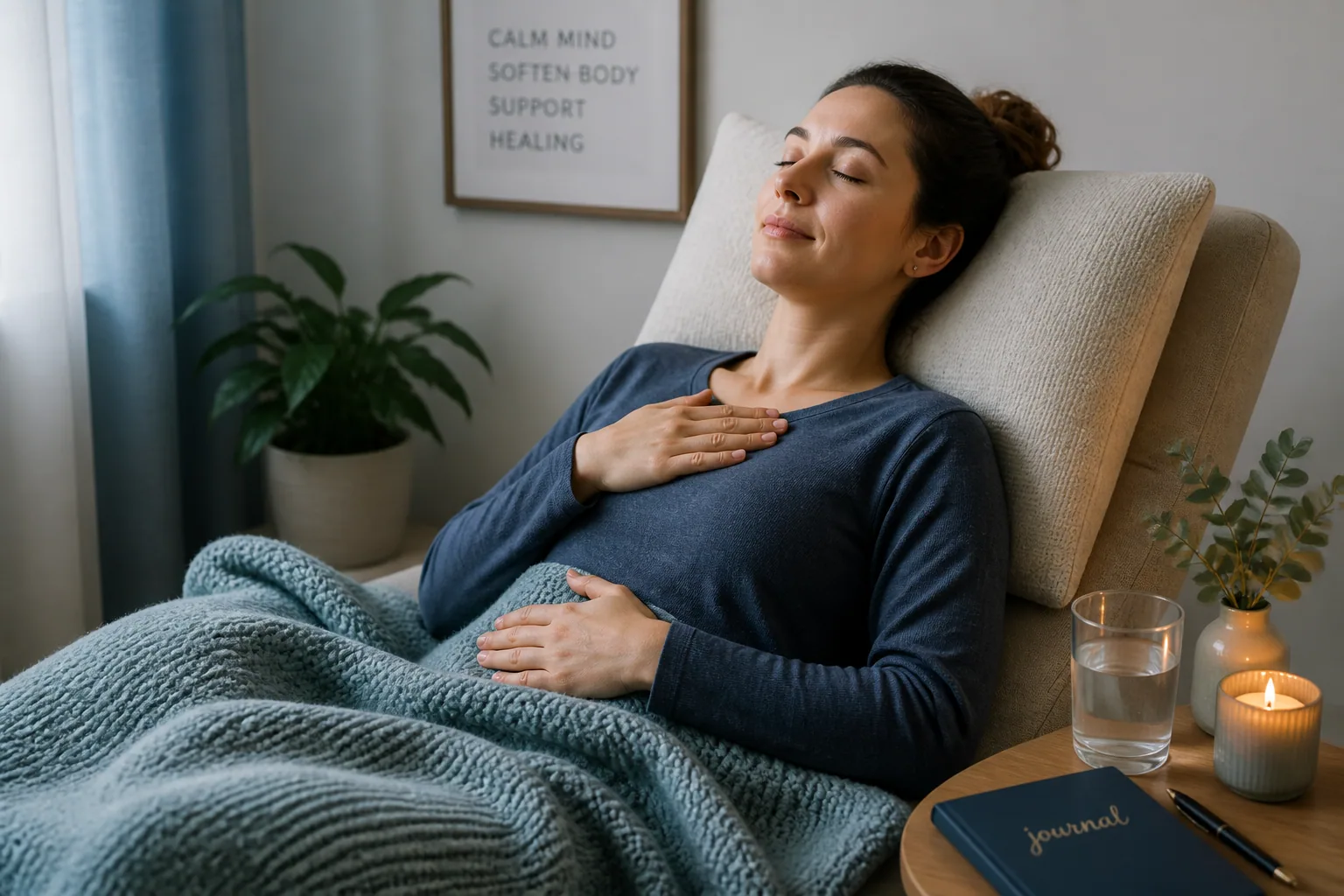
Breathwork is appealing because it can be done lying down, seated, or even for just one minute at a time. It gives people a way to participate in recovery without demanding a strong cardiovascular push.
What Is Resonant Breathing and Why Is It Getting Attention?
Resonant breathing is a form of slow, steady breathing that typically uses a rate near five to six breaths per minute. The goal is not to force the breath, but to find a rhythm where inhale and exhale create a smooth pattern that supports autonomic balance. Some people call this coherent breathing or paced breathing, but the basic idea is the same: slow the breath enough to influence physiology without straining.
It is getting attention because it appears to affect the body in measurable ways. Slow breathing has been shown to reliably increase heart rate variability, a marker often associated with greater parasympathetic activity, both during practice and after repeated sessions. A systematic review and meta-analysis found these HRV effects across voluntary slow breathing studies https://www.sciencedirect.com/science/article/pii/S0149763422002007
In Long COVID specifically, resonant breathing is not just theoretical. In one study of 99 people with Long COVID who practiced resonant breathing about 7 sessions per week for 8 to 13 minutes at a time over at least 4 weeks, participants reported meaningful improvements from baseline in focus, stress control, breathing ability, wellness, and sleep quality https://pmc.ncbi.nlm.nih.gov/articles/PMC11272651/
How Diaphragmatic Breathing Supports Breath Control, Calm, and Energy
Diaphragmatic breathing is often described as belly breathing, but it is really about using the diaphragm efficiently so the breath becomes more relaxed and less shallow. Instead of lifting the shoulders and chest with each inhale, the abdomen and lower ribs move more freely. This can reduce unnecessary tension and make breathing feel more economical.
There is also a nervous system effect. A narrative review on diaphragmatic breathing found that it can enhance baroreflex sensitivity, increase heart rate variability, and influence blood pressure oscillations through slow breathing and diaphragm excursion https://pmc.ncbi.nlm.nih.gov/articles/PMC7602530/ In practice, that means it may help the body shift away from a stress response and toward a more regulated state.
A particularly interesting finding is that adding a brief rest after exhalation may make the practice even more effective. In one University of Kentucky study, a 4-2-4 inhale-exhale-rest timing increased high-frequency HRV and lowered heart rate more than a pattern without the rest period, such as 5-5 breathing https://pmc.ncbi.nlm.nih.gov/articles/PMC5319881/ For some people with Long COVID, that tiny pause can feel more grounding than a continuous cycle.
What Current Research Suggests About Breathwork for Long COVID Recovery
The emerging research is encouraging, especially because it matches what many patients report subjectively. Slow-paced breathing has been shown in a recent case-control study of health care workers with Long COVID to improve cardiovascular autonomic function, as measured by HRV, compared with controls https://www.sciencedirect.com/science/article/pii/S0002934324003395
There is also broader evidence that deep breathing at around 6 breaths per minute can shift autonomic markers in a helpful direction. In an Indian randomized trial, one month of deep breathing in healthy subjects reduced spontaneous respiratory rate, increased HF power, and lowered mean arterial pressure https://pubmed.ncbi.nlm.nih.gov/23029969/
Even in older adults, structured and natural forms of deep breathing have been associated with increases in parasympathetic HRV indices such as SDNN and RMSSD without harmful blood pressure side effects https://pubmed.ncbi.nlm.nih.gov/39617275/ That does not prove it will work the same way for every Long COVID patient, but it does support the idea that breathing-based autonomic modulation can be safe when approached gently.
How Slow Breathing May Affect HRV, Vagal Tone, Sleep, and Brain Fog
Heart rate variability is one of the most common ways researchers look at autonomic balance. Higher HRV is often linked with stronger parasympathetic activity, especially vagal tone, while low HRV can reflect stress, inflammation, poor recovery, or autonomic strain. Slow breathing tends to push the body toward a more parasympathetic pattern, which may help explain why many people feel calmer after a session.
This is important for Long COVID because sleep disruption and brain fog often travel together. If the nervous system cannot downshift properly at night, sleep quality may suffer, and poor sleep can worsen attention, mood, pain sensitivity, and fatigue the next day. In the Long COVID resonant breathing study, sleep quality improved by 34.9%, while ability to focus improved by 57.5% compared with baseline https://pmc.ncbi.nlm.nih.gov/articles/PMC11272651/
That does not mean breathing alone solves cognitive symptoms, but it may help create conditions where the brain can function with less noise. When the body is less reactive, the mind often has a little more space.
How to Start a Breathwork Practice When Energy Is Limited
If you are dealing with fatigue, start smaller than you think you need to. Breathwork should feel like support, not another task to power through. A good starting point may be 2 to 5 minutes once a day, either seated or lying down. If that feels easy after a few days, you can gradually extend the session or add a second short practice.
A simple resonant breathing pattern might be inhale for 5 seconds and exhale for 5 seconds. If that feels too long, try 4 seconds in and 4 seconds out. If you tolerate pauses well, you might experiment with a brief rest after exhalation. The best pace is the one that feels smooth, not forced.
Some people also like visual or audio guidance because it reduces the effort of counting. A tool like Just Breathe: Relax Daily can make it easier to stay consistent with gentle guided patterns, custom rhythms, and calming reminders https://findthe.app/just-breathe-ujhm1e.
Safe Pacing Tips to Avoid Overwhelm and Symptom Flare-Ups
With Long COVID, even calming practices can become too much if they are prolonged or done at the wrong time. The key is pacing. Stop before you feel overworked, not after. If you notice dizziness, chest discomfort, air hunger, headache, tingling, or an increase in fatigue after sessions, reduce the duration or slow the pace of change.
It can help to practice at the same time each day so the body learns the pattern gradually. Avoid breath holds if they make you lightheaded. Keep the breath soft. You do not need large inhales to get the benefits. In fact, overbreathing can worsen symptoms for some people by increasing discomfort or reducing CO2 tolerance.
A useful rule is to finish feeling like you could do a little more. That is often the sweet spot for nervous system retraining.
How to Pair Breathwork With Rest, Nutrition, and Physiotherapy
Breathwork works best when it fits into a broader recovery routine. Think of it as one tool in a larger system. Pairing it with rest helps reduce load. Pairing it with adequate hydration and regular meals can support blood pressure stability and energy availability. For people working with a physiotherapist, breathing practice may also complement gentle mobility work, posture support, and symptom-limited movement.
Some people like to practice before meals, after waking, or before sleep. Others find it useful after a short rest period in the afternoon. The right timing depends on your symptom pattern. If you tend to crash later in the day, a brief morning session may be best. If anxiety and sleep problems are bigger issues, a calmer evening practice may be more useful.
The point is not to force a perfect routine. It is to give the nervous system repeated, low-stress signals that it is safe to settle.
Signs Breathwork Is Helping and When to Adjust Your Approach
Early signs that breathwork may be helping can be subtle. You might notice that your heart rate settles faster after standing or stress, your breathing feels less effortful, or you fall asleep more easily. Some people also report better concentration, less internal tension, or a smaller emotional reaction to daily triggers.
Tracking can make these changes easier to see. You can jot down how long you practiced, what style you used, how you felt before and after, and whether symptoms changed later in the day or the next morning. Small improvements matter, especially in a condition where progress is often gradual.
If symptoms worsen, scale back. Shorten the session, remove pauses, breathe more naturally, or take a day off. Breathwork should ideally leave you steadier, not more depleted.
A Gentle Recovery Tool Worth Exploring
Long COVID recovery is rarely linear, and no single practice will be right for everyone. Still, resonant breathing and diaphragmatic breathing stand out because they are low-cost, accessible, and aligned with what many patients need most: less strain, more regulation, and a way to work with the body rather than against it.
The current evidence suggests that slow breathing can influence HRV, vagal tone, blood pressure, stress perception, sleep, and even focus. That makes it a promising option for people whose symptoms seem tied to autonomic imbalance. If you begin gently, pace carefully, and pay attention to your body’s feedback, breathwork may become a practical and reassuring part of your Long COVID recovery journey.