Breathing Through Panic: Science-Backed Breathwork Techniques for Acute Anxiety Relief
When panic starts rising, “just take a deep breath” can feel useless or even irritating. That is because panic is not a mindset problem first, it is a body state. Your breathing changes, your heart rate climbs, your chest may tighten, and the nervous system shifts into a threat response. In that moment, the goal is not to force calm. It is to give the body a signal that the alarm can come down.
That is where breathwork can help. Used well, it can interrupt the panic spiral by working with the autonomic nervous system instead of fighting it. In this guide, we will look at how panic alters breathing, how to spot the early signs of a rising attack, and which techniques are most useful in real time, including the physiological sigh, exhale-emphasized breathing, and 4-7-8 breathing.
Why “Just Take a Deep Breath” Often Doesn’t Help During Panic
The phrase sounds supportive, but during panic it often misses the point. A big, fast inhale can actually make things worse if you are already breathing too quickly or too shallowly. Panic frequently comes with over-breathing, which lowers carbon dioxide too much and can trigger dizziness, tingling, lightheadedness, and a stronger sense that something is wrong.
So the issue is not breathing itself, but the pattern. During panic, the body often needs slower breathing, a longer exhale, and less effort, not larger breaths. This is why many people feel more relief from a gentle reset breathing pattern than from trying to force “deep breaths.”
How Panic Changes Breathing in the Body
Acute anxiety changes breathing in a very physical way. The inhale often becomes more frequent and shallow, the exhale shortens, and breathing may shift into the upper chest. That can feed back into the nervous system and reinforce the sense of urgency. In other words, the body starts interpreting its own breathing as part of the threat.
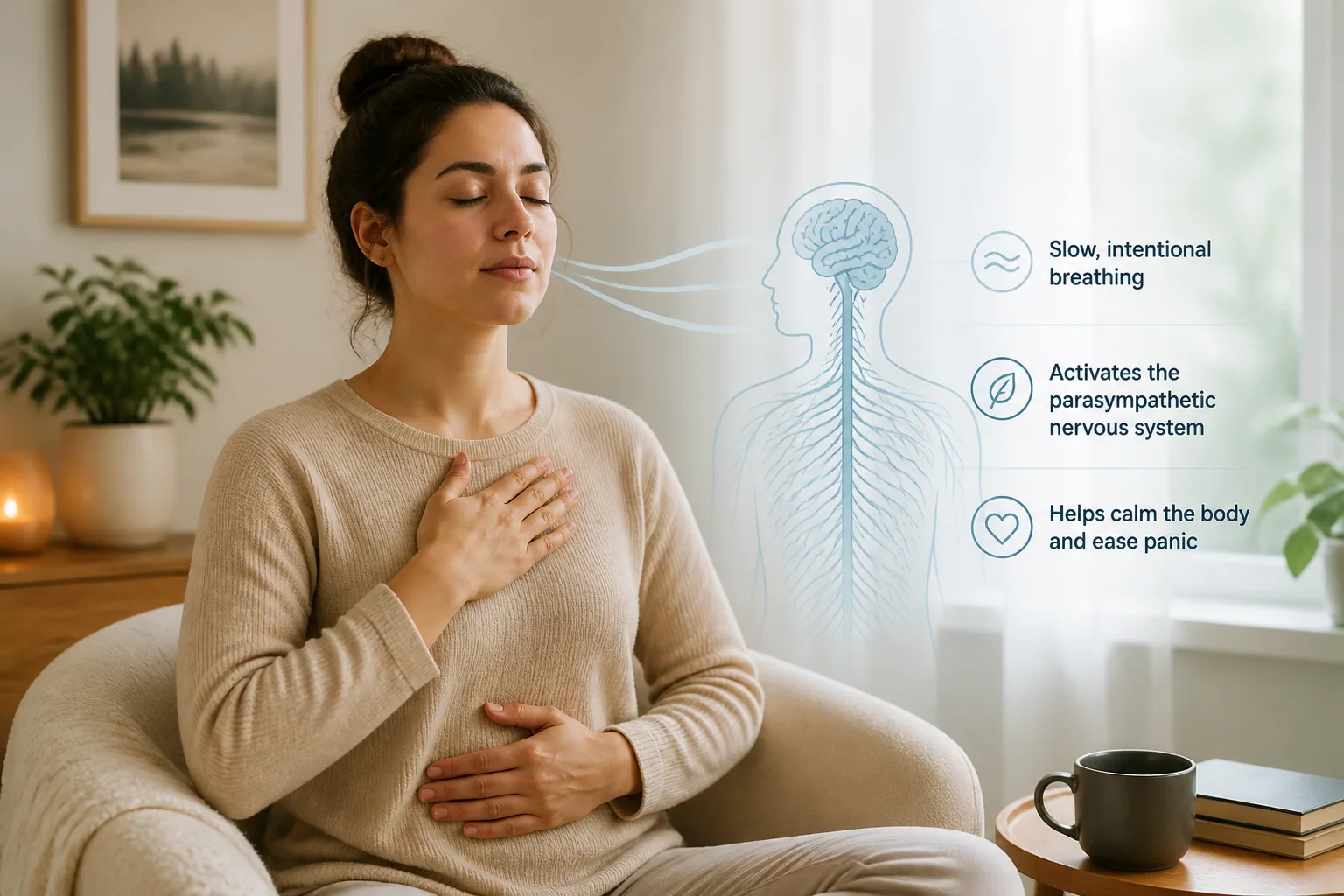
When this happens, the sympathetic nervous system, the branch associated with fight or flight, becomes more active. At the same time, parasympathetic calming signals are reduced. This is one reason breathwork can be so useful: it gives you a way to influence that balance directly through the rhythm and depth of breathing.
Early Signs of Acute Anxiety and a Rising Panic Attack
The earlier you catch the pattern, the easier it is to intervene. Signs often begin subtly: breathing gets faster, the chest feels tighter, thoughts start racing, and your attention narrows onto bodily sensations. You may notice a growing sense that something bad is about to happen, even if there is no obvious reason.
That early window matters. If you can notice the first increase in breathing rate or tension, you can use a simple technique before the cycle escalates. If symptoms continue or become severe, especially if there is chest pain, extreme shortness of breath, fainting, or the episode lasts a long time, it is important to seek professional or medical help. Kaiser Permanente notes that persistent or severe symptoms should not be ignored, and WebMD similarly advises getting help when a panic episode feels medically concerning: https://healthy.kaiserpermanente.org/health-wellness/health-encyclopedia/he.Panic-Attacks-Care-Instructions.uf8358 and https://www.webmd.com/anxiety-panic/hospital-for-panic-attack
The Science of Breathwork: CO₂, the Vagus Nerve, and the Autonomic Nervous System
Breathing is one of the few body functions that happens automatically but can also be consciously changed. That makes it unusually useful during panic. When you slow your breathing, extend your exhale, and reduce unnecessary effort, you help shift the body away from a high-alert state.
A few mechanisms are especially important. First, carbon dioxide balance matters. Over-breathing can lower CO₂ too much, which may cause the very symptoms people fear during panic. Second, the vagus nerve helps support parasympathetic activity, which is associated with settling the body. Third, the autonomic nervous system responds to breathing patterns, meaning the rhythm of your breath can influence heart rate, tension, and subjective stress.
This is not just theory. A 2023 meta-analysis of more than 30 randomized controlled trials found that breathwork techniques reduce anxiety and stress, improve mental health outcomes, and increase parasympathetic activity through heart rate variability, supporting their role in modulating the autonomic nervous system. Source: https://www.nature.com/articles/s41598-022-27247-y
Technique 1: The Physiological Sigh for Fast Nervous System Downshifting
The physiological sigh is one of the simplest and fastest techniques for acute stress. It uses a double inhale followed by a long, easy exhale. The purpose is not to take in as much air as possible. The purpose is to reset the breathing pattern and signal downregulation.
How to do it: inhale through the nose, then take a second short top-up inhale without fully emptying the lungs, then exhale slowly and fully through the mouth or nose. Repeat for a few cycles. Keep the effort light. The exhale should feel longer than the inhale, and the whole pattern should remain comfortable.
Why it works: spontaneous sighs appear to function as physiological resetters. Research has found that sighing increases during transitions to relief or after stress, especially in people with higher anxiety sensitivity, and is associated with reduced physiological tension and sympathetic arousal. Studies on the physiological sigh have also found that it can produce strong improvements in mood and respiratory rate during acute stress, sometimes outperforming box breathing and mindfulness meditation in short-term conditions. Sources: https://pubmed.ncbi.nlm.nih.gov/28315375/, https://www.sciencedirect.com/science/article/pii/S0031938416305121, https://deepbreathingexercises.com/physiological-sigh-panic-attack
When to use it: this is often the best first move when panic is rising quickly, especially if your breathing feels disorganized, your chest feels tight, or you need something simple that does not require counting for a long time.
Technique 2: Exhale-Emphasized Breathing to Reduce Arousal
If you need something steadier than a one-off reset, exhale-emphasized breathing is a strong option. The idea is simple: make the exhale longer than the inhale. This pattern reliably reduces sympathetic nervous system activity, enhances vagal tone, and supports subjective relaxation.
How to do it: inhale gently for a count of 3 or 4, then exhale for a count of 5, 6, or even slightly longer if it remains comfortable. The key is not to breathe more forcefully. It is to breathe more slowly and softly. You want the body to sense ease, not effort.
Research on prolonged expirational breathing supports this approach. Longer exhales relative to inhales are associated with lower sympathetic activation and more relaxation. That is why many calming techniques, from yoga-style breathing to paced breathing, make the exhale the longer phase. Source: https://pubmed.ncbi.nlm.nih.gov/30046408/
When to use it: this works well when you feel anxious but still have enough presence to follow a rhythm. It is especially helpful if you are beginning to feel agitated, fidgety, or mentally overstimulated, but are not yet fully flooded by panic.
Technique 3: 4-7-8 Breathing, When It Helps and When to Modify It
The 4-7-8 method is another exhale-heavy pattern, and for some people it is a very effective calming tool. The structure is straightforward: inhale for 4, hold for 7, exhale for 8. Because it includes a breath hold, though, it is not always the best choice in the middle of a panic spike.
How to do it: breathe in through the nose for 4 counts, hold gently for 7 counts, then exhale slowly for 8 counts. Keep the breath smooth and avoid straining. If the hold feels uncomfortable, shorten it or omit it entirely. The method should calm the body, not create a new stressor.
Evidence suggests the technique can be powerful when practiced comfortably. In healthy young adults, 4-7-8 breathing produced immediate reductions in heart rate and blood pressure and improved heart-rate variability, even under sleep deprivation. Participants’ respiratory rate dropped to around 3 breaths per minute during practice. Source: https://pmc.ncbi.nlm.nih.gov/articles/PMC9277512/
When to use it: it may be useful when you are anxious but stable enough to tolerate a hold. It is often better as a regulation practice than as the first choice during severe panic. If breath holds increase your discomfort, switch to a simpler exhale-focused pattern.
How to Choose the Right Breathing Technique in the Moment
A useful way to choose is to match the technique to the level of activation. If panic is surging fast, start with the physiological sigh. If you feel activated but still able to follow a rhythm, use exhale-emphasized breathing. If you are calm enough to tolerate a structured pattern and you already know it well, 4-7-8 may be appropriate.
As a rule of thumb, the more distressed you feel, the simpler the technique should be. The goal is not to perform breathing perfectly. It is to interrupt escalation. That is why the best technique is often the one you can remember and do gently under pressure.
Safety Tips: Avoiding Hyperventilation, Dizziness, and Breathwork Pitfalls
One of the biggest mistakes during panic is breathing too much. Rapid, shallow inhalations can reduce CO₂ too quickly and worsen symptoms like dizziness, tingling, and chest tightness. If this happens, the solution is usually to slow down and reduce the size of the breath, not to take even bigger breaths.
Another common pitfall is using long breath holds when you are already anxious. Breath retention can feel controlling when you are calm, but when panic is active it may increase discomfort or create a sense of air hunger. If a hold makes you more tense, stop and return to a simple slow exhale pattern or a physiological sigh.
If you become lightheaded, pause the exercise and breathe normally. Breathwork should feel tolerable and grounded. It should not leave you feeling more disconnected from your body. When in doubt, soften the effort, shorten the count, and keep the breath light.
Reactive vs. Proactive Practice: When to Use Breathwork
Breathwork can be used reactively, in the middle of anxiety, but it tends to work best when it has also been practiced proactively. That is because panic narrows attention and makes it harder to remember unfamiliar techniques. If you only try breathing tools during a crisis, you may not have enough familiarity to use them smoothly.
This is why regular practice matters. Daily slow, exhale-focused breathing and cyclic sighing can lower baseline respiratory rate, improve mood, and help build CO₂ tolerance over time. That makes the techniques more available when stress hits unexpectedly. Sources: https://inhalespace.com/anxiety and https://deepbreathingexercises.com/physiological-sigh-panic-attack
How to Build a Breathwork Habit So It’s There in a Crisis
The most effective practice is the one you can repeat. Keep it short, predictable, and easy enough that you are willing to do it on ordinary days. A few minutes after waking, during a lunch break, or before bed can be enough to create familiarity.
Try pairing practice with a cue you already do daily, like making coffee, starting work, or turning off the lights at night. Consistency matters more than intensity. It can also help to track what you feel after each session, because noticing the effects makes the practice more believable and more likely to stick.
A tool like Just Breathe: Relax Daily can make this easier by offering guided breathing patterns, visual pacing, ambient sounds, reminders, and progress tracking. If you want a simple way to build repetition before a crisis happens, you can explore it here: https://findthe.app/just-breathe-ujhm1e
When Breathwork Isn’t Enough: Signs It’s Time to Seek Professional Support
Breathwork is a useful skill, but it is not a substitute for care when symptoms are severe, recurrent, or medically concerning. If panic episodes are frequent, if they are interfering with your daily life, or if you are avoiding places and activities out of fear of another attack, professional support can help address the larger pattern.
You should also seek help if symptoms include chest pain, severe shortness of breath, fainting, or if the episode does not settle. Panic can feel intensely physical, but it is important not to assume all chest or breathing symptoms are anxiety. A clinician can help determine what is going on and make sure you are safe.
The most reassuring takeaway is this: panic is a body loop, and breath is one of the fastest ways to interrupt it. You do not need to force calm or breathe perfectly. You need a few reliable patterns, practiced ahead of time, that help your body remember what safety feels like.