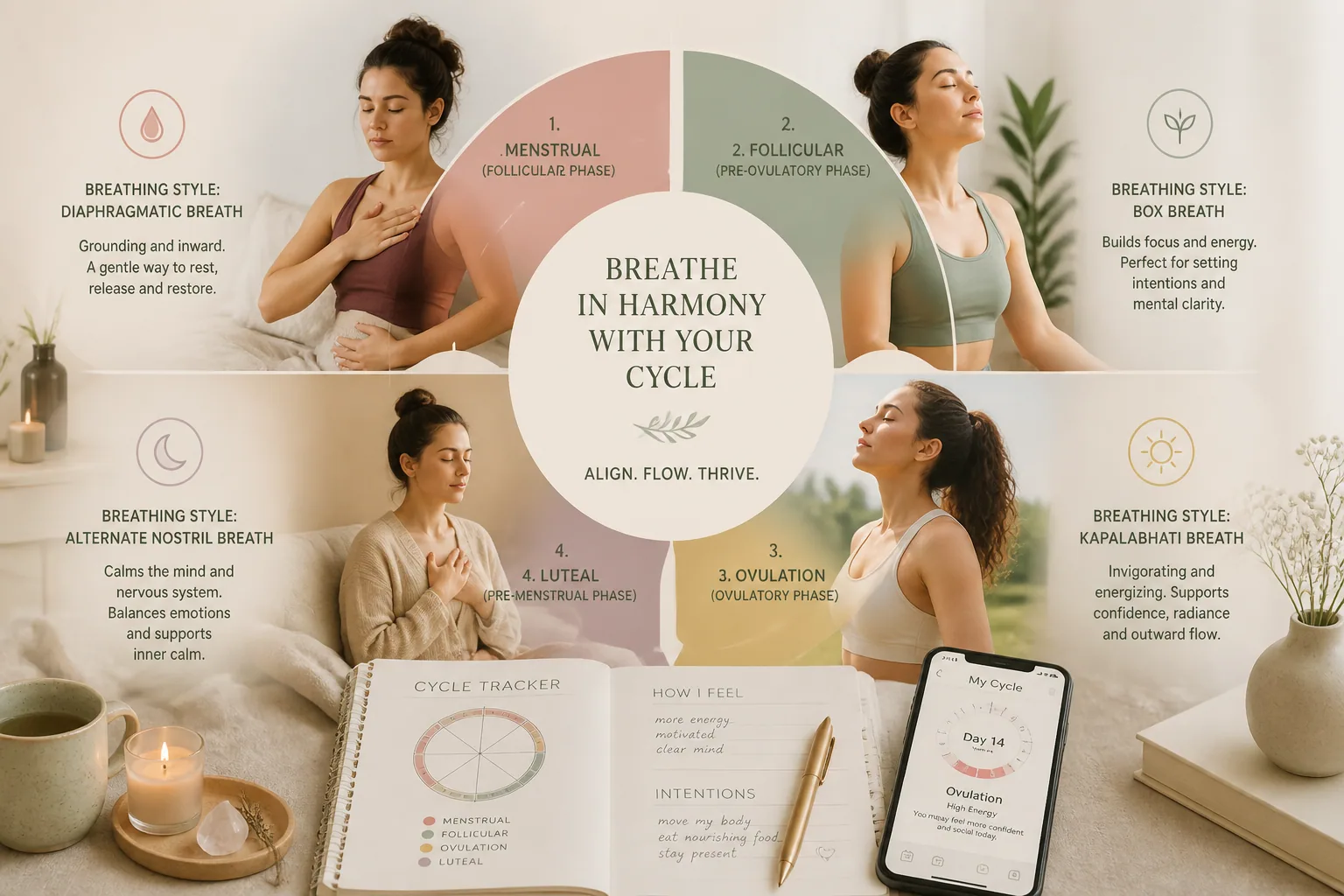
Breathwork & Monthly Hormone Rhythms: How to Support Each Cycle Phase with Targeted Breathing
Breathwork can be powerful on its own, but it often works even better when you stop treating every day like the same day. The menstrual cycle changes energy, focus, sleep, stress tolerance, appetite, and mood in predictable ways, and your breathing practice can meet those shifts instead of fighting them. That means softer, more restorative breathing when hormones are low and symptoms are louder, and more rhythmic, energizing, or coherence-style practices when your body is naturally more resilient and alert.
This is not about perfection or rigid scheduling. It is about using breath as a practical tool that matches your body’s monthly rhythm. For many people, that simple shift makes breathwork feel more effective, more sustainable, and much easier to keep doing.
Why Breathwork Works Better When You Follow Your Body’s Rhythm
The menstrual cycle is not just about reproduction. It is also a monthly pattern of hormonal change that can influence the nervous system. Estrogen and progesterone rise and fall across the cycle, and those shifts can affect how calm, focused, sleepy, sensitive, or physically comfortable you feel. If you have ever noticed that the same meditation, workout, or breathing drill feels amazing one week and irritating the next, your cycle may be part of the reason.
Breathwork is especially useful here because breathing directly affects the autonomic nervous system. Slower breathing, longer exhales, and structured rhythm-based practices can reduce subjective stress and anxiety, and research suggests that certain techniques, including slow-paced breathing and exhale-focused patterns, can have meaningful effects over both single sessions and short daily practice periods. A meta-analysis found small-to-medium benefits for stress, anxiety, and depressive symptoms, while a structured respiration study found that cyclic sighing improved mood and reduced physiological arousal. See the review here: https://pmc.ncbi.nlm.nih.gov/articles/PMC9828383/ and the five-minute breathwork study here: https://pmc.ncbi.nlm.nih.gov/articles/PMC9873947/
When you combine that evidence with cycle awareness, you get something practical: use calming downregulating breaths when your system is already taxed, and use more activating or balanced breathing when your body has more capacity. The result is less forcing, more alignment, and often better consistency.
The Four Menstrual Cycle Phases: What Changes in Energy, Mood, Stress, and Sleep
Although every cycle is unique, the menstrual cycle is usually described in four phases: menstrual, follicular, ovulation, and luteal. Each phase has a different hormonal backdrop, and that backdrop can shape how you feel day to day.
During the menstrual phase, usually days 1 to 5, estrogen and progesterone are both at their lowest. Kaiser Permanente notes that this low point reduces their sleep- and mood-stabilizing effects, which can leave mood more fragile and physical discomfort like cramps more noticeable. Tom’s Guide also highlights that sleep quality can dip during menstruation, which helps explain why some people feel more tired or less resilient at this time: https://healthy.kaiserpermanente.org/southern-california/health-wellness/healtharticle.phases-of-the-menstrual-cycle and https://www.tomsguide.com/wellness/sleep/menstrual-cycle-and-sleep
In the follicular phase, from the end of menstruation to ovulation, estrogen rises steadily while progesterone stays low. This is often the phase when people feel more mentally clear, motivated, verbally fluent, and ready to start things. A hormonal and metabolism review in MDPI also notes that insulin sensitivity is higher and carbohydrate oxidation is favored in the follicular phase, which fits the common experience of more energy and easier effort tolerance: https://www.mdpi.com/2072-6643/18/7/1063
Ovulation sits around the middle of the cycle and is marked by an estrogen peak and an LH surge. For many people, that means more energy, social confidence, alertness, and libido. Some people also notice a quick mood wobble or irritability around the hormonal drop after the peak. Ovulation is often a “bright” phase, but not always a perfectly smooth one.
The luteal phase begins after ovulation and continues until menstruation. Progesterone rises first, then both progesterone and estrogen fall sharply before the next period. Earlier in the luteal phase, progesterone and its calming metabolite allopregnanolone can support sleepiness and emotional steadiness. In late luteal, the premenstrual drop in both hormones often lines up with anxiety, irritability, fatigue, disrupted sleep, brain fog, and cravings. This is why so many people feel most sensitive in the days before their period. Research and clinical summaries suggest that around 75 percent of menstruating people experience some PMS symptoms, and a smaller group experience symptoms severe enough to meet PMDD criteria.
The main takeaway is simple: the cycle is not one steady state. It is a sequence of changing conditions, and breathwork can be adapted to each one.
What Current Research Suggests About Breathwork and Hormonal Regulation
There is not yet a huge body of research specifically testing cycle-phase-specific breathwork protocols. That said, the broader evidence on breathwork is strong enough to give us a useful foundation. Slow breathing, diaphragmatic breathing, coherent breathing, and exhale-dominant methods consistently show benefits for stress regulation and emotional balance.
Box breathing is one of the best-known structured methods. Cleveland Clinic explains that it helps activate the parasympathetic nervous system, lower cortisol, reduce stress, calm the mind, and promote emotional stability. That makes it useful when the cycle is making you feel scattered or keyed up: https://health.clevelandclinic.org/box-breathing-benefits/
Cyclic sighing is another interesting option because it emphasizes a longer exhale than inhale. In a controlled study, just five minutes a day for a month improved mood, lowered respiratory rate, and reduced physiological arousal more effectively than mindfulness meditation in that comparison. This is especially relevant if you want a quick practice that helps settle the body rather than requiring a long sit.
When you combine these findings with what we know about hormonal fluctuations, the logic becomes clear. On low-energy or high-symptom days, the goal is to reduce load on the nervous system. On high-energy days, the goal is to channel that energy without pushing into overactivation. Breathwork can do both.
Menstrual Phase: Restorative Breathing for Fatigue, Cramps, and Nervous System Support
The menstrual phase is often the time to slow down. With estrogen and progesterone at their lowest, sleep can be lighter, discomfort can feel sharper, and emotional resilience may be lower. That does not mean you need to do nothing. It means your breath practice should probably be gentler and more restorative.
The best styles here are downregulating techniques: longer exhales, soft nasal breathing, relaxed belly breathing, and anything that encourages your body to unclench. Think of this phase as a time to tell the nervous system, “You are safe, you can soften, you do not need to brace.”
A simple menstrual-phase practice is a 4-second inhale and a 6 to 8-second exhale for 5 to 10 minutes. If you feel crampy or depleted, keep the inhale quiet and unforced. You can also use box breathing if you want structure, but many people find a longer exhale feels more soothing than equal-count breathing during menstruation. If your body feels extra sensitive, aim for breath sessions that are low effort and easy to finish.
This is also a good phase for pairing breath with other soothing inputs: a warm drink, a heating pad, or a quiet room. If your sleep has been worse around your period, a short relaxation breath practice before bed can be more useful than trying to “push through” with high-output techniques.
Follicular Phase: Energizing Breathwork for Motivation, Focus, and Momentum
The follicular phase is often where breathwork can become more active. As estrogen rises, many people notice better mood, sharper focus, and more motivation. This is a good window for practices that feel crisp, rhythmic, and slightly more energizing.
Here the goal is not to overstimulate yourself. It is to meet your naturally increasing capacity with a breath pattern that helps you build momentum. You might try a more rhythmic inhale-exhale pattern, a gentle coherence practice, or a slightly faster energizing sequence if it feels good in your body.
Because estrogen is associated with improved mood, focus, learning, and verbal fluency, the follicular phase is often a great time to do breathwork before work sessions, creative planning, movement, or social commitments. The MDPI review on menstrual cycle and metabolism also notes that insulin sensitivity is higher in this phase, which can support the sense of lightness and efficiency many people report.
A practical follicular-phase pattern is 5 seconds in and 5 seconds out for 5 to 10 minutes. If you prefer a little more lift, you can use a gentle energizing breath, as long as it does not make you dizzy or anxious. This phase is also a strong candidate for morning breathwork, because it can help translate natural rising energy into clear action.
If you are trying to create a habit, the follicular phase is often the easiest place to reinforce it. The body tends to cooperate more, and that can help you establish consistency before the more sensitive later phases arrive.
Ovulation Phase: Balanced Breathing for Confidence, Social Energy, and Steady Stress Response
Around ovulation, many people feel their strongest mix of energy, sociability, and alertness. Estrogen peaks, LH surges, and the body often feels more open and outward-facing. This is a good time for breathwork that supports poise and steadiness, not just calm or activation.
Balanced coherence-style breathing works well here. Cardiac coherence, or heart coherence, uses a steady breathing rhythm to support emotional regulation and a more even stress response. It is useful when you want to keep your energy high but smooth out spikes, especially if your calendar is busy or social demands are higher.
You can use a pattern like 5 or 6 seconds in and 5 or 6 seconds out for 5 to 10 minutes. This can be especially helpful before presentations, meetings, dates, travel, or anything else that calls for confidence without tension. If you sometimes get irritable after the ovulatory peak, a coherent breathing practice can help you stay centered through that brief shift.
This phase is also a good reminder that more energy does not always mean more intensity. Breathwork can help you direct that energy cleanly, so you feel engaged rather than overamped.
Luteal Phase: Calming Breath Practices for Irritability, PMS, Cravings, and Better Sleep
The luteal phase is where many people need the most support. Early luteal can feel steady, focused, and even cozy, but late luteal often brings the familiar premenstrual slide: lower mood, more cravings, sleep disruption, reduced concentration, and a shorter fuse. This is the phase where calming breathwork can make the biggest day-to-day difference.
Because progesterone and estrogen fall before menstruation, the nervous system may feel less buffered. That is one reason symptoms can intensify. You are not imagining it, and you are not failing at self-care. Your body is asking for a different kind of support.
The best breath practices here are the ones that reduce reactivity. Longer exhales, box breathing, cyclic sighing, and simple paced breathing can all help. If you feel anxious or wired at night, a 5-minute exhale-focused session can be a good way to transition into sleep mode. If irritability is the main issue, a structured practice can create just enough pause between feeling and reacting.
For many people, the luteal phase is not the time to chase intensity. It is the time to lower the volume. A breath session before meals can also help if cravings or impulsive eating feel stronger, not because breathwork “fixes” hunger, but because it can make the body feel less stressed and more regulated.
If late luteal symptoms are strong, it may help to lower expectations for performance and use breathwork as a stabilizer rather than a productivity tool. In this phase, success can simply mean sleeping a little better, snapping a little less, or getting through the day with more ease.
How Long and How Often to Practice in Each Phase
There is no single correct dose, but research suggests that consistency matters more than length. Daily practice, even for just 5 minutes, can be enough to create measurable benefits over time. That said, your cycle phase can guide how much you do and how structured the practice should be.
During menstruation, aim for 3 to 10 minutes once or twice per day if needed. Keep it restorative and low effort. In the follicular phase, 5 to 10 minutes once a day is often a good sweet spot, especially if you want to pair it with focus or planning. Around ovulation, 5 to 10 minutes of balanced breathing can help keep energy grounded. In the luteal phase, especially late luteal, 5 to 15 minutes daily may be helpful, with extra short sessions on stressful days or before bed.
If you are new to breathwork, it is better to do a little every day than to rely on long sessions you cannot maintain. A steady rhythm builds familiarity, and familiarity makes the practice more useful when symptoms spike.
Micro-Breath Breaks: Simple 1- to 5-Minute Resets for Busy Days
Not every breath practice has to be a full session. Micro-breaks can be incredibly effective, especially if you tend to forget your longer routine or need support in the middle of a busy day.
A 1-minute reset can be as simple as slowing your exhale and softening your shoulders. A 2-minute break might use a 4-in, 6-out rhythm. A 3-minute reset can be a mini box breathing session. A 5-minute break can be a full cyclic sighing practice or a coherence-style pace.
These tiny sessions work well before stressful emails, during a commute, before a meal, after a difficult conversation, or when you notice your body clenching. If you are in the luteal phase, micro-breaks can be especially useful because symptoms often build gradually through the day. If you are in the follicular phase, they can help you keep momentum without tipping into overdrive.
The point is not to create another obligation. It is to make regulation more accessible in real life.
How to Track Your Cycle, Mood, and Breathwork Patterns to Personalize Results
The most useful breathwork routine is the one that matches your actual patterns, not an idealized template. That is why cycle tracking matters. Kaiser Permanente recommends symptom tracking, and Lumen also encourages paying attention to phase-specific changes in energy and cognition: https://healthy.kaiserpermanente.org/southern-california/health-wellness/healtharticle.phases-of-the-menstrual-cycle and https://lumencal.com/follicular-phase
You can track a few simple things each day: cycle day, sleep quality, mood, stress level, energy, focus, cravings, cramps, and what type of breathwork you practiced. Over time, patterns tend to emerge. Maybe box breathing helps most in late luteal, while rhythmic coherent breathing works best in the follicular phase. Maybe a short relaxation breath before bed is the key during menstruation. The more you observe, the more personalized your routine becomes.
A note about tracking: you do not need a perfect app. A paper journal is enough. What matters is noticing the relationship between your body and the practice.
Helpful Apps, Journaling Prompts, and Signs Your Routine Is Working
If you like a guided experience, a simple breathing app can make consistency easier. One option is Just Breathe: Relax Daily, which offers cardiac coherence, box breathing, relaxation breath, energizing breath, custom patterns, soothing animations, ambient sounds, reminders, and progress tracking. You can find it here: https://findthe.app/just-breathe-ujhm1e
Journaling can also help you notice what changes and what does not. Good prompts include: What phase am I in? What does my energy feel like right now? Did my breath practice make me calmer, clearer, sleepier, or more focused? Did I need more structure or more softness today? Was my practice easier before ovulation than before my period?
Signs your routine may be working include easier recovery from stress, less reactivity, slightly better sleep, lower tension, improved focus after a few minutes of breathing, and a greater sense that you can choose your response instead of reacting automatically. The changes may be subtle at first, but they often accumulate.
Safety Tips, Irregular Cycles, and How to Adapt If You’re Not Menstruating
If your cycles are irregular, very long, very short, or affected by perimenopause, postpartum changes, hormonal contraception, stress, or a medical condition, do not force a calendar-based approach. In that case, symptom-led breathing is usually better. Focus on what your body is showing you now: low energy, poor sleep, irritability, anxiety, cramping, or focus issues. Then choose the breath style that fits the symptom, not just the date.
If you are not currently menstruating, you can still use the same framework in an adapted way. You may notice monthly rhythms even without bleeding, or you may benefit more from a symptom-based pattern that matches sleep, stress, or mood fluctuations. The key is flexibility. Breathwork should support your nervous system, not become another source of pressure.
As with any breath practice, stop if you feel dizzy, panicky, or uncomfortable, and keep the breaths natural if you have respiratory or cardiovascular concerns. If you have a history of trauma or breathing difficulties, gentler practices and professional guidance may be a better starting point. Breathwork should feel supportive, not forcing.
A Simple Month-Long Breathwork Template to Get Started
If you want a simple plan, try this for one cycle and adjust from there.
Menstrual phase: 5 to 10 minutes daily of long-exhale or relaxation breathing. Keep it soothing and low effort.
Follicular phase: 5 to 10 minutes daily of rhythmic breathing, coherence-style breathing, or an energizing pattern if it feels good.
Ovulation phase: 5 to 10 minutes daily of balanced coherent breathing to support confidence and steadiness.
Luteal phase: 5 to 15 minutes daily of box breathing, cyclic sighing, or other calming patterns, with extra micro-breaks during stressful moments or before sleep.
After one month, look back at your notes and ask a few simple questions. Which phase felt easiest? Which phase needed the most support? Which breath pattern helped the most with sleep, mood, or stress? Did your energy improve when the practice matched the phase? From there, refine the next cycle.
The most important thing to remember is that breathwork is not just a technique. It is a conversation with your nervous system. When you listen to your cycle and respond with the right kind of breathing, that conversation becomes much more effective, and much more humane.