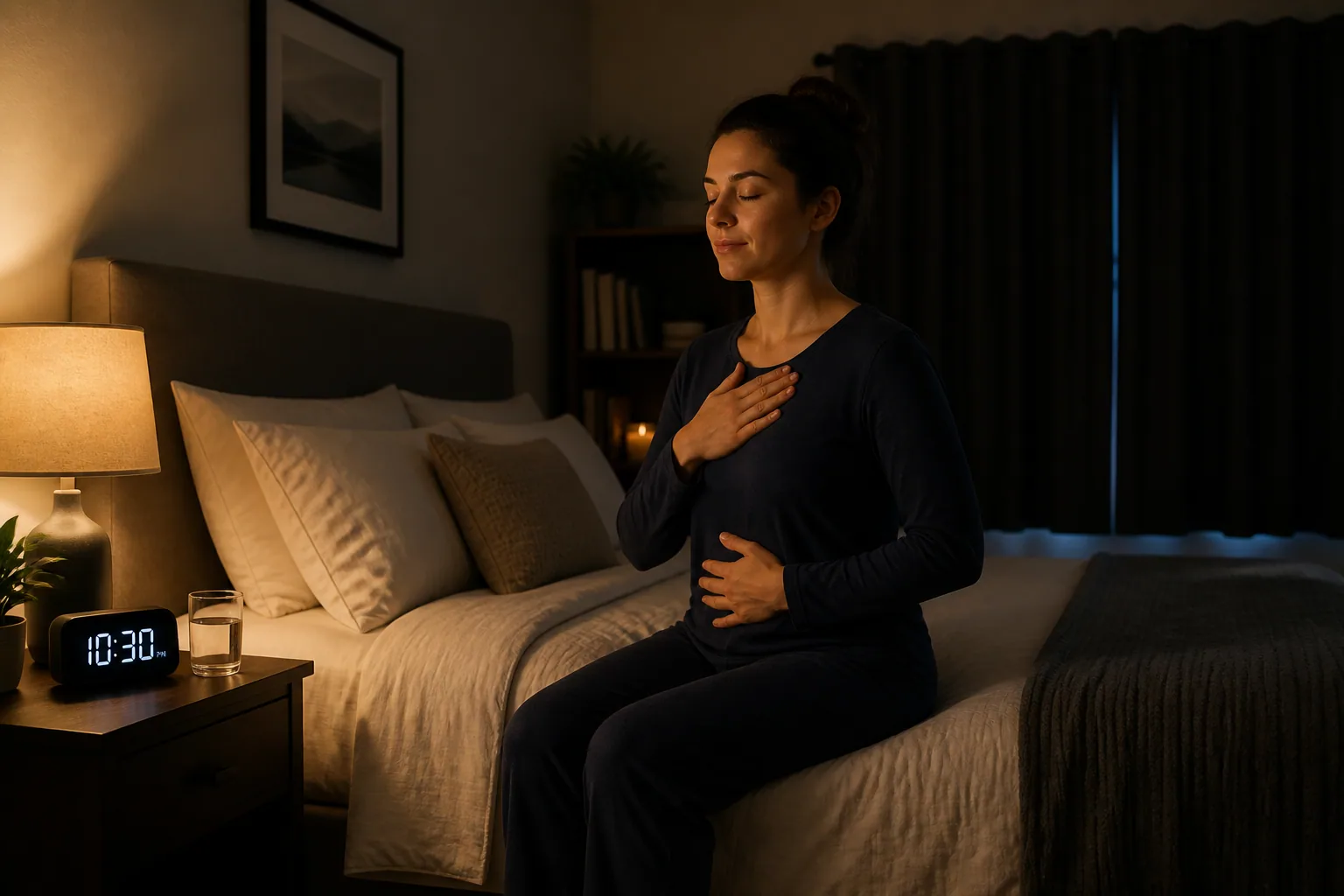
Breathwork & Sleep Hygiene: The Night Routine That Can Help You Fall Asleep Faster and Sleep Deeper
If you have ever done everything “right” and still stared at the ceiling for an hour, you already know that sleep is not just about being tired. It is about whether your body and brain are actually ready to power down. That is why breathwork and sleep hygiene work so well together. Sleep hygiene creates the right conditions for sleep, while breathwork helps shift your nervous system out of alert mode and into a calmer state that can actually accept rest.
This matters more than ever. In 2024, 30.5% of U.S. adults reported sleeping fewer than 7 hours per night, which falls below the recommended minimum for healthy adults. According to the American Heart Association, adults should aim for 7 to 9 hours of sleep each night because sleep supports heart health, brain function, immune health, mood, learning, and memory. In other words, better sleep is not a luxury. It is a foundation.
In this guide, we will look at the core sleep habits that still matter most, the breathing patterns that are best before bed, and how to build a nighttime routine that fits your life, whether you are an insomniac, a shift worker, a parent, or simply someone who wants deeper rest.
Why Breathwork and Sleep Hygiene Work Better Together
Sleep hygiene and breathwork solve different parts of the same problem. Sleep hygiene reduces outside friction. Breathwork reduces inside friction. If your room is too bright, too warm, or full of stimulation, your brain stays on alert. If your nervous system is buzzing with stress, mental replay, or anxiety, your body may be in bed but your system is still “on.”
Research on sleep hygiene shows that the most common components include caffeine, alcohol, exercise, sleep timing, light exposure, napping, smoking, noise, temperature, wind-down routines, stress levels, and stimulus control. That list makes an important point: falling asleep faster is rarely about one trick. It is about stacking the right conditions so sleep has a chance to happen naturally. Source: https://pubmed.ncbi.nlm.nih.gov/38761649/
Breathwork fits into that picture as a bridge. It helps you transition from the pace of the day to the slower rhythm of sleep. When used alongside a consistent routine, it can become a signal to your body that the day is over and recovery can begin.
The Basics of Sleep Hygiene That Still Matter Most
A lot of sleep advice gets overly complicated, but the basics still matter the most. The goal is to create an environment and schedule that make sleep easier rather than fighting against your biology.
One of the strongest sleep hygiene foundations is a cool, dark, quiet bedroom. Mayo Clinic recommends room-darkening shades, a fan, earplugs, and limiting screen exposure before bed as key environmental factors that support better sleep. Source: https://www.mayoclinic.org/healthy-lifestyle/adult-health/in-depth/sleep/art-20048379
Consistency matters just as much. Going to bed and waking up at roughly the same time every day, including weekends, helps reinforce the body’s internal sleep-wake clock. That regularity improves alertness and sleep continuity over time. Source: https://www.mayoclinic.org/healthy-lifestyle/adult-health/in-depth/sleep/art-20048379
This is especially important because irregular sleep schedules are not just inconvenient. They are associated with higher risks of depression, anxiety, elevated BMI, insulin resistance, hypertension, and cardiovascular events. Low sleep regularity is also linked with greater all-cause mortality independent of sleep duration and quality. That means the rhythm of your sleep matters, not just the number of hours. Source: https://pubmed.ncbi.nlm.nih.gov/41259946/
The simplest sleep hygiene upgrades are often the most powerful: dim the lights, reduce late screen exposure, keep your room cool, limit late caffeine and alcohol, and protect a consistent sleep window as often as you can.
How Breathing Affects the Nervous System Before Bed
Breathing is one of the few automatic functions you can also control voluntarily, which makes it a powerful tool for changing state on purpose. When your breathing becomes slower and smoother, your nervous system gets information that it may be safe to unwind.
A systematic review of nine studies with 457 participants found that slow breathing techniques, defined as 10 breaths per minute or fewer, practiced immediately before bedtime improved self-reported sleep duration and sleep quality. Objective sleep measurements were more mixed, but the subjective benefits were still meaningful. The review also noted that slow breathing before bed influences heart-rate variability, suggesting shifts toward greater parasympathetic calm. Source: https://pubmed.ncbi.nlm.nih.gov/41886931/
That parasympathetic shift is the key idea. The sympathetic system is associated with activation, urgency, and vigilance. The parasympathetic system supports rest, digestion, recovery, and downregulation. If you are carrying stress into bed, slower breathing can help nudge your system away from tension and toward rest.
This is why breathwork can be especially useful for people who feel mentally busy but physically exhausted. The body may be ready for sleep, but the mind and nervous system need a clearer cue that it is time to let go.
Why Exhale-Focused Breathwork Helps You Wind Down
If there is one feature that shows up again and again in calming breath practices, it is the extended exhale. Exhale-focused breathing tends to feel more soothing because the exhale naturally supports downshifting, while a long inhale pattern can sometimes feel energizing or activating.
A 2023 randomized remote trial comparing several breathwork methods with mindfulness meditation found that cyclic sighing, a technique with a double inhale and prolonged exhale, produced greater improvement in mood and a larger decrease in respiratory rate than meditation. The same study suggested that exhale-focused patterns are especially effective at lowering physiological arousal. Source: https://pmc.ncbi.nlm.nih.gov/articles/PMC9873947/
That makes exhale-focused techniques particularly useful if you tend to feel wired, overstimulated, anxious, or “tired but unable to sleep.” Instead of trying to force sleep, you are teaching the body to soften its grip on alertness. Over time, that can make the transition into sleep feel less abrupt and less effortful.
The Best Breathwork Techniques for Falling Asleep Faster
Not all breathwork is ideal right before bed. Some methods are better for focus or energy, while others are better for calming the body. For sleep, the most useful techniques are usually slow, repetitive, and gentle.
Relaxation breathing is one of the simplest options. The goal is not perfection. It is ease. A common approach is to breathe in gently through the nose and out a little longer than the inhale, letting the exhale become the “release” part of the pattern. This works well for people who want something uncomplicated and low effort.
Cyclic sighing is another strong option. It uses a double inhale through the nose, followed by a longer exhale. This can help interrupt the build-up of physical tension and can be especially useful when your body feels overstimulated after a long day.
Box breathing is popular, but it is not always the best choice immediately before sleep. Because it uses equal counts for inhale, hold, exhale, and hold, some people find it steadying and calming, while others experience the breath-holds as too alerting or too structured at bedtime. It may be better earlier in the evening or for people who simply like rhythm and structure.
A practical rule is simple: if a technique helps you feel softer, slower, and less mentally noisy, it may belong in your bedtime routine. If it feels effortful, energizing, or too mentally demanding, save it for another time.
When to Use Cyclic Sighing, Relaxation Breathing, or Box Variations
Choosing the right breath pattern depends on what you are trying to solve. If you are anxious and physically keyed up, cyclic sighing can be a strong first choice because it is more clearly exhale-dominant and may reduce respiratory rate more noticeably. If you want something gentle and easy to maintain while lying in bed, relaxation breathing may be a better fit.
Box breathing can still be useful if your mind is scattered and you benefit from a structured rhythm, but it is usually better when you are not so close to sleep that any breath holding might keep you too alert. Some people also prefer a modified box pattern with shorter holds or a softer pace, which can preserve the calming structure without making the practice feel intense.
The best technique is the one you will actually repeat consistently. If a pattern feels pleasant and predictable, it is more likely to become a sleep cue. If it feels complicated, your brain may treat it like another task to perform instead of a signal to rest.
How Long Before Bed You Should Practice Breathwork
There is no single perfect timing window, but the simplest answer is this: practice close enough to sleep that your body begins linking the breathwork with bedtime, but early enough that you do not turn it into another source of performance pressure.
For many people, 10 to 20 minutes before lights out is a helpful range. That gives you time to reduce stimulation, complete a short breathing practice, and move into sleep without feeling rushed. If you are someone whose mind speeds up as soon as your head hits the pillow, doing breathwork before you even get into bed can be easier than trying to calm down once you are already frustrated.
The review on slow breathing before bed suggests that immediate pre-sleep practice can be beneficial, especially for subjective sleep quality. That makes a brief breathing session a good candidate for the final phase of your wind-down, not just a general wellness habit earlier in the day. Source: https://pubmed.ncbi.nlm.nih.gov/41886931/
Building a Personalized Nighttime Routine for Your Sleep Style
A good bedtime routine should feel realistic, not idealized. You do not need a perfect hour-long ritual to sleep better. You need a repeatable sequence that tells your brain what comes next.
Start by identifying your main sleep issue. If you struggle to fall asleep, emphasize environmental darkening, screen reduction, and exhale-focused breathing. If you wake often through the night, your routine should make it easy to return to calm without too much stimulation. If your schedule is irregular, your best gains may come from consistency anchors such as a stable wake time, a short pre-sleep ritual, and a predictable sleep environment.
Try to think in layers. Layer one is schedule. Layer two is environment. Layer three is breath. When all three point in the same direction, sleep often gets easier.
Sleep Routine Tips for Insomniacs, Shift Workers, and Parents
Insomniacs often do best with fewer moving parts. Keep the routine short, repeatable, and low pressure. A consistent sequence like dim lights, put the phone away, 5 minutes of slow breathing, and bed can be more effective than rotating through many tactics. If sleep does not come right away, avoid mentally arguing with yourself. That can keep the nervous system activated.
Shift workers need flexibility without chaos. If your sleep window changes, focus on cues you can control every time: the same breathing pattern, the same sound environment, and the same pre-sleep lighting adjustments. Even when your schedule varies, your ritual can stay familiar.
Parents often have fragmented sleep and limited control. In that case, the goal is not a flawless wind-down. It is to create a mini-reset that helps you fall back asleep faster after interruptions. A few slow exhale-focused breaths can be enough to shift from alert caregiving mode back toward rest.
Across all of these sleep styles, the most useful routines are the ones that lower decision fatigue. The less you have to think about what comes next, the easier it is for your body to follow the pattern.
Environmental Cues That Strengthen Your Bedtime Ritual
Your environment is part of the routine. The brain learns through repetition and association, so the same cues repeated each night can become powerful sleep signals.
A dark room is one of the strongest cues. Light exposure before bed can keep the brain more alert, which is why reducing screens and bright overhead lighting matters. A cool room, a fan, soft bedding, and noise reduction all help create the sense that the world is quieting down. Mayo Clinic specifically highlights room-darkening shades, fans, earplugs, and screen limitation as helpful sleep-promoting conditions. Source: https://www.mayoclinic.org/healthy-lifestyle/adult-health/in-depth/sleep/art-20048379
Calming environmental cues can also include scent, a favorite blanket, low lighting, or a specific playlist of ambient sounds. The goal is not to create dependence on one exact setup, but to build reliable associations that say, “this is the part of the day when we rest.”
Common Breathwork Mistakes That Can Keep You Awake
One common mistake is breathing too forcefully. Breathwork for sleep should feel soft, not strenuous. If you overbreathe, you may feel dizzy, stimulated, or more aware of your body in a way that makes sleep harder.
Another mistake is chasing a perfect count. Counting can help, but if it becomes a source of pressure, it can backfire. Sleep is not a breathing test. It is a nervous system transition.
Some people also choose a pattern that is too energizing for bedtime. Faster techniques, intense retention, or anything that makes you feel “activated” may be better suited for daytime use. If your breathing practice leaves you more awake than before, it is not the right sleep tool for that moment.
Finally, do not expect breathwork to erase every sleep issue on its own. If your room is bright, your caffeine intake is late, or your schedule is wildly irregular, breathwork will help, but it works best when paired with the basics of sleep hygiene.
A Simple 15-Minute Pre-Sleep Routine to Try Tonight
Here is a practical routine you can test tonight. Start 15 minutes before you want to fall asleep. Dim the lights and put away screens. Make the room as cool and quiet as you reasonably can. Then sit or lie down comfortably and choose one slow breathing pattern.
For the first 5 minutes, try relaxation breathing with a slightly longer exhale than inhale. Keep it gentle. If your mind wanders, simply return to the rhythm.
For the next 5 minutes, switch to cyclic sighing if you feel especially wired or tense. Use a soft double inhale and a slow, unforced exhale. Let the body feel heavier with each round.
For the final 5 minutes, stop counting and simply rest with your natural breath. Notice the bed, the room, and the sense of permission to sleep. If your mind still feels busy, do not fight it. Just keep returning to the fact that you are safe, still, and done for the day.
If you want help staying consistent with these patterns, a guided tool like Just Breathe: Relax Daily can make the practice easier to repeat. Its Relaxation Breath, Box Breathing, Cardiac Coherence, custom patterns, and calming moon-themed visual guides can be a simple way to turn breathwork into a real nighttime habit: https://findthe.app/just-breathe-ujhm1e
The best sleep routine is rarely the most complicated one. It is the one that combines a calm environment, a regular schedule, and a breathing practice that tells your nervous system, clearly and repeatedly, that the day is over. When those pieces work together, falling asleep can feel less like a struggle and more like a natural release into rest.