Breathwork as a Language of Safety: How Your Breath Pattern Can Reveal and Regulate Your Nervous System
Breathwork is often treated like a technique you do to calm down. But your breath is also something else: a real-time signal. It changes when you are stressed, when you feel safe, when you are focused, when you are tired, and when your system is overloaded. If you learn how to notice those changes, breathing becomes less about forcing relaxation and more about reading your nervous system with more accuracy and care.
That is what makes breathwork so useful for everyday regulation. You do not need to wait until you are in a full anxiety spiral to pay attention. Your breathing pattern can show you a shift before your thoughts catch up. Breath rate, depth, rhythm, pauses, and muscular tension all offer clues about what state you are in, and which type of practice is likely to help. This is a more personalized approach to wellness, and it is also a more sustainable one.
Why Your Breath Is a Real-Time Map of Your Nervous System
Your breathing is closely tied to autonomic nervous system activity, which includes both sympathetic arousal and parasympathetic recovery. When stress rises, breathing often becomes faster, shallower, choppier, and more chest-based. When the system is settled, the breath tends to soften, lengthen, and become more rhythmic. These changes are not random. They reflect what your body is doing to stay alive, alert, and regulated.
Research shows that slow-paced breathing around 6 breaths per minute, which is roughly 0.1 Hz, can significantly increase heart rate variability, lower systolic blood pressure, and reduce resting heart rate, all of which are markers associated with parasympathetic activation and calm. A separate review also notes that breath depth and rhythmic structure, including pauses and changes in inhale-exhale ratios, can influence autonomic outcomes and emotional regulation. Source: https://link.springer.com/article/10.1007/s12671-023-02294-2 and https://pmc.ncbi.nlm.nih.gov/articles/PMC6137615/
In other words, breath is not just a byproduct of your state. It is one of the ways your state expresses itself.
What Your Everyday Breathing Habits May Be Telling You
Most people have a default breathing style that shows up under ordinary conditions. Some people breathe high in the chest and barely notice it. Others hold the breath between tasks. Some sigh often, some breathe through the mouth, and some maintain a very even rhythm until pressure rises. None of these patterns are automatically good or bad. They are information.
Chest-dominant breathing can be a sign that the body is preparing for action or trying to protect itself. Ragged timing, breath holds, and very shallow breaths may show that you are running on stress and not fully recovering between demands. On the other hand, a slower and more even pattern often suggests that the nervous system has enough bandwidth for rest, digestion, or focus. These breathing clues can appear before you consciously label yourself as overwhelmed.
That is why breathwork is so helpful for self-awareness. Instead of asking only, ‘How do I feel?’, you can also ask, ‘How am I breathing right now?’
How to Find Your Personal Breath Baseline
A helpful breath practice starts with curiosity, not correction. Before you try to change anything, notice what is normal for you when you are relatively okay. Your baseline is not a perfect breathing pattern. It is your usual pattern when you are not in acute stress, not in exhaustion, and not trying to perform calm.
To find it, observe your breathing at a few different times of day. Notice whether it is mostly nasal or mouth-based, whether it is high in the chest or lower in the belly, whether the inhale and exhale are similar or uneven, and whether you naturally pause between breaths. Pay attention to the speed too. Some people settle at a naturally slower rhythm, while others breathe more quickly even when relaxed. The point is to learn your range.
It also helps to notice the body around the breath. Are your shoulders lifted? Is your jaw tight? Is the belly rigid, or does it move freely? Muscular tension often tells you more than breath alone. A breath pattern becomes much easier to interpret when you pair it with posture, sensation, and emotional tone.
The 1 to 2 Minute Micro-Check-In Practice
A short breath check-in can be surprisingly powerful because it gives you a chance to catch state changes early. You do not need a full meditation session. You only need one or two minutes, repeated throughout the day, to notice what is shifting.
Start by pausing where you are. Bring attention to three things: breath rate, breath quality, and body tension. Ask yourself whether the breath feels smooth or rough, shallow or deep, quick or slow, and whether the pause between inhale and exhale feels natural or interrupted. Then check whether the chest, shoulders, face, or belly are carrying effort.
The goal is not to judge the breath as good or bad. The goal is to notice a shift in state before it becomes a bigger spiral. If your breath suddenly becomes short, tight, or irregular, that may be your cue to slow down, reduce stimulation, or switch tasks. If your breath feels flat and effortful, that may signal fatigue or shutdown. If it feels steady and easy, you may already be in a good place to focus or recover.
Common Nervous System States: Wired, Tired, Overwhelmed, Focused, and Regulated
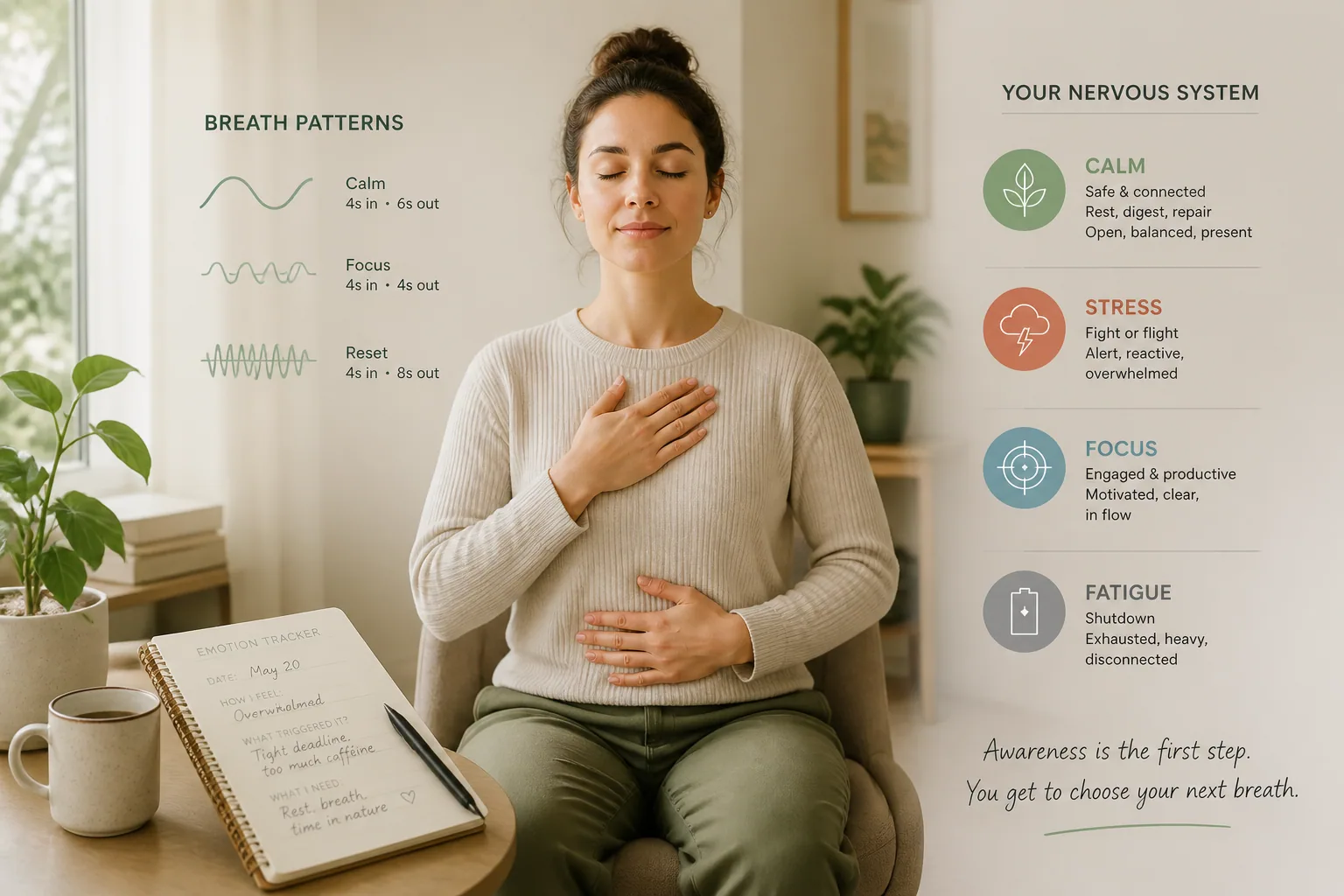
Different states tend to have different breathing signatures. When you are wired, the breath is often fast, shallow, and upper-chest dominant. You may feel keyed up, restless, or unable to settle. This is usually a sign of sympathetic activation, and it often responds best to slow, lengthened breathing with an emphasis on the exhale.
When you are tired or shut down, the breath may become slow but weak, low in energy, or irregular. You might notice less movement in the belly, less motivation, and a kind of flatness rather than anxiety. In this state, overly calming breathwork can feel unhelpful. Sometimes what is needed first is gentle awareness, a little more oxygenation, or a more enlivening rhythm.
When you are overwhelmed, the breath can become erratic. You may notice sighing, breath holding, forgetfulness about the breath entirely, or a sense that you cannot get a satisfying inhale. Emotional reactivity often shows up here too. In those moments, the most useful breathwork is usually simple, short, and reassuring rather than intense.
When you are focused, the breath may become quieter and more subtle. It can still be somewhat shallow without being stressful. The difference is that your nervous system has enough organization to stay task-oriented. And when you are regulated, the breath tends to feel rhythmic, easy, and adaptable. You can shift it without strain.
How to Match Breathwork Techniques to What You Feel
The best breathwork is not the most dramatic one. It is the one that matches your state. Matching matters because the nervous system responds differently depending on whether you are trying to downshift, energize, stabilize, or simply maintain balance.
If you feel wired, use a technique that lengthens the exhale and invites slower pacing. If you feel foggy or shut down, you may need something more alerting, or at least a practice that does not push you deeper into low energy. If you feel emotionally reactive, look for something that simplifies your attention and restores a sense of internal safety. If you feel focused, you may not need much change at all, only a brief reset to keep your baseline steady.
This is where personalized breathwork begins to feel very different from one-size-fits-all advice. Instead of asking, ‘What is the best breathing pattern?’, ask, ‘What state am I in, and what does my system need right now?’
When to Use Cardiac Coherence, Extended Exhales, and Nostril Breathing
Cardiac coherence is often a strong option when stress is high and you want a steady, regulating rhythm. It usually involves slow, even breathing with a calm, intentional focus, and it may be paired with positive emotion such as gratitude. Research suggests that cardiac coherence practices can improve perceived stress, mood, sleep, cognitive performance, and energy, likely through increased vagal tone and more synchronized heart rhythms over time. A randomized trial also found that coherent breathing at about 5.5 breaths per minute and a placebo breathing rate both improved mental health, sleep, well-being, and anxiety over four weeks, which is a useful reminder that consistent breathing practice itself matters. Sources: https://journals.sagepub.com/doi/10.1177/27536130251408821 and https://pmc.ncbi.nlm.nih.gov/articles/PMC10719279/
Extended exhale breathing is especially helpful when you feel activated, tense, or unable to settle. Lengthening the exhale tends to cue the body toward parasympathetic response and can help lower intensity without requiring a long session. It is often a good entry point when you want relief quickly and do not have much bandwidth.
Nostril-based practices can be useful when you want to fine-tune state. Left-nostril emphasis is often associated with a more calming effect, lower heart rate, and reduced sympathetic arousal, while right-nostril breathing is often linked with alertness and cognitive focus. Alternate nostril breathing has also been associated with stress reduction, improved attention, and cardiovascular benefits. If you want to learn this kind of guided practice more easily, a tool like Just Breathe: Relax Daily can help you follow patterns without overthinking the timing: https://findthe.app/just-breathe-ujhm1e
Why Timing, Intensity, and Dosage Matter in Breathwork
Breathwork is not automatically beneficial just because it is intentional. Timing, intensity, and dosage matter a great deal. A very strong practice can be too much if your system is already overloaded. A calming technique can feel flat if you are depleted. Even ultra-slow breathing, which can have powerful effects, may create different responses depending on the exact pace and your current state.
Research suggests that ultra-slow breathing around 0.05 Hz may produce different physiological and emotional outcomes than breathing around 0.1 Hz, including stronger respiratory heart rate variability and greater reduction in negative affect, while 0.1 Hz may produce more global neural deactivation. That means not every slow-breathing method does the same thing, and not every nervous system needs the same dose at the same time. Source: https://www.sciencedirect.com/science/article/pii/S0301051126000475
This is why breathwork should be treated like dosage-sensitive self-regulation. If a practice leaves you dizzy, agitated, spacey, or emotionally flooded, it may be too intense, too long, or simply the wrong type for the moment. Gentler often works better than harder.
How to Reflect After Stressful or Emotionally Reactive Moments
One of the most useful breathwork habits is reflection after the fact. When something difficult happens, take a minute to notice what your breath did during the event and what it does afterward. Did you hold your breath? Did your inhale get shorter? Did you start sighing? Did you forget to breathe deeply? These details can teach you a lot about your triggers and your protective patterns.
This kind of reflection helps you move from vague self-criticism into useful observation. Instead of saying, ‘I am bad at handling stress,’ you can say, ‘My breath gets high and fast when I feel cornered, and I do better with an exhale-based reset.’ That is actionable. It also creates compassion, because it shows that your body was trying to manage something, not just failing.
After emotional reactivity, keep the response simple. Avoid trying to force deep breathing if that makes you feel worse. Start with a few smooth exhales, a quiet return to nasal breathing if possible, and a few moments of stillness. Then note what changed.
Using Notes and Mood Tracking to Spot Breath Patterns Over Time
Patterns become clearer when you track them. A brief note after a breathing check-in or a stressful moment can reveal trends you would otherwise miss. You might notice that your breath becomes shorter before meetings, more irregular in the afternoon, or tighter when you skip meals or sleep poorly. Over time, these observations build a personal map.
Tracking does not need to be complicated. You can record the time, your mood, your energy level, the quality of your breath, and what practice you used. You can also add one sentence about what happened afterward. Did the practice help? Did it make you feel more grounded, more awake, or unchanged? This is how you learn what works for your nervous system, not just in theory but in real life.
Tools that support session history, notes, and mood tracking can make this process easier to maintain. That is one reason a guided companion like Just Breathe: Relax Daily can be useful, because it helps you stay consistent while building your own feedback loop.
How to Adapt Your Breathwork Plan as Resilience Builds
Your breathwork practice should evolve with you. What helps during a period of high stress may not be what you need once your system becomes more resilient. In the beginning, you may need shorter practices, more structure, and more reminders. Later, you may be able to work with subtler signals and use breathwork as a fine-tuning tool rather than an emergency brake.
As resilience builds, you may find that you need less intensity to get the same result. A brief coherence practice may be enough to reset your day. An extended exhale may be enough to interrupt a stress response. Alternate nostril breathing may become a reliable bridge between task modes. The key is to keep adjusting based on feedback instead of assuming one method should work forever.
This adaptive mindset is what makes breathwork sustainable. It respects the fact that the nervous system changes with sleep, hormones, workload, emotion, and life stress. A practice that is right for you today may need to be modified next month, next season, or even next hour.
A Gentle, Personalized Approach to Breathwork That Actually Sticks
The most effective breathwork is usually not the most intense or the most complicated. It is the one that helps you notice your state, respond appropriately, and return to yourself without resistance. That means learning your baseline, checking in often, and choosing techniques that fit the moment rather than forcing a single method onto every state.
When you treat breath as a language of safety, the practice becomes much more useful. You begin to recognize that a shallow breath may mean stress, that a ragged rhythm may be a warning sign, that a slower pattern may indicate recovery, and that your system is always giving you information. Over time, that awareness builds trust.
And trust is what makes a breathing practice stick. Not perfection, not performance, but a steady conversation with your body. That is where breathwork becomes not just a wellness trend, but a practical tool for everyday regulation.