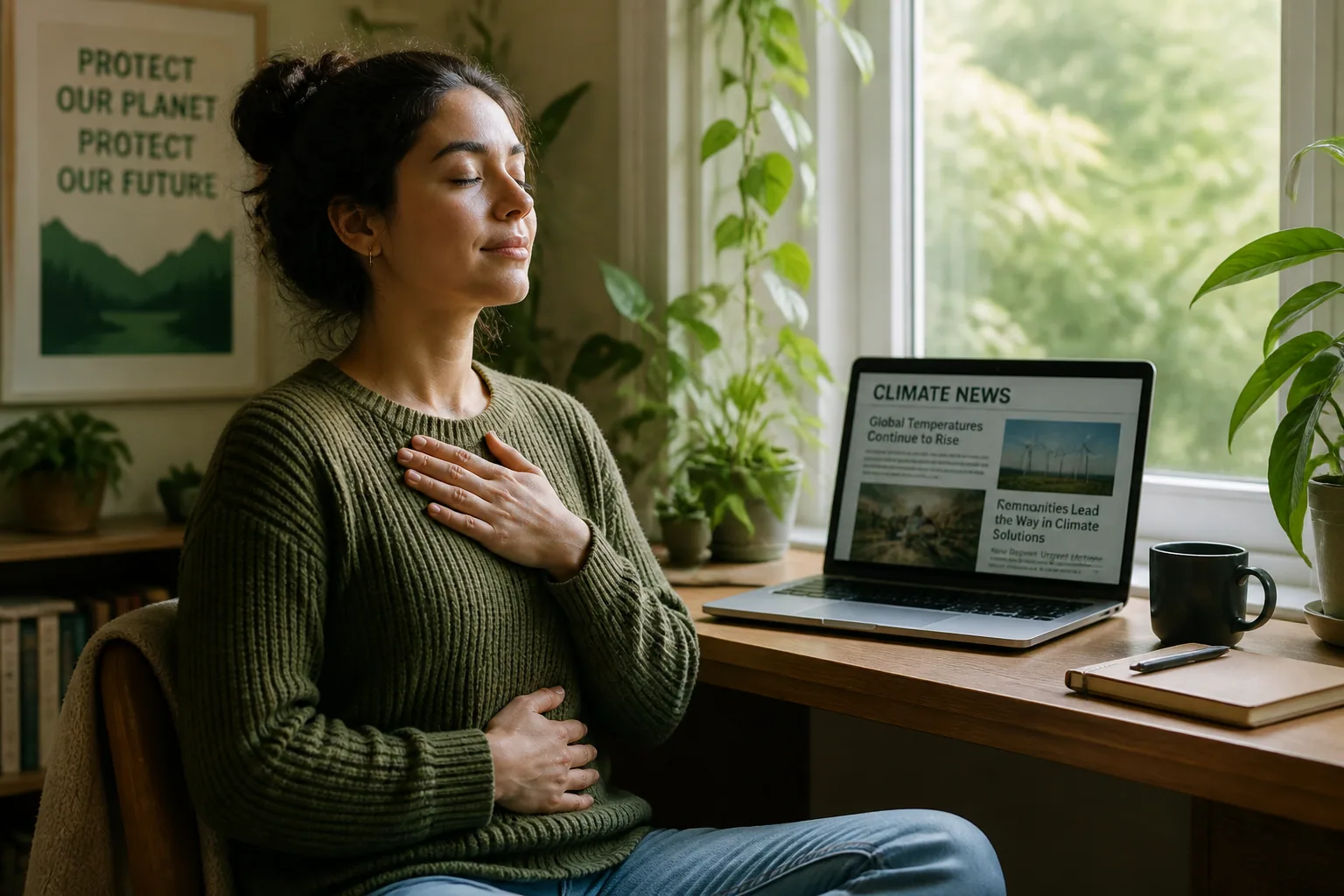
Breathwork for Eco-Anxiety: Techniques to Calm Your Nervous System When the World Feels Overwhelming
Eco-anxiety is not a sign that you are too sensitive or not resilient enough. It is a very human response to a very real set of threats: climate change, environmental disasters, biodiversity loss, and the constant stream of alarming information that makes it feel as if the future is always shifting under your feet. For many people, this shows up as racing thoughts, shallow breathing, irritability, insomnia, or a lingering sense of helplessness that is hard to explain to others.
The important thing to know is that your body is not making this up. Climate stress can activate the same survival systems that respond to immediate danger, and that is why a news alert, a wildfire update, or a long doomscroll session can leave you feeling physically shaken. Breathwork can help interrupt that cycle. It does not deny the problem, and it does not ask you to stop caring. Instead, it gives your nervous system a way to come back down so you can think clearly, feel more steady, and choose your next step with more intention.
What Is Eco-Anxiety and Why So Many People Feel It Now
Research is making it clear that climate anxiety is not rare. In a meta-analysis of 94 studies with more than 170,000 participants across 27 countries, climate change anxiety was found to be rising rapidly in recent years, negatively related to well-being, but positively related to taking climate action. The same analysis also found higher levels among women, younger people, those with left-leaning political views, and people exposed to frequent climate information. Source: https://www.sciencedirect.com/science/article/pii/S0959378025000524
A separate systematic review and meta-analysis of 69 papers and more than 65,000 people found the average level of eco-anxiety to be moderate, at about 34.8 on a 0-100 scale. Women scored higher than men, while age was not a statistically significant factor. That mix of findings matters because it reinforces something many people already feel in their own lives: eco-anxiety is widespread, and it tends to rise when people are paying attention to the state of the world. Source: https://pmc.ncbi.nlm.nih.gov/articles/PMC12609564/
In a national survey from the European Social Survey, 42.8% of respondents across 25 countries said they felt very worried or extremely worried about climate change. Worry levels varied by country, education, health status, and gender. In other words, this is not just an individual struggle. It is a broad social response to a shared reality. Source: https://pmc.ncbi.nlm.nih.gov/articles/PMC10595173/
How Climate Stress Affects the Nervous System
When anxiety kicks in, the sympathetic nervous system shifts the body into fight-or-flight mode. The hypothalamus releases adrenaline and cortisol, heart rate and blood pressure rise, breathing becomes faster and more shallow, digestion slows, muscles tense, and sleep gets disrupted. That is why climate fear often feels so physical, with racing thoughts, an unsettled stomach, tight chest, and that familiar inability to fully settle down. Source: https://health.clevelandclinic.org/what-happens-to-your-body-during-the-fight-or-flight-response
With ongoing stress, the body can stay stuck in a state of hyperactivation. Chronic fight-or-flight can weaken immune function, disturb sleep architecture, contribute to digestive issues, and create long-term strain on cardiovascular health. So when eco-anxiety becomes constant background noise, it is not only draining emotionally. It can also wear down the systems that help you recover. Source: https://www.healthline.com/health/anxiety/effects-on-body
One of the most common signs of anxiety-related activation is shallow breathing. In anxiety, shallow breathing can mean over-breathing, where you exhale carbon dioxide faster than your body produces it. That can lead to light-headedness, chest tightness, tingling, and a sense of breathlessness, which then makes the body even more alarmed. Source: https://www.calmclinic.com/anxiety/symptoms/shallow-breathing
This is why breathwork can be so helpful for eco-anxiety. It gives you direct access to one of the fastest ways to influence the autonomic nervous system. If the body is being told that everything is urgent, the breath can send a different message.
Why Breathwork Works for Anxiety and Overwhelm
Breathwork helps because breathing is one of the few body functions that is both automatic and voluntarily adjustable. That means you can use it to nudge your nervous system toward safety, even when your mind is still spinning. Slower, deeper, and more intentional breathing patterns can activate the parasympathetic nervous system, lower heart rate, reduce blood pressure, and create a felt sense of calm. Deep diaphragmatic breathing in particular has been shown to counter hyperventilation and support this shift. Source: https://www.simplypsychology.com/articles/anxiety-physical-symptoms-body
This is not about forcing relaxation. For many people, especially when emotions are already high, the goal is regulation rather than instant calm. Regulation means helping the body move out of alarm enough that you can stay present with what is happening, instead of spiraling into shutdown or panic.
Different breathing practices can help in different ways. Some improve heart rate variability, which is often associated with better emotional regulation. Some slow the breath enough to interrupt panic. Others work like a reset button after a stressful headline or conversation. The right technique depends on whether you need a quick interruption, a longer practice, or a more grounding routine before sleep. Source: https://www.nationalgeographic.com/health/article/health-benefits-of-breathing-exercises
The Best Breathwork Techniques for Eco-Anxiety
If your goal is to calm a stressed nervous system, a few techniques stand out. Extended exhales are simple and effective because a longer exhale tends to signal safety and help slow the heart rate. Diaphragmatic or belly breathing encourages the breath to move lower and fuller, rather than staying stuck high in the chest. Box breathing, with equal inhale, hold, exhale, and hold cycles, can be especially helpful when you need structure and focus. Coherent breathing, often around 5 to 6 breaths per minute, creates a smooth and steady rhythm that many people find deeply settling. Pursed-lip breathing can also help slow the out-breath and reduce the feeling of breathlessness. Source: https://www.nationalgeographic.com/health/article/health-benefits-of-breathing-exercises
For many people, the physiological sigh is one of the most practical tools. In a randomized controlled trial of 110 adults over one month, cyclic sighing, a double inhale through the nose followed by a long exhale through the mouth, produced larger improvements in mood and greater reductions in resting respiratory rate than mindfulness meditation and other breathing techniques. The same research showed that even 1 to 3 repetitions can reduce physiological arousal in about 30 seconds, even without prior breathwork practice. Source: https://www.simplypsychology.com/articles/physiological-sigh-breathwork
That matters for eco-anxiety because climate stress often arrives suddenly. You may not have time for a long meditation, but you may have 30 seconds after a distressing message, a wildfire update, or a doomscrolling spiral. In that window, the goal is not perfection. The goal is to soften the stress response enough to regain choice.
A 30-Second Reset After Distressing News
When climate news hits hard, try this short reset: inhale through the nose, then take a second short top-up inhale, then exhale slowly and fully through the mouth. Repeat this 1 to 3 times. Let the exhale be noticeably longer than the inhale. Keep your shoulders soft and your jaw unclenched. If it helps, place one hand on your chest and one on your belly to feel the breath more clearly.
You can do this before opening another app, before replying to a stressful message, or before trying to work after reading something upsetting. Think of it as a pause between stimulus and reaction. Even a brief reset can stop the nervous system from escalating into full fight-or-flight.
If you prefer a more structured version, try box breathing for one minute: inhale for 4, hold for 4, exhale for 4, hold for 4. Some people love the symmetry because it gives the mind something precise to follow. Others find holds too intense when already anxious. If that is you, choose an extended exhale or a gentle physiological sigh instead.
Longer Breathing Practices for Ongoing Climate Grief and Stress
Eco-anxiety is not always a sudden spike. Sometimes it is a chronic ache, the kind that shows up in the morning before you check the news and stays with you all day. For that kind of ongoing stress, a longer breathwork practice can help create a more stable baseline. Coherent breathing, for example, uses a smooth rhythm with no holds, often around 5 to 6 breaths per minute. Many people find that this kind of steady pacing supports a calmer state without making them feel trapped or overly controlled.
A simple practice is to breathe in for 5 seconds and out for 5 seconds for 5 minutes. If that feels too long, begin with 2 minutes. If you feel more settled with belly breathing, let the abdomen gently expand on the inhale and soften on the exhale. If your mind keeps drifting back to climate worries, that is normal. You are not failing at the practice. You are training the body to stay with a rhythm while the mind learns it does not need to keep sounding the alarm.
This kind of routine can be especially supportive before bed, when eco-anxiety often becomes louder in the quiet. A longer, slower exhale can help unwind the body after a day of carrying too much information. That is one reason breathing exercises are often used not just for stress relief, but for sleep support as well. Source: https://www.nationalgeographic.com/health/article/health-benefits-of-breathing-exercises
When to Use Breathwork and When to Take Action
One of the most important things to remember is that breathwork is not meant to replace action. In fact, the research on climate anxiety suggests something very important: higher climate anxiety is positively related to taking climate action. That means distress and action are not opposites. Sometimes worry is the signal that you care deeply enough to do something meaningful. Source: https://www.sciencedirect.com/science/article/pii/S0959378025000524
Use breathwork when your body is overwhelmed, when your thoughts are spiraling, when you need to sleep, or when you want to respond rather than react. Use action when your system has steadied enough to make a plan. That might mean donating, voting, calling a representative, changing a habit, volunteering, or joining a local effort. Breath can create the space that action needs.
If your fear is telling you that nothing you do matters, take that as a sign to regulate first. A dysregulated nervous system tends to think in extremes. Once you are calmer, you may be able to see a wider field of options.
Pairing Breathwork With Activism, Community, and Purpose
Eco-anxiety often becomes heavier in isolation. One of the strongest antidotes is connection. Community reminds the nervous system that you are not carrying the burden alone. Breathwork can be a bridge into that connection by helping you arrive more present, less flooded, and more available for shared purpose.
If you are involved in activism or community care, a short breathing practice before a meeting, rally, phone bank, or difficult conversation can help you show up with more steadiness. A few physiological sighs or a minute of coherent breathing can be enough to settle the body before engaging with hard topics. That way, the action itself becomes more sustainable.
Purpose also matters. People are often more resilient when they have a role to play, even a small one. Breathwork can help you pause long enough to remember what matters to you, and then move in that direction with less collapse and less reactivity.
Mindset Shifts That Help You Stay Engaged Without Burning Out
Eco-anxiety can feed a harsh internal script: I should be doing more, I am not enough, the problem is too big, or if I stop thinking about it, I am being irresponsible. These thoughts are common, but they are not always helpful. A more sustainable mindset is to aim for consistent engagement rather than constant alarm.
That might look like setting limits on how often you consume climate news, deciding when you will check updates, and balancing information with recovery. The same way your phone battery needs charging, your emotional system needs periods of restoration. Breathwork is one way to recharge without disconnecting from reality.
It can also help to remember that caring deeply does not require suffering continuously. You can be informed, compassionate, and active without living in a permanent state of activation. That distinction is essential if you want your concern to become endurance instead of burnout.
Breathwork should feel supportive, not punishing. If you are prone to panic, dizziness, trauma responses, or feeling air-hungry, start gently. Some techniques, especially breath holds or overly forceful breathing, can be activating for certain people. If a practice makes you feel worse, stop and return to natural breathing.
A safer starting point is usually the physiological sigh, a soft extended exhale, or quiet belly breathing with no holds. Keep the breath small, smooth, and unforced. You do not need to breathe deeply to breathe well. In fact, forcing big inhales can sometimes increase discomfort if you are already over-breathing.
If you notice tingling, chest tightness, light-headedness, or rising panic, that is your cue to slow down and simplify. Sit with both feet on the floor, look around the room, and let the exhale lengthen naturally. If you have a history of trauma or a respiratory condition, it may also be wise to consult a qualified clinician before starting a more intense practice.
Creating a Personal Eco-Anxiety Calm Plan
A good calm plan is simple enough to use on your worst day. Start with three layers. First, a fast reset for distressing news, such as 1 to 3 physiological sighs. Second, a daily practice, such as 5 minutes of coherent breathing or belly breathing. Third, a support plan that includes action, community, and rest so that breathwork is not carrying the whole burden alone.
You can make the plan more concrete by deciding when you will use each tool. For example: after checking the news, do a 30-second reset. Before sleep, do 5 minutes of slow breathing with a calming sound. Once a week, pair a breathing session with a small action, like writing a message to a local group or planning one concrete step you can take. If you want help staying consistent, a guided tool like Just Breathe: Relax Daily can make it easier to keep a rhythm, especially with options like Cardiac Coherence, Box Breathing, soothing ambient sounds, and gentle reminders: https://findthe.app/just-breathe-ujhm1e
The goal is not to eliminate eco-anxiety entirely. The goal is to create enough regulation that your concern becomes workable. Breathwork can help you stay present with the reality of the climate crisis without losing access to rest, clarity, and hope. And when the world feels overwhelming, that combination matters more than ever.