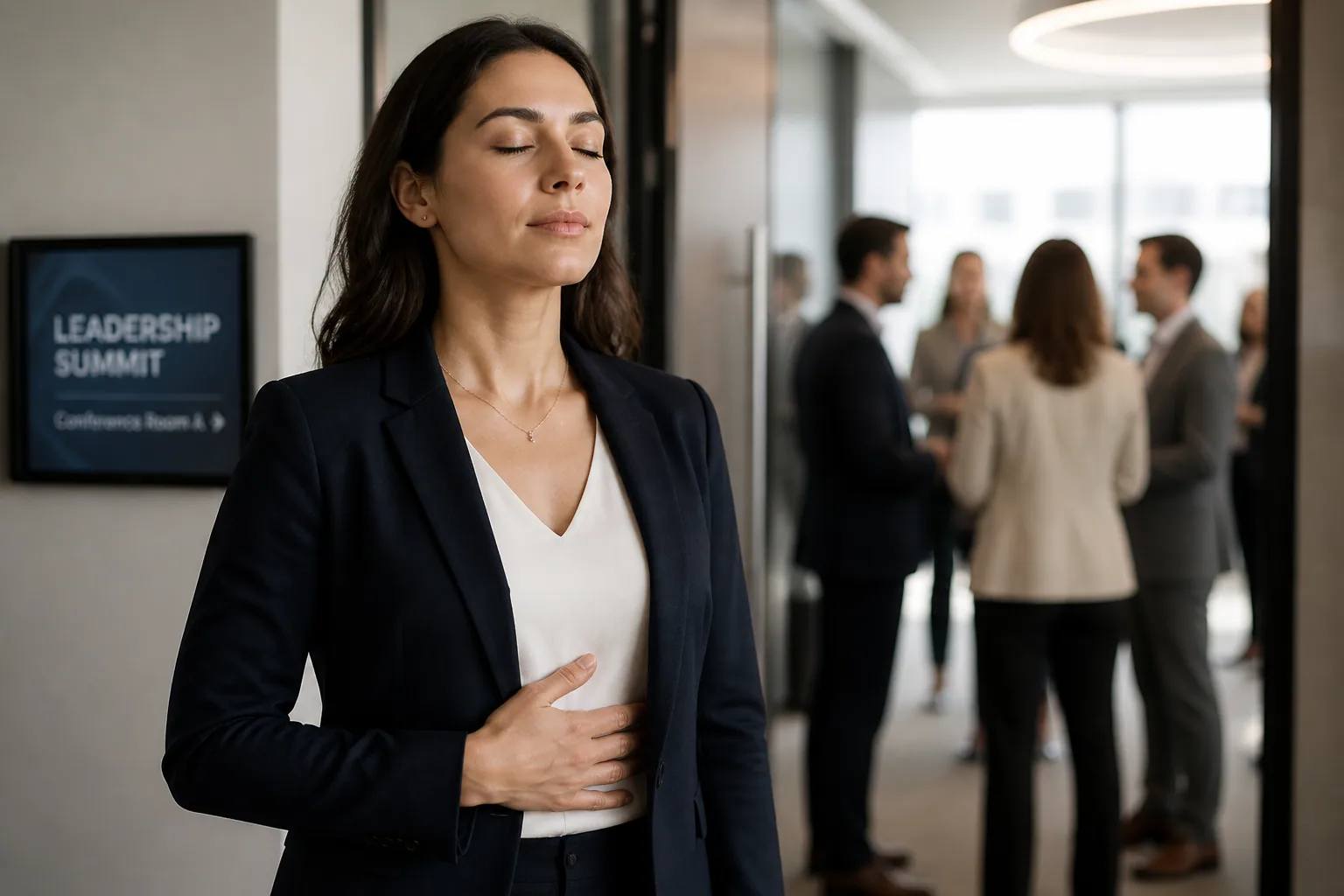
Breathwork for Social Confidence: How Controlled Breathing Can Tame Nervousness in Public Settings
Social nervousness often shows up in the body before it shows up in the mind. Your chest tightens, your jaw clenches, your breathing gets shallow, and suddenly a simple conversation can feel like a performance. The good news is that breathwork can help interrupt that stress loop in real time. By changing how you breathe, you can influence the autonomic nervous system, calm fight-or-flight activation, and create enough physical steadiness to think more clearly, speak more easily, and show up with more confidence.
This is not about forcing yourself to feel fearless. It is about giving your body a faster exit ramp from nervousness. With the right breathing patterns, you can lower tension before a meeting, settle your nerves before a date, or recover quickly when anxiety spikes in the middle of a social moment.
Why Social Anxiety Shows Up in the Body First
When you feel socially exposed, your body often reacts before your thoughts catch up. You may notice a racing heart, a dry mouth, rapid breathing, or a sense that you need to escape. That is your stress response doing its job, even if the situation is not truly dangerous. In public settings, the brain can interpret uncertainty, attention, or evaluation as a threat and activate the sympathetic nervous system, which is the fight-or-flight branch.
This is why social anxiety can feel so physical. It is not just worry. It is a full-body state. Breathing becomes shallow and fast, which can amplify the sensation of panic and make it harder to stay present. The shift you want is not to suppress the feeling, but to change the physiology enough that your mind can come back online.
The Science of Breathwork and the Fight-or-Flight Response
Controlled breathing can activate the parasympathetic nervous system, the rest-and-digest branch that helps slow heart rate and lower blood pressure. That directly counteracts the fight-or-flight response associated with anxiety. The American Heart Association has noted that careful breathing can support health by calming the body’s stress response and improving cardiovascular markers: https://www.heart.org/en/news/2023/07/07/its-not-just-inspiration-careful-breathing-can-help-your-health
Research also points to a key principle that matters for social confidence: relaxed or prolonged exhalation appears especially powerful. Breath-based practices that emphasize a longer out-breath engage vagal pathways, lowering heart rate and blood pressure while increasing parasympathetic tone relative to sympathetic activity. In other words, the exhale is one of the fastest ways to tell your nervous system that you are safe enough to settle: https://www.frontiersin.org/journals/psychiatry/articles/10.3389/fpsyt.2026.1774490/full
A broader review of breathwork trials found that 54 out of 72 breathing interventions were effective for stress and anxiety reduction. The more effective approaches tended to avoid fast-only breathing, include at least five minutes per session, and rely on repeated practice over time. That is useful because it tells us breathwork is not just a momentary trick. It is a skill that becomes more reliable with repetition: https://pubmed.ncbi.nlm.nih.gov/38137060/
How Exhale-Emphasized Breathing Quickly Lowers Physical Nervousness
If you need a fast reset before walking into a room, exhale-emphasized breathing is one of the most practical tools available. The goal is simple: make the out-breath longer than the in-breath. A longer exhale helps shift the body toward parasympathetic dominance, which is exactly what you want when your heart is pounding and your mind is over-forecasting worst-case scenarios.
A simple pattern is to inhale for four counts and exhale for six or eight counts. You do not need to force a giant breath. In fact, smaller and calmer is often better. The emphasis is on softness, control, and a slightly extended release. The Stanford study on cyclic sighing showed that just five minutes per day of an intentional long-exhale pattern could reduce overall anxiety, improve mood, and lower resting respiratory rate: https://med.stanford.edu/news/insights/2023/02/cyclic-sighing-can-help-breathe-away-anxiety
This makes exhale-emphasized breathing ideal right before a presentation, while waiting outside a restaurant for a first date, or sitting in the car before entering an event. It is discreet, quick, and effective because it addresses the bodily side of nervousness first.
Diaphragmatic Breathing for Grounded, Steady Presence
Diaphragmatic breathing, also called belly breathing, is useful when you want to feel more grounded rather than just less tense. Instead of breathing high into the chest, you let the breath move lower and fuller so the diaphragm does more of the work. This can reduce anxiety symptoms by shifting you away from shallow, chest-based breathing and toward slower, more complete lung usage. Healthline summarizes this well and notes that deep or rhythmic breathing, especially diaphragmatic breathing, can reduce anxiety: https://www.healthline.com/health/anxiety/anxiety-breathing
For social confidence, diaphragmatic breathing works well because it changes your posture and pace at the same time. When your abdomen gently expands on the inhale and softens on the exhale, your body tends to look and feel less guarded. That can make your internal state match the impression you want to give: calm, open, and collected.
A simple version is to place one hand on your chest and one on your belly. Breathe in so the belly hand rises more than the chest hand. Then exhale slowly and let the belly fall. If this feels awkward at first, that is normal. The point is not to perform perfect breathing, but to train your body to exit the shallow panic pattern that social stress creates.
Breath-Hold Drills: When and How to Use Them Safely
Breath-hold drills can help some people interrupt spiraling thoughts, but they should be used carefully and gently. The goal is not to create strain. A short, comfortable hold after an exhale can create a pause that helps you reset attention and reduce reactivity. For example, you might exhale fully, pause for two to four seconds, then breathe in again smoothly.
These drills are best used when you have a few moments alone, such as in a restroom before a meeting, in a parked car, or at home during practice. They are not the first choice if you feel lightheaded, panicky, or physically unwell. If holding the breath increases distress, skip it and return to steady exhale-focused breathing instead. The safest and most effective breathwork tends to be controlled, relaxed, and repeatable rather than extreme.
Think of breath holds as an optional refinement, not a main strategy. For many people, the most reliable social calming comes from slow breathing, a longer exhale, and a lower overall breathing rate.
What to Do Before a Meeting, Presentation, or First Date
The best time to use breathwork is before your nervous system is already fully activated. A short routine before a meeting, presentation, or date can keep anxiety from building into a bigger wave. You do not need a long session. Five minutes is enough to change your state if you use it consistently.
A useful sequence is to sit or stand comfortably, relax your shoulders, and do one to two minutes of diaphragmatic breathing. Then shift into a four-in, six-to-eight-out pattern for another two to three minutes. If you are especially keyed up, add a few cycles of a soft cyclical sigh, where you take a comfortable inhale, then a second small top-up inhale, followed by a long, slow exhale. That mirrors the type of long-exhale pattern associated with reduced anxiety in Stanford’s research.
Before social situations, it also helps to set one clear intention for the interaction. For example: I do not need to impress everyone, I only need to be present and engaged. Breathwork lowers the body’s alarm; intention gives your mind a direction.
How to Calm Yourself During an Anxiety Peak Without Drawing Attention
When anxiety spikes in the middle of a conversation, the goal is subtlety. You want to reduce the internal surge without making yourself more self-conscious. That is where quiet exhale lengthening works best. You can inhale normally through the nose and make the exhale slightly longer and softer than usual. No one around you will notice, but your body will.
If you feel the panic rise in a meeting, lower your shoulders, place both feet on the floor, and silently count a longer exhale. A pattern like inhale for three, exhale for five can be enough to shift the state of your nervous system. You can also use a mini grounding cue, such as noticing the texture of the chair or the sensation of your feet, while you breathe. The breath gives you regulation; the sensory cue gives you orientation.
The important thing is not to fight the feeling. Fight tends to intensify fight-or-flight. Instead, breathe as if you are making more room inside the moment. That slight change in attitude can keep a small spike from becoming a full spiral.
Pairing Breathwork With Mindset Reframes That Reduce Social Pressure
Breathwork works even better when you pair it with simple mindset reframes. If your inner script says, Everyone is judging me, your breathing may help, but the brain is still interpreting the room as a threat. A better reframe is, I am allowed to be a person in this room, not a performance.
Another useful shift is to replace outcome pressure with process focus. Instead of asking, Did I sound perfect? ask, Was I present? Did I listen? Did I stay steady enough to continue? This takes some of the emotional weight off the moment and makes your breathwork more effective because the body is no longer trying to prepare for a high-stakes judgment.
The research on prolonged exhalation is interesting here too. One recent experiment found that prolonged exhalation increases parasympathetic activity without increasing sympathetic activity and may enhance reward sensitivity in brain regions involved in decision-making and emotional regulation. That suggests slow breathing may not just calm you down, but may also make it easier to engage with social situations more flexibly and less defensively: https://www.sciencedirect.com/science/article/pii/S0896627326003399
A 5-Minute Daily Breath Ritual to Build Baseline Social Ease
The best social confidence strategy is not only what you do in the moment, but what you practice when nothing is at stake. A short daily breath ritual can lower your baseline tension and make social situations feel less loaded over time. Stanford’s cyclic sighing findings are useful here because they suggest a small daily dose can create meaningful change.
A simple five-minute ritual can look like this: one minute of settling into your posture, two minutes of diaphragmatic breathing, and two minutes of exhale-emphasized breathing. If you like structure, use a breathing app like Just Breathe: Relax Daily to guide the rhythm and keep the practice consistent. It offers guided patterns, gentle visual animations, ambient sounds, smart reminders, and progress tracking, which can make a daily breath habit easier to maintain: https://findthe.app/just-breathe-ujhm1e
Keep the ritual small enough that you will actually do it. The goal is not to create another chore. The goal is to teach your nervous system, every day, that calm breathing is familiar, safe, and available.
Common Breathwork Mistakes That Can Make Anxiety Feel Worse
One common mistake is breathing too fast. Fast-only breathing can reinforce the stress response instead of calming it, which is one reason effective interventions often avoid it. Another mistake is taking huge breaths that feel forced. Over-breathing can leave you lightheaded and more aware of your body, which may increase anxiety rather than reduce it.
A third mistake is expecting instant perfection. Breathwork is not a switch that makes social anxiety disappear forever. It is a regulation tool that works best with repetition. The systematic review of breathwork trials is helpful here because it suggests duration, guidance, and repeated practice matter. In other words, you build reliability by using the techniques regularly, not only in emergencies.
Finally, do not use breath holds or intense techniques if they make you feel worse. The most effective breathwork for social calm is usually the simplest: slower pace, relaxed exhale, controlled depth, and steady repetition.
How to Practice Consistently and Track Your Confidence Gains
Confidence grows when your body collects evidence that it can recover. That is why it helps to track not just whether you felt anxious, but how quickly you settled, how well you stayed present, and how often you used the tools instead of avoiding the situation. A brief note after practice can be enough: where you used the breathwork, which pattern you used, and how your body felt afterward.
Try to track a few simple markers over two to four weeks. Notice whether your heart rate settles faster before social events, whether your voice feels steadier, whether you recover more quickly from awkward moments, and whether you are less tempted to leave situations early. These are all signs that your nervous system is learning.
It can also help to practice in low-stakes settings first. Use the breathing pattern while making coffee, sitting at your desk, or taking a short walk. Then bring it into more challenging social moments. Confidence often comes from familiarity, and familiarity comes from repetition.
Final Takeaway: A Simple Breath Plan for Showing Up Calm and Confident
If social nervousness lives in the body first, then breathwork is one of the fastest ways to respond. A longer exhale can lower physical arousal, diaphragmatic breathing can ground you, and brief breath-hold pauses can be used carefully to interrupt a spiral. Together, these tools can help you enter meetings, presentations, dates, and everyday conversations with more steadiness.
The simplest plan is this: use diaphragmatic breathing to settle, use exhale-emphasized breathing to reduce nervousness, and practice for five minutes a day so your baseline calm improves over time. Then pair the breath with a kinder inner narrative. You do not need to be effortless. You only need to be regulated enough to be present.