Breathwork is commonly used as a broad term for intentional breathing practices. Pranayama is a discipline rooted in yoga, with its own philosophical context and purposes. Pranayama can fit under that broad English-language umbrella, but calling it breathwork alone leaves out part of what it means.
Breathwork and pranayama overlap, but are not interchangeable
If you want a short breathing break, either label might lead you to a suitable exercise. The difference is often the context: are you learning a breathing pattern as a standalone tool, or studying breath within yoga?
Contemporary usage varies. A yoga teacher might advertise “breathwork,” while a secular class might teach a pattern drawn from pranayama. Check the description rather than relying on the name.
| Point of comparison | Breathwork as a broad label | Pranayama |
|---|---|---|
| Origins | Covers practices from several traditions and contemporary approaches | Rooted in yoga |
| Purpose | Varies by method, including calm, focus, or exploration | Breath discipline within a broader yogic practice |
| Typical instruction | May emphasize timing, pace, and a specific goal | May include technique, attention, and traditional explanations |
| Practice context | Apps, workplaces, classes, or individual routines | Yoga study, classes, and personal practice |
The labels overlap; they are not exact synonyms. You can choose a simple exercise without treating every breathing tradition as the same thing.
What pranayama means within yoga
Pranayama has a place within yoga beyond physical postures. It involves deliberate regulation of breathing and is traditionally connected with attention and preparation for meditation. A review of pranayama research and its yogic context describes it as part of a broader yoga discipline, rather than an isolated relaxation technique.
Traditional explanations also refer to prana, often translated as life force or vital energy. Read that as a concept within yoga philosophy, not as another name for oxygen or a measured nervous system response. Traditional meaning and biomedical explanation are different kinds of explanation.
Alternate nostril breathing, often called Nadi Shodhana, is one recognizable example discussed in research on pranayama practices. It involves alternating the nostril used for breathing, but a technique name alone does not tell you the pace, duration, or level of instruction involved.
If you want to learn pranayama, look for a teacher who explains both the practice and its context. You do not need to begin with complicated techniques or force your breathing to make the practice count.
What people mean by breathwork today
“Breathwork” does not identify one standardized method. It can describe a gentle timed exercise, a yoga-derived practice, or a session with a very different pace and intention. Some approaches borrow from yoga; others are taught in secular settings without a yoga framework.
For a beginner-friendly timed break, you might encounter:
- Gentle paced breathing: following a comfortable, steady rhythm rather than changing pace from breath to breath.
- Equal breathing: giving the inhale and exhale the same duration, such as four seconds each.
These descriptions can overlap. The two-minute exercise below is both paced and equal breathing.
Neither category is uniformly calming, and pranayama is not always slow. For your short routine, choose instructions that explicitly say gentle, unforced, and no breath holds, rather than assuming the label guarantees that experience.
Choose by your goal, then check the actual instructions
For a straightforward timed break between tasks, secular guided breathing is a practical starting point. You can follow a count without needing to study yoga philosophy first.
For breathing within a broader yoga practice, choose pranayama instruction that includes context. Look for someone who explains how breath, attention, and meditation relate, rather than presenting a traditional name as a shortcut to a promised result.
If your main question is where meditation fits, our comparison of breathwork and meditation explains that related distinction.
Before choosing a class or recording, check:
- Pattern: What exactly will you do on each inhale and exhale?
- Pace: Can you follow it without pulling in extra air or rushing?
- Duration: Does it fit the time you actually have?
- Instruction: Are you told how to ease off or stop?
There is no universal winner. For comfort, those details matter more than the category name.
Try two minutes of gentle, equal breathing
Use this as a neutral paced-breathing exercise, not as a complete pranayama practice. Choose a moment when you can sit without needing to watch traffic, answer messages, or finish another task.
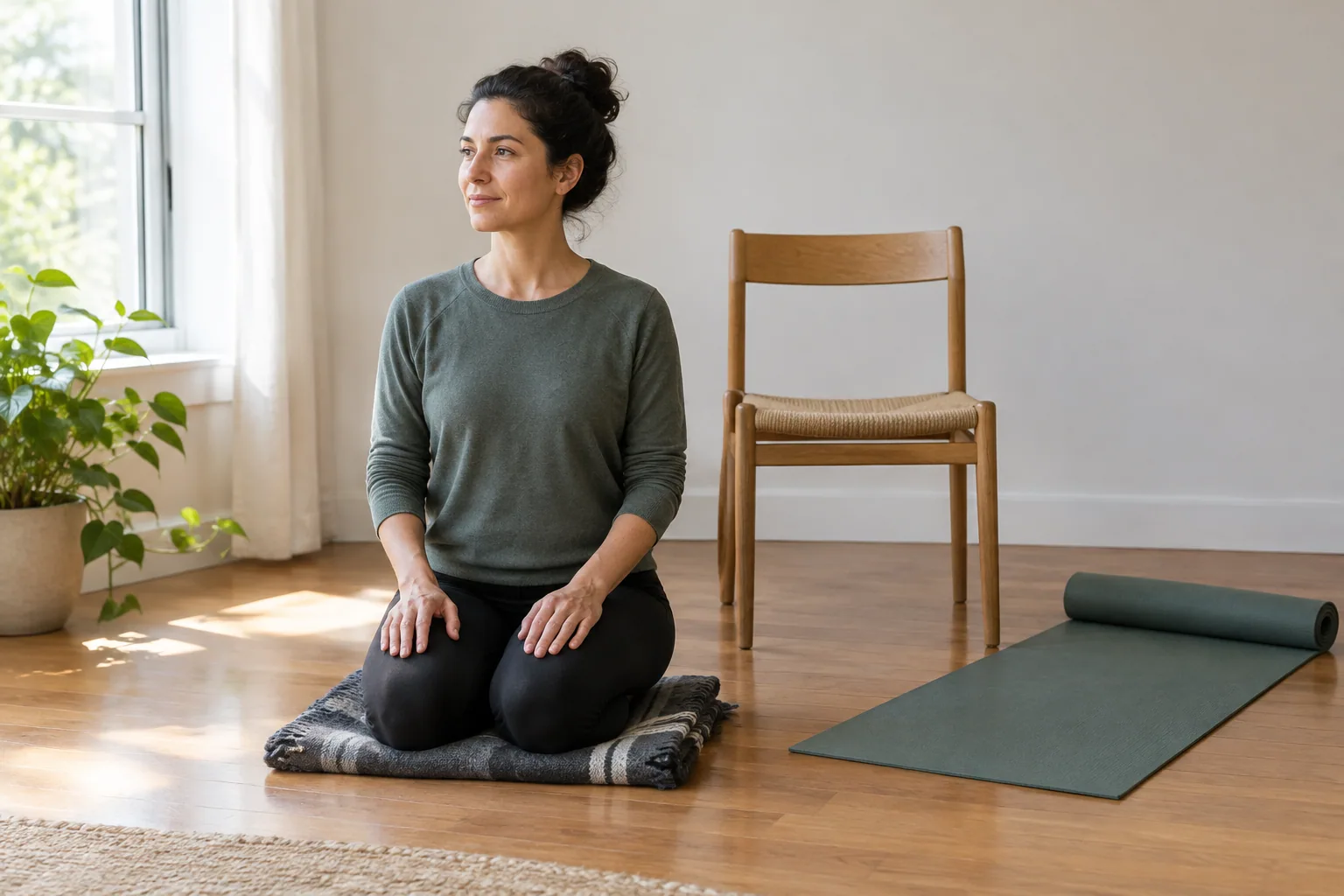
- Sit comfortably. Support your back if that helps, and let your shoulders settle.
- Inhale gently for four seconds. Keep the breath quiet and ordinary-sized, not maximally deep.
- Exhale gently for four seconds. Do not push the air out. Move into the next inhale without a deliberate hold.
- Repeat for 15 cycles. Each cycle takes eight seconds, so 15 cycles equals two minutes.
- Return to normal breathing. Notice whether the rhythm felt comfortable before deciding to repeat it another day.
If the count feels strained, return to normal breathing. Stop if you feel dizzy.
A common mistake is taking a huge breath to fill the entire four seconds. Instead, use less effort; if the timing still feels uncomfortable, leave the count behind. Completing the timer is not the goal.
To avoid counting every second yourself, use this guide to set up a custom four-second inhale and four-second exhale pattern, with both holds set to zero.
You may encounter a similar rhythm in yoga instruction. Sharing one breathing pattern does not make breathwork and pranayama identical, just as sharing an exercise does not make two learning traditions interchangeable.
Choose guidance that explains more than the label
Before following a teacher, video, or app, use this short checklist:
- The instructions state clear counts and duration.
- You have permission to return to normal breathing or stop.
- The teacher explains their relevant training and background.
- The description acknowledges a practice’s origins accurately.
- The guidance does not promise the same experience for everyone.
For yoga-based learning, seek qualified instruction that includes context as well as technique. Our guide to honoring the lineage of breathing traditions offers further reading on respectful acknowledgment.
For repeating the gentle exercise above, Just Breathe offers custom breathing patterns and visual guides, so you can follow the rhythm rather than count each second. A daily reminder can help you attach those two minutes to an existing cue, such as closing your laptop after work. Treat that as support for a timed routine, not a substitute for pranayama instruction.
FAQ
Are breathing exercises always yoga?
No. Breathing exercises can be taught as standalone practices in secular settings, while pranayama belongs to yoga. To understand what you are learning, check the technique’s origin, purpose, and teaching context rather than its name alone.
Do you need to practice yoga postures to learn pranayama?
No, you do not need to perform a sequence of yoga postures before beginning to learn pranayama. You can seek instruction focused on breathing while still learning its place within yoga. If that is your goal, ask a prospective teacher: “Do you offer beginner breathing instruction without holds, and do you explain its yogic context?”