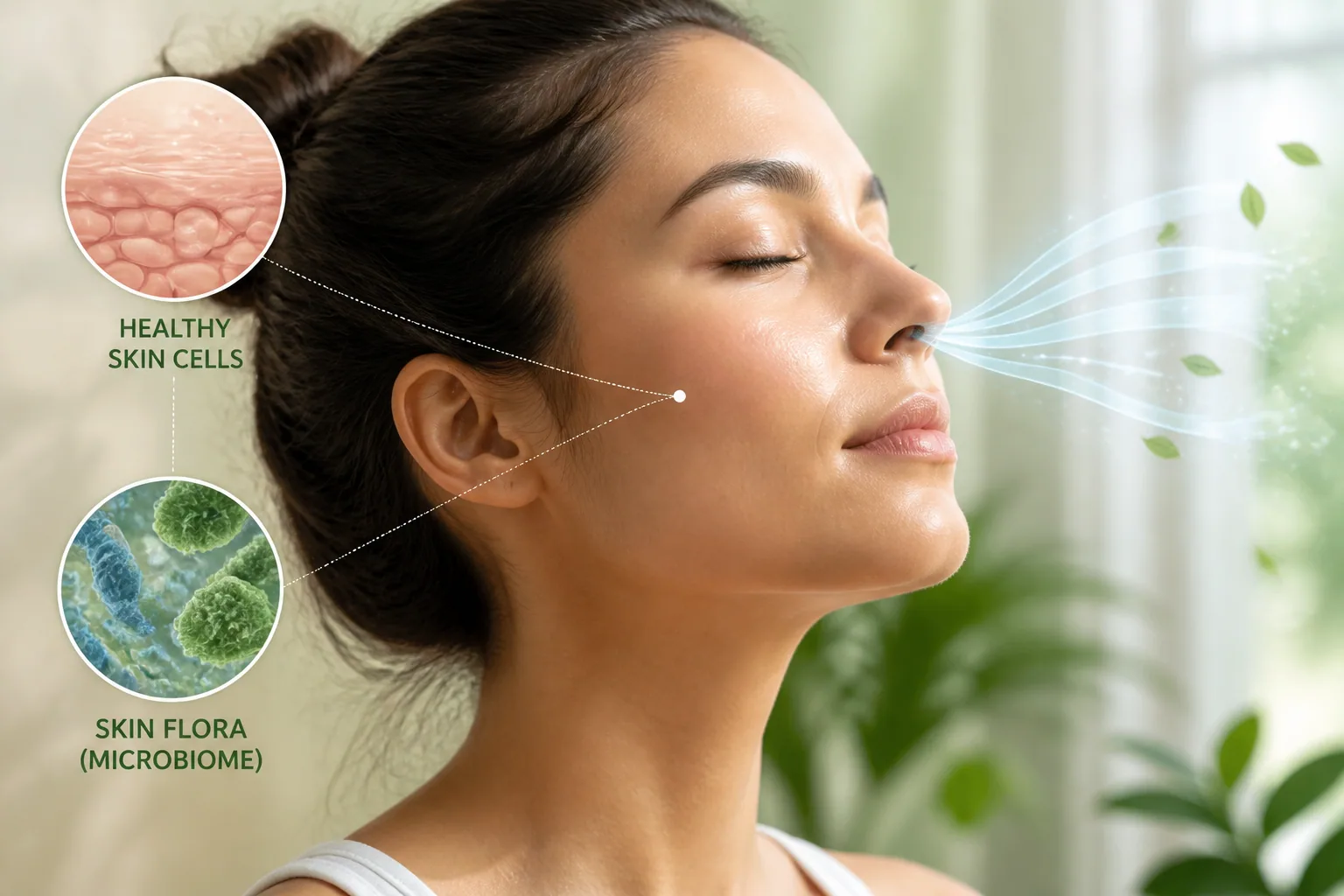
Can Your Exhale Change Your Skin? Breathwork, the Skin Microbiome & Barrier Health
It sounds almost too simple to be true, but the way you breathe may matter more for your skin than most people realize. Not because breathing is a replacement for skincare, but because breathwork sits upstream of several systems that shape skin behavior: stress hormones, inflammation, autonomic tone, and the condition of your skin barrier. If those systems are calmer, your skin is often living in a friendlier environment too.
That is the big idea behind this conversation. We are not claiming that one breathing exercise will erase acne, cure eczema, or permanently fix rosacea. The science is not there yet. But there is enough emerging evidence, plus a strong biological rationale, to ask a fair question: can specific breathing patterns help create the internal conditions that support healthier skin?
Why Skin Health Might Start With the Way You Breathe
Most people think of skin health as something that starts on the surface. Cleanser, moisturizer, sunscreen, actives, maybe diet and sleep. Those things matter. But the skin is not isolated from the rest of the body. It responds to nervous system signals, hormonal shifts, immune activity, and stress load.
When you are stressed, your body does not just feel tense. It enters a coordinated physiological state involving the hypothalamic-pituitary-adrenal, or HPA, axis and the sympathetic nervous system. That state can affect how much cortisol you produce, how reactive your immune system becomes, and how well your skin barrier holds onto water and lipids. In other words, stress biology can show up on your face and body.
Breathing is one of the rare tools that can directly and repeatedly influence the autonomic nervous system. It is not magic. It is physiology. Slow, paced, or longer-exhale breathing can shift the balance toward parasympathetic activity, improve heart rate variability, and potentially reduce the stress signaling that makes skin more reactive over time.
What the Skin Microbiome Actually Does for Your Face and Body
The skin microbiome is the community of bacteria, fungi, and other microorganisms that live on your skin. That may sound like a problem, but in healthy skin, many of these microbes are partners, not enemies. They help maintain balance, occupy ecological space so harmful organisms have less room to overgrow, and interact with your skin’s immune system.
Different areas of the body host different microbial communities. Oily zones, dry areas, folds, and exposed surfaces all create different environments. Your skin pH, moisture level, sebum production, barrier integrity, hygiene habits, and inflammation all influence which microbes thrive.
The microbiome matters because skin health is partly an ecosystem problem. If the barrier is impaired and inflammation rises, the microbial environment can shift. If the microbial environment shifts, irritation and immune responses can worsen. It is a feedback loop, not a one-way street.
That is why anything that supports barrier function and lowers unnecessary stress signaling could theoretically help maintain a more stable skin microbiome. Breathwork does not directly sterilize or repopulate the skin, but it may influence the conditions in which that ecosystem functions.
Stress, Cortisol, and Sympathetic Tone: The Skin-Brain Connection
The skin and brain are much more connected than most people were taught. When stress rises, the HPA axis drives cortisol production. Cortisol is useful in the short term, but chronic elevation can be disruptive. A meta-analysis of 21 studies found that psychological stress increases HPA axis activation and systemic glucocorticoid production, which then reduces epidermal lipids and structural proteins, lowers stratum corneum hydration, and increases transepidermal water loss, or TEWL, all signs of a weaker barrier. Source: https://pubmed.ncbi.nlm.nih.gov/30614527/
There is also evidence that stress increases local cortisol activity in skin itself. Under psychological stress, the enzyme 11β-hydroxysteroid dehydrogenase type 1, or 11β-HSD1, rises in skin and oral mucosa. That increase boosts local active cortisol and correlates with increased TEWL, impaired stratum corneum integrity, and slower barrier recovery. Source: https://pmc.ncbi.nlm.nih.gov/articles/PMC5910426/
This matters because your skin barrier is not just a cosmetic feature. It is a functional shield. When it is compromised, skin can become drier, more sensitive, more inflamed, and more reactive to products, weather, friction, and microbes. Stress can also make skin aging signals more visible. A clinical exploratory study found that people with moderate chronic stress showed about 32.9% greater severity of skin aging signs, lower antioxidant capacity, and measurable barrier impairment compared with those under mild stress. Source: https://pubmed.ncbi.nlm.nih.gov/39506493/
So where does breathing fit in? Breathwork may help shift the body away from the constant alert state that keeps the HPA axis and sympathetic nervous system revved up. That does not mean it will solve every skin problem. But it could be one way to reduce the internal pressure that keeps the skin barrier under strain.
What New Research Says About Resonance Breathing and Skin Nerve Activity
One of the most interesting recent findings is that breathing can affect skin sympathetic nerve activity itself. In a randomized crossover trial with 27 healthy adults, a single 15-minute session of resonance breathing significantly reduced skin sympathetic nerve activity after the session and increased heart rate variability measures such as RMSSD and RR interval. Those findings suggest a shift toward better autonomic balance. Source: https://pubmed.ncbi.nlm.nih.gov/40304861/
That is important because sympathetic activity is part of the body’s stress response. If skin sympathetic drive is elevated, it may contribute to a more reactive physiological state. Lowering that tone, even briefly, could matter for skin environments that are already prone to inflammation or sensitivity.
A separate literature review on heart rate variability and slow-paced breathing found that breathing near the resonant frequency, around 0.1 Hz or roughly 5 to 6 breaths per minute, enhances cardiac oscillations, boosts vagal activity, improves baroreflex sensitivity, and may reduce inflammation. Source: https://doi.org/10.1016/J.NEUBIOREV.2022.104576
Another breathing study comparing resonance frequency breathing to slightly faster or slower rhythms found that resonance breathing produced higher HRV, improved mood, and reduced blood pressure reactivity in response to stress. Source: https://www.frontiersin.org/journals/public-health/articles/10.3389/fpubh.2017.00222/full
Put simply, the current research suggests that breathing patterns can measurably change autonomic function. Since autonomic function and stress biology influence skin barrier health, inflammation, and possibly the skin ecosystem, it is reasonable to explore breathwork as a supportive skin habit.
How Specific Breathing Patterns Could Influence the Skin Microbiome
This is where the science becomes more inferential. We do not yet have strong evidence that breathing patterns directly reshape the skin microbiome in a predictable way. But we do know several things that make the idea biologically plausible.
First, stress can change sweat composition, sebum output, immune signaling, and barrier recovery, all of which affect microbial habitats on the skin. Second, skin microbes respond to moisture, lipids, pH, and inflammation. Third, breathwork can reduce sympathetic arousal and potentially reduce cortisol-related disruption. If stress declines, the skin environment may become less volatile.
Think of it like this: breathwork probably does not act on the microbiome like a probiotic cream. Instead, it may influence the weather in which the microbiome lives. When the internal climate is calmer, the skin surface may be less likely to swing toward dryness, redness, overproduction, or irritation.
That is especially relevant for people whose skin seems to flare when life gets hectic. If stress triggers breakouts, itching, flushing, or sensitivity, then downshifting the stress response may indirectly benefit the microbial and barrier environment that sits underneath those symptoms.
Longer Exhales, Nasal Breathing, and Diaphragmatic Breathing Explained
Not all breathing is the same. The style of breathing matters because it changes which nerves and reflexes are activated.
Longer exhales are often the simplest starting point. When the exhale is longer than the inhale, the body tends to shift toward parasympathetic dominance. That can be calming, especially when practiced gently and consistently. It is one reason many relaxation techniques emphasize breathing out slowly rather than forcefully.
Nasal breathing can also matter. Breathing through the nose helps filter, warm, and humidify air, and it encourages a slower, more controlled rhythm. For some people, nasal breathing is easier to sustain without overbreathing or feeling lightheaded. It also pairs well with relaxation practices because it naturally slows the breath.
Diaphragmatic breathing, sometimes called belly breathing, encourages the diaphragm to move more efficiently so the breath becomes deeper and less chest-dominant. That can reduce the feeling of effort and help prevent the quick, shallow pattern that often appears during stress. In practical terms, it can make breathwork more comfortable and more sustainable.
If you want the shortest version of the physiology, it is this: slower, smoother, more controlled breathing tends to support vagal activity, reduce sympathetic overdrive, and improve HRV. That is the internal shift that may be helpful for skin.
Could Breathwork Help Acne, Eczema, Rosacea, or Sensitive Skin?
Potentially, but only as a support strategy, not a stand-alone treatment. Different skin conditions have different drivers, and breathwork would probably help through shared pathways such as stress reduction, inflammation modulation, and barrier support.
For acne, stress can worsen flare frequency and make the skin more reactive. If a breathing routine helps lower tension and cortisol output, it may indirectly reduce one trigger in the acne loop. That said, acne still depends on oil production, follicular plugging, bacteria, inflammation, and hormones, so you still need a real skincare plan.
For eczema, the barrier connection is especially relevant. Eczema-prone skin often struggles with moisture loss and immune reactivity. If stress contributes to barrier breakdown and scratching behavior, breathwork may help by reducing arousal and supporting better self-regulation during flare-prone moments. But it is not a substitute for emollients, trigger management, or medical treatment when needed.
For rosacea, stress and flushing often go hand in hand. Breathwork may be helpful because it can lower the body’s baseline alarm state and reduce the intensity of stress-related flushing episodes. Again, this does not replace sunscreen, trigger avoidance, or dermatologist-guided care.
For sensitive skin in general, calmer autonomic tone may mean less overreaction to products, friction, weather changes, or sleep deprivation. The skin may still be sensitive, but its response threshold could improve if the nervous system is less keyed up.
A Practical Breathwork Routine for Supporting Epidermal Health
If you want to use breathwork as part of a skin-supportive routine, consistency matters more than intensity. You do not need a dramatic session. You need a repeatable one.
A simple approach is to practice 5 to 10 minutes once or twice a day. Use a slow rhythm, ideally around 5 to 6 breaths per minute if it feels comfortable. That pace is close to resonance breathing and aligns with the research showing favorable effects on HRV and autonomic balance.
Here is an easy structure: inhale gently through the nose for about 4 to 5 seconds, exhale for about 5 to 6 seconds, and keep the breath smooth. If that feels too long, shorten it. The goal is calm, not strain. If you become dizzy, breathless, or tense, return to a normal resting breath.
A useful time to practice is before your skincare routine, after work, or before bed. That way, the practice becomes linked to a skin-friendly cue. You can also use it during moments when you notice your skin is flaring from stress, heat, or emotional tension.
If you want help staying consistent, a guided tool like Just Breathe: Relax Daily can make the routine easier to stick with. It offers guided breathing patterns, visual animations, ambient sounds, and reminders, which can be useful if you are building a daily calming ritual. https://findthe.app/just-breathe-ujhm1e
What Breathwork Can’t Do on Its Own
It is important to be honest here. Breathwork is promising, but it is not a cure-all. It cannot cleanse clogged pores, replace prescription treatment, rebuild a severely damaged barrier overnight, or eliminate the microbiome shifts that come from antibiotics, overcleansing, or active disease.
It also will not override major factors like genetics, hormones, chronic illness, diet in some cases, harsh weather, or inappropriate products. If a skin condition needs medical care, breathwork should be considered a complement, not the main intervention.
In other words, breathwork can help set the stage, but it cannot act the whole play. A calmer nervous system may make your skincare routine work better, but it does not remove the need for the routine.
How to Pair Breathwork With Skincare, Hygiene, and Lifestyle Support
The best version of this approach is integrated, not mystical. Think of breathwork as one piece of a skin-supportive system.
Pair it with gentle cleansing so you do not strip the barrier. Use moisturizers and barrier-supportive ingredients to reduce TEWL and replenish lipids. Protect skin from sun and environmental stress. Keep acne or eczema routines consistent if you already have one.
Then add the lifestyle layer. Sleep matters because poor sleep raises stress load. Movement helps regulate autonomic balance. Hydration supports general skin function. Lowering alcohol excess, nicotine exposure, and chronic overload can also help reduce the physiological noise that keeps skin irritated.
The real advantage of breathwork is that it is accessible. It costs almost nothing, can be done anywhere, and does not conflict with most skincare routines. That makes it a practical habit for people who want a low-friction way to support skin health from the inside out.
The Biggest Research Gaps and What We Still Don’t Know
This is still an emerging area, and the gaps are large. We have promising data showing that breathing affects HRV, vagal tone, blood pressure reactivity, and skin sympathetic nerve activity. We also have strong evidence that stress harms barrier function and increases cortisol-related disruption. What we do not yet have is a long-term clinical picture showing that breathwork reliably improves skin outcomes across different conditions.
We need more studies on whether slow breathing changes the skin microbiome directly, how long any effects last, whether certain skin types benefit more than others, and whether benefits are stronger in people with high stress to begin with. It would also be helpful to know whether resonance breathing produces measurable changes in TEWL, hydration, redness, flares, itch, or lesion counts over time.
So for now, the best position is cautious optimism. The biology makes sense, the early data are encouraging, and the practice is low risk for most people. But it should be framed as supportive care, not proven dermatologic therapy.
Final Takeaway: Your Exhale as Part of a Smarter Skincare Ritual
Your exhale probably will not be the single factor that transforms your skin. But it may be one of the most underrated tools for reducing the stress signals that quietly undermine barrier health, increase inflammation, and make skin more reactive over time.
That is what makes breathwork interesting in a skincare context. It connects the nervous system to the skin in a way that is both practical and biologically plausible. If you breathe more slowly, more intentionally, and more consistently, you may help create an internal environment that is kinder to your microbiome, your barrier, and your visible skin health.
So yes, your exhale may matter. Not as a miracle, but as part of a smarter ritual. When paired with good skincare, good hygiene, and medical care when needed, it can become a simple habit that supports the skin from the inside out.