Controlling Your Breath to Control Your Blood Pressure: How Breathwork Supports Heart Health
If you live with hypertension, pre-hypertension, or a family history of heart disease, breathing may not be the first tool you think of for blood pressure support. But it should be on the list. Targeted breathwork does not replace medication, nutrition, exercise, or medical care, yet it can be a practical way to support healthier cardiovascular function and reduce the strain of chronic stress on the body.
The reason is simple: breathing is one of the few automatic functions you can also control on purpose. When you slow it down and make it more deliberate, you can influence the autonomic nervous system, increase vagal activity, improve baroreflex function, and reduce the stress-driven signals that often push blood pressure higher. Over time, that can matter more than people expect.
Why Breathing Matters for Blood Pressure
Blood pressure is not only about salt, weight, or genetics. It is also shaped by the nervous system in real time. When you are stressed, rushed, anxious, or overstimulated, the body tends to shift into a sympathetic state, which raises heart rate, tightens blood vessels, and makes circulation work harder. Slow, controlled breathing can interrupt that pattern and encourage the opposite response.
This is why breathwork is often described as a bridge between the mind and the heart. It gives you a way to apply direct influence to a system that is usually running in the background. Breathing more slowly and evenly can help reduce physiological arousal, and that may support better pressure control throughout the day, especially when practiced consistently.
How the Autonomic Nervous System Connects Breath and Heart Health
The autonomic nervous system has two main branches. The sympathetic branch prepares the body for action, while the parasympathetic branch supports recovery, digestion, and calm. Blood pressure tends to rise when sympathetic activity dominates and fall when parasympathetic tone improves.
Slow breathing appears to support this balance in several ways. It can increase vagal tone, improve heart rate variability, and enhance baroreflex sensitivity, which is the body’s ability to detect and correct changes in blood pressure. Research also suggests that slow breathing may stimulate cardiopulmonary stretch receptors and reduce sympathetic nervous system activity, creating a more stable cardiovascular state.
A 2018 study in essential hypertensive participants found that slow breathing at 8 breaths per minute increased heart rate variability, shifted sympatho-vagal balance toward vagal activity, and improved baroreflex sensitivity significantly, from about 59.5 to 78.9 ms/mm Hg during slow breathing. That is a strong signal that the breathing pattern itself can meaningfully affect the control systems that regulate pressure. Source: https://pubmed.ncbi.nlm.nih.gov/29718876/
What Recent Research Says About Breathwork and Hypertension
The evidence base has grown steadily, and while not every study is the same, the pattern is encouraging. In a study of 20 patients with essential hypertension, controlled slow breathing at around 6 breaths per minute lowered average systolic pressure from about 149.7 to 141.1 mm Hg and diastolic pressure from about 82.7 to 77.8 mm Hg. The improvement was accompanied by better arterial baroreflex sensitivity. Source: https://pubmed.ncbi.nlm.nih.gov/16129818/
A newer randomized meta-analysis of 13 randomized controlled trials, involving roughly 1,097 hypertensive patients, found that voluntary slow breathing reduced systolic blood pressure by an average of about 7.68 mm Hg and diastolic blood pressure by about 4.02 mm Hg. It also reduced heart rate and the LF/HF ratio, which is often used as a measure of autonomic balance. Source: https://pmc.ncbi.nlm.nih.gov/articles/PMC13093598/
Not every breathwork intervention produces the same result, and that matters. A 2025 Vanderbilt University study on yoga-based slow breathing found modest average blood pressure reductions overall, about 2.4/1.6 mm Hg, but participants who began with elevated blood pressure saw larger drops, around 10.3/3.8 mm Hg. That suggests breathwork may be especially useful when baseline pressure is already trending high. Source: https://pmc.ncbi.nlm.nih.gov/articles/PMC12464420/
There is also evidence that slow-paced breathing can create immediate improvements in nonclinical populations. A 2024 meta-analysis of 1,133 people found significant reductions in systolic blood pressure, along with increases in HRV measures such as RMSSD and SDNN. Source: https://link.springer.com/article/10.1007/s12671-023-02294-2
Taken together, the research suggests a realistic conclusion: breathwork is not a cure, but it is a legitimate supportive practice with measurable effects on the systems that regulate blood pressure.
If you are new to breathwork, start with diaphragmatic breathing. The goal is to breathe low and slow, allowing the belly to expand gently on the inhale instead of lifting the chest aggressively. This encourages a fuller, calmer breath and often reduces the sense of strain that comes with shallow breathing.
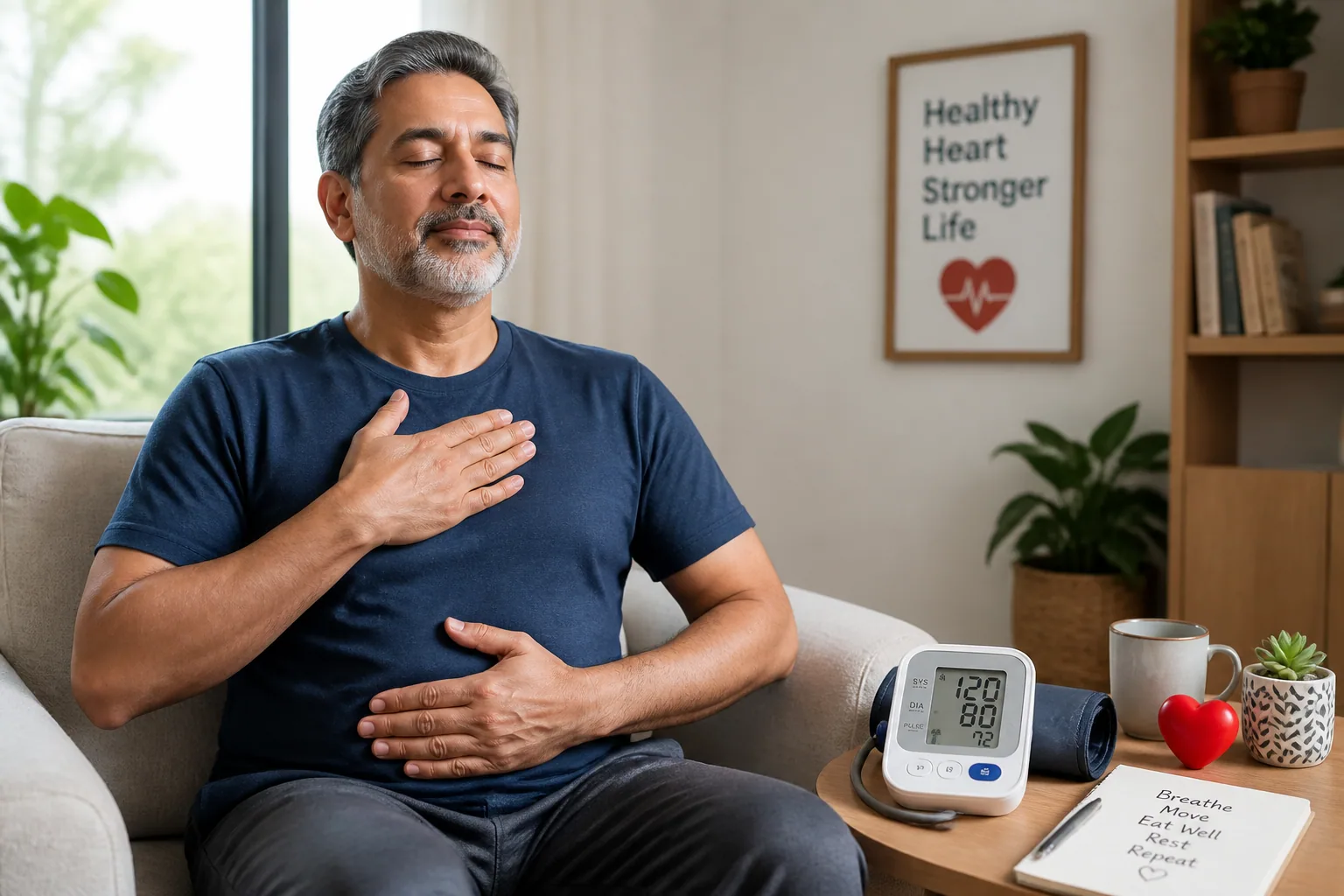
Here is a simple version to try. Sit or lie down comfortably. Place one hand on your chest and one on your belly. Inhale through the nose for about 4 to 5 seconds, letting the belly rise first. Exhale gently for 4 to 5 seconds, allowing the belly to soften. Keep the shoulders relaxed and the jaw unclenched. Repeat for 5 minutes to begin with.
What matters most is not perfect technique, but consistency and ease. If your breath feels forced or tense, slow it down less or shorten the session. The practice should feel steady and sustainable, not like a performance.
An extended exhale is one of the easiest ways to activate a calmer physiological state. By making the out-breath slightly longer than the in-breath, you emphasize parasympathetic influence and signal to the body that it can downshift.
A simple ratio is inhale for 4 seconds and exhale for 6 seconds. Another option is 3 in and 5 out, especially if you are just starting. The longer exhale should feel smooth rather than forced. You do not need to empty the lungs completely. Instead, aim for a gentle, continuous release of air.
This approach is especially helpful during stressful moments, before checking blood pressure, or as part of a wind-down routine in the evening. While it may not create dramatic changes after one session, it can reduce short-term stress reactivity, which is an important part of heart-health management.
Resonance-frequency breathing refers to a breathing rate that tends to optimize the natural coupling between breathing, heart rate, and blood pressure regulation. For many people, this falls around 5 to 6 breaths per minute, though the exact best rate can vary from person to person.
Why timing matters is that the cardiovascular system has rhythms of its own. When breathing is paced in a way that resonates with those rhythms, the result may be a stronger baroreflex response and improved autonomic balance. This is one reason slow breathing can have measurable effects beyond general relaxation.
In practical terms, resonance breathing often feels slower than most people expect. It may take a few sessions to adjust. A comfortable place to start is inhaling for 5 seconds and exhaling for 5 seconds, then experimenting with a slightly longer exhale if needed. If you feel dizzy or uncomfortable, reduce the depth of the breath or increase the speed slightly.
Device-guided breathing tools can be helpful, especially if you struggle to keep a rhythm on your own. Some systems use visual cues, music, or app-based feedback to help you maintain a slower pace and stay consistent. In one study of mild hypertensive participants, device-guided slow breathing acutely reduced systolic blood pressure by about 6 mm Hg and diastolic pressure by about 4 mm Hg, while also lowering muscle sympathetic nerve activity. Source: https://www.nature.com/articles/hr201074
That said, the full picture is mixed. A 2020 systematic review and meta-analysis of 22 randomized controlled trials found that device-guided slow breathing did not significantly lower blood pressure compared with usual care, with high heterogeneity among studies. Source: https://pmc.ncbi.nlm.nih.gov/articles/PMC9110782/
So what should you conclude? Device-guided breathing may help some people stick with the practice, and for some it may improve short-term readings, but it is not guaranteed to produce large long-term reductions by itself. The best tool is often the one you will actually use every day.
If you prefer guided sessions, a tool like Just Breathe: Relax Daily can make the routine easier to follow with structured breathing patterns, visual guidance, ambient sounds, and reminders. You can explore it here: https://findthe.app/just-breathe-ujhm1e
A beginner routine should be simple enough to repeat without overthinking. Here is one approach you can use at home, at work, or before bed.
Step 1: Sit upright or lie down in a comfortable position. Uncross your legs if possible and relax your shoulders.
Step 2: Breathe in through the nose gently for 4 seconds. Let the breath feel soft and unforced.
Step 3: Exhale for 6 seconds. If this feels too long, begin with 4 in and 5 out.
Step 4: Continue for 5 minutes. Focus on the smoothness of the breath instead of trying to breathe deeply.
Step 5: Notice how your body feels afterward. Some people feel calmer, warmer, or more grounded. That feedback helps reinforce the habit.
Once that becomes easy, you can increase to 10 or 15 minutes a day, or add a second short session later in the afternoon.
For meaningful benefits, occasional breathing is usually not enough. Breathwork works best as a regular practice, because it trains the nervous system over time rather than only producing a brief relaxation effect.
A practical target is 5 to 10 minutes once or twice daily. Many people do well with one session in the morning and one in the evening, or a single longer session before bed. If you are very busy, even a few minutes daily is better than nothing, especially if you can keep it consistent.
The most important factor is adherence. Studies may show improvements after weeks of practice, but the benefit depends on repetition. Try pairing breathwork with an existing habit, such as after brushing your teeth, before taking medication, or right after sitting down with your morning coffee.
Breathwork is generally safe for most people, but it is not appropriate to push through dizziness, breathlessness, chest pain, or panic. If a technique makes you feel worse, stop and return to normal breathing.
If you take blood pressure medication, do not change your dosage on your own because you have started breathing exercises. Breathwork may support blood pressure control, but it does not replace prescribed treatment. If you notice lower readings over time, discuss them with your clinician before making changes.
You should also talk to your doctor before starting if you have a history of fainting, serious arrhythmia, uncontrolled cardiovascular disease, severe lung disease, or any condition where altered breathing patterns could be a concern. The same advice applies if you are pregnant and have blood pressure complications.
Use extra caution if you are prone to anxiety or hyperventilation. Slow breathing should be gentle. Overbreathing too deeply can cause lightheadedness, tingling, or tightness in the chest. A calmer, smaller breath is usually better than a bigger one.
One common mistake is breathing too hard. Slow breathing is not the same as deep breathing. Forcing large breaths can create discomfort and may even increase lightheadedness.
Another mistake is going too fast to be effective. If your breathing rate is still close to your normal pace, you may not be giving the autonomic nervous system enough of a signal to shift toward calm. On the other hand, breathing so slowly that it becomes strained can also be counterproductive. The sweet spot is slow, steady, and relaxed.
People also tend to expect immediate dramatic results. Some will see a temporary drop in pressure after one session, but long-term improvement usually comes from routine practice. Think of breathwork as training, not a one-time fix.
Finally, inconsistency is a major barrier. Five mindful minutes every day usually beats a perfect 30-minute session once a week. The body responds well to patterns it can recognize and repeat.
The best breathing practice is the one that fits your real life. Start with a small target you can keep, such as 5 minutes after waking or 5 minutes before sleep. If you want to reinforce the routine, use reminders, track your sessions, and note how you feel afterward.
You can also link the practice to other heart-healthy habits. For example, do a slow breathing session before a walk, after checking your blood pressure, or while waiting for a healthy meal to finish cooking. Pairing breathwork with another routine makes it more likely to stick.
Over time, the goal is not to obsess over every reading or every breath. It is to create a calm, repeatable daily signal that supports your nervous system, your vascular function, and your broader heart-health plan. That is where breathwork becomes more than a relaxation trick and starts acting like a real support strategy.