Creating Calmer Kids: How Breathwork Helps Children Regulate Big Emotions
When kids feel overwhelmed, their bodies often react faster than their words can catch up. Tears, yelling, freezing, silliness, or sudden shutdowns can all be signs that a child’s nervous system is in stress mode. Breathwork gives children a simple, repeatable way to come back to calm. It is not about forcing a feeling away. It is about helping the body slow down enough for the brain to catch up.
Used consistently and in an age-appropriate way, breathwork can support emotional regulation, focus, sleep, and behavior. It can also become a shared language between adults and children, which matters a lot when emotions are running high. In this guide, we’ll look at why breathwork works, which techniques tend to be easiest for kids, when to use them, how often to practice, and what the research says about the benefits.
Why Breathwork Works for Kids’ Big Emotions
Breathwork helps because breathing is one of the few automatic body functions we can also control on purpose. When a child slows their breathing, especially with longer exhales, the body receives a cue that it is safe enough to downshift. That change can reduce physical tension, ease anxious energy, and make it easier to think clearly again.
This is especially helpful for children because their emotional regulation skills are still developing. Young kids often feel emotions very intensely, but they do not yet have the same executive functioning skills that older children and adults use to pause, reflect, and choose a response. Breathwork gives them a concrete tool they can feel right away, rather than asking them to talk their way out of distress when their system is already overloaded.
Children’s Hospital of Philadelphia describes therapeutic breathwork as a practice used with infants, children, and adolescents to help “bring balance to the nervous system,” which can support emotion regulation, muscle relaxation, anxiety reduction, and better sleep. That idea fits well with what many parents and teachers notice in real life: when breathing slows, the whole room often softens too. Source: https://www.chop.edu/health-resources/therapeutic-breathwork
What Happens in a Child’s Nervous System During Stress
When a child feels threatened, frustrated, embarrassed, or overstimulated, the sympathetic nervous system steps in. This is the “fight or flight” response. Heart rate rises, muscles tighten, breathing becomes faster or shallower, and the body prepares to react quickly. In some children, especially when they feel trapped or ashamed, the response may look more like freezing or shutting down.
At the same time, the brain shifts resources away from higher-level thinking and toward survival. That means skills like listening, problem-solving, memory, and impulse control can temporarily go offline. A child who is melting down is not choosing to be difficult. Their system is trying to protect them, even if the reaction is no longer useful in the moment.
Breathwork helps interrupt that stress loop. Slow, intentional breathing supports the parasympathetic nervous system, which is the “rest and digest” side of the body’s regulation system. Over time, children can learn that breathing is not just a calm-down trick, but a signal that helps the body move from alarm back toward safety.
The key is pacing and consistency. Recent research on paced slow breathing at a 5:5 rhythm found immediate and sustained reductions in neural markers of stress and subjective anxiety, showing how powerful a steady breathing pattern can be for calming the system. Source: https://arxiv.org/abs/2507.10175
The Best Breathing Exercises for Children by Age
The best breathing exercise for a child is usually the one they can understand, remember, and enjoy enough to repeat. For younger children, the practice should feel like a game. For older children, it can be framed more as a skill they can use before school, after recess, or when they notice stress building.
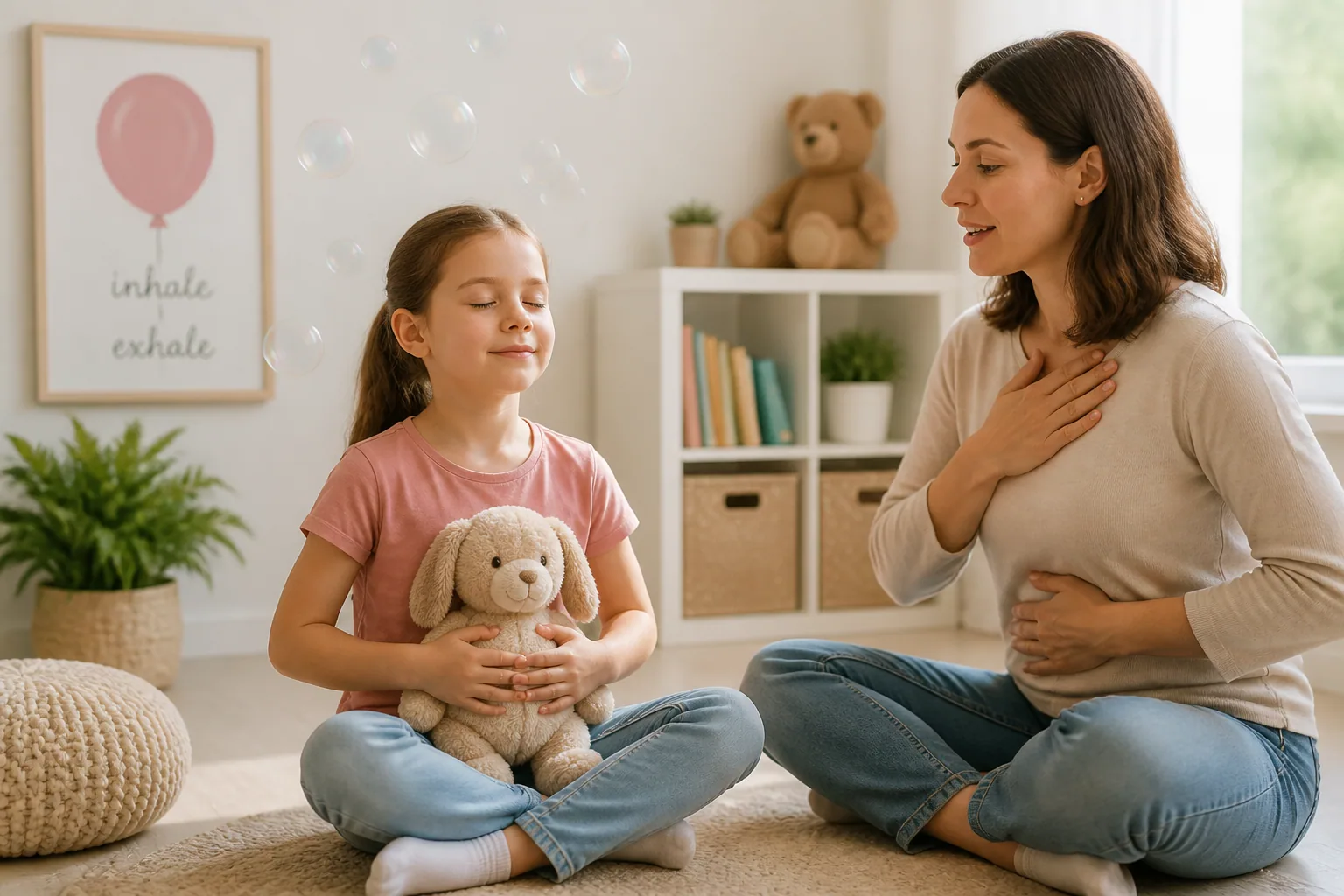
For preschoolers, short and playful exercises work best. Think belly breathing with a stuffed animal, bubble breaths, or pretend “smell the flower, blow out the candle” breathing. The goal is not to teach perfect technique. The goal is to make the breath visible, slow, and familiar.
For elementary-age children, you can begin introducing simple counting, pattern breathing, and visual supports. Counting to three or four on the inhale and exhale can give structure without feeling too complicated. Balloon breaths can help kids understand how their belly expands and softens as they breathe.
For older children and preteens, breathwork can be connected to performance, focus, and stress management. They may be more willing to try a quiet breathing pattern before a test, sports practice, bedtime, or a difficult conversation. At this age, it can also help to explain the why behind the practice in a straightforward way.
How to Teach Belly Breathing, Balloon Breaths, and Counting Breaths
Belly breathing is often the easiest place to start because it gives children a simple body cue to notice. Ask the child to place a hand on their belly and another on their chest. Then invite them to breathe in slowly through the nose so the belly rises like a balloon filling with air, and breathe out gently so the belly falls. If they are very young, you can model it first and let them copy you.
Balloon breaths work well because they translate breathing into imagery. You can say, “Let’s fill up our balloon belly” on the inhale and “let the air out slowly” on the exhale. For some children, it helps to make the exhale longer than the inhale, since a longer out-breath often supports relaxation more effectively than quick breathing does.
Counting breaths can be especially useful for school-age children who like structure. Try inhaling for a count of three or four, then exhaling for the same count, or slightly longer on the exhale. If the child is anxious or dysregulated, keep the count short and simple. A practice that feels too long can make children frustrated, which defeats the purpose.
The best teaching tip is to practice when the child is already calm. If breathwork only appears during a meltdown, kids may associate it with correction or urgency. When it becomes part of ordinary life, they are more likely to use it on their own later.
Using Visual Aids, Stuffed Animals, and Play to Make Practice Easier
Children often learn best through something they can see or touch. A stuffed animal on the belly can show whether breathing is deep and slow, because the toy rises and falls with each breath. This works especially well with younger children because it turns an invisible process into a game they can watch.
Visual cues can also make practice more accessible for children who struggle with language, attention, or anxiety. You might use a finger-tracing shape, a picture of a balloon, a bubble wand, or a simple inhale-exhale graphic. The idea is to reduce the amount of explaining and increase the amount of doing.
Playful imagery matters too. Some kids like “flower and candle” breathing. Others prefer “dragon breaths” for release, or “turtle breaths” for slowing down into a shell. When children can choose the image, they often feel more invested. The more a child feels ownership, the more likely the skill becomes part of their emotional toolkit.
This is also where a digital support like Just Breathe: Relax Daily can fit naturally for older children, teens, or caregivers who want a visual breathing guide for themselves. The app offers guided breathing patterns, beautiful animations, ambient sounds, and gentle reminders, which can make it easier to keep a regular practice going. You can learn more here: https://findthe.app/just-breathe-ujhm1e
When Kids Should Practice Breathwork: Before School, After Recess, and Bedtime
One of the best times to practice breathwork is before school. Many children wake up with a full day ahead of them, and the transition into the morning routine can be one of the most stressful parts of the day. A two-minute breathing practice can help create a calmer start, especially for kids who are sensitive to separation, noise, or rushing.
After recess is another useful time. Recess can be exciting, but it can also leave children overstimulated, frustrated, or dysregulated from conflict and sensory overload. A brief breathing reset before returning to class can help them shift from high-energy play back into a learning-ready state.
Bedtime is often one of the easiest moments to build a lasting habit because the environment is already moving toward rest. Slow breathing can support the body’s transition out of the day’s stimulation. Research suggests this may matter for sleep quality. A 2022 prospective observational cohort study of 115 school-aged children found that a mindfulness curriculum including paced breathing was associated with increased total sleep duration and REM sleep over two years compared with controls. Source: https://pmc.ncbi.nlm.nih.gov/articles/PMC9435327/
Breathwork can also be used during emotional overwhelm, but it works best when it is not introduced only at the point of crisis. Children are more likely to accept it if they have already practiced it in calm moments. That way, the skill feels familiar instead of corrective.
How Often Breathwork Should Be Used to Build Lasting Regulation Skills
Frequency matters more than perfection. A few minutes a day is often better than a long session once a week. The brain and body learn through repetition, so the goal is to build recognition and comfort with the practice over time.
For many families and classrooms, one or two short practices a day is enough to begin. That might mean a quick breathing routine in the morning and another at bedtime. In school, it could mean a brief reset after recess or before a challenging transition. The point is to make breathwork feel ordinary and predictable.
As children get used to the routine, they can begin using the skill independently. At that stage, breathwork becomes less of an adult-led activity and more of a self-regulation strategy. This is where reminders can help. Gentle prompts, schedules, and rituals make the practice easier to remember until it becomes automatic.
It is also worth noting that a calm-down skill only becomes useful when it is practiced outside of distress. If a child has enough experiences of success, they are more likely to reach for breathing when emotions begin to rise rather than after the meltdown is already in full swing.
How Breathwork Can Support Better Sleep, Focus, and Behavior
Breathwork can help children settle their bodies, which is one reason it is often used at bedtime. When the nervous system is less activated, it becomes easier to fall asleep and stay asleep. A 2026 systematic review of slow breathing before bedtime, defined as 10 breaths per minute or less, found that self-reported sleep duration and sleep quality improved after 28 to 30 days of practice, though objective measures were less conclusive. Source: https://pubmed.ncbi.nlm.nih.gov/41886931/
Improved sleep may also feed back into better daytime regulation. Well-rested children are often better able to handle frustration, follow directions, and stay on task. That does not mean breathwork solves every sleep issue, but it can be one helpful piece of a larger routine that supports rest.
There is also growing evidence that breathwork inside mindfulness and social-emotional learning programs can improve classroom behavior and attention. In a review of 18 mindfulness-based intervention studies with young children, all included breathwork and showed evidence of improved behavioral regulation, including decreases in hyperactivity, aggression, and conduct problems, as well as increases in impulse control. The review also found better emotional awareness, self-calming, and reduced emotional reactivity in studies that measured emotional regulation. Source: https://pmc.ncbi.nlm.nih.gov/articles/PMC8936381/
That does not mean breathwork is a magic fix. But it does mean that simple breathing practices can support the kinds of skills children need most, especially when they are learning to manage big feelings in real-world settings.
What the Research Says About Breathwork and Mindfulness for Children
Research on breathwork in children is growing, and the evidence is encouraging. A school-based mindfulness trial in Barcelona with children aged 8 to 10 found that an 8-week program improved emotion regulation strategies and executive function, with around 53.8% of the effect on emotion regulation mediated through working memory, inhibitory control, and cognitive flexibility. That matters because emotional regulation is not just about feeling calmer. It is also about being able to pause, hold attention, and choose a response. Source: https://pubmed.ncbi.nlm.nih.gov/41858457/
Another useful finding comes from the review of mindfulness-based interventions in young children. Because all of the included studies used breathwork, the review suggests that breathing is not just a nice add-on. It may be one of the core components that helps children become more aware of their emotions and less reactive when stressed. Source: https://pmc.ncbi.nlm.nih.gov/articles/PMC8936381/
There is also emerging evidence that paced breathing can have a direct effect on stress physiology. Slow, steady breathing appears to influence the body’s arousal level and subjective anxiety, which helps explain why children often seem more settled after even a brief practice. Combined with the sleep findings, the picture is becoming clearer: calm breathing can help the body regulate, and better regulation can support learning, behavior, and rest.
Common Mistakes to Avoid When Teaching Kids to Breathe Through Stress
One common mistake is introducing breathwork only when a child is already in a full meltdown. In that moment, many children are too overwhelmed to follow instructions well. It is better to teach the skill during calm moments, then use short reminders during stress.
Another mistake is overcomplicating the technique. Long scripts, too many steps, or strict expectations can make breathing feel like another demand. Keep it simple. A child usually needs one cue, one model, and one chance to try.
It is also helpful to avoid saying things like “Just breathe” in a way that sounds dismissive. For a distressed child, those words can feel like pressure instead of support. A better approach is to stay close, stay calm, and offer the breathing skill as one option among a few.
Finally, do not assume that breathwork will work the same way for every child. Some children need movement first, then breathing. Others need a sensory break, a drink of water, a hug, or quiet before they can settle enough to breathe. Breathwork is a tool, not the entire toolbox.
Simple Ways Parents, Teachers, and Caregivers Can Build a Calming Routine
The easiest way to make breathwork stick is to attach it to something that already happens every day. You might do three belly breaths before putting on shoes, two balloon breaths before a test, or a slow breathing routine after brushing teeth. Linking the practice to routine lowers resistance and makes it easier to remember.
In classrooms, a short whole-group breathing reset can become part of the transition between activities. At home, parents can model the practice themselves, which is often more powerful than verbal instruction. Children learn by watching. If they see adults using breathwork to manage stress, they begin to understand that calm is something we practice, not something we wait for.
Caregivers can also use language that builds confidence. Instead of “You need to calm down,” try “Let’s help your body feel safer” or “Let’s do our balloon breaths together.” This keeps the tone collaborative and reduces shame.
A visual timer, a short song, or a favorite breathing app can all help maintain the routine. The best system is the one the adults can actually keep up with. Consistency matters more than perfection.
When Breathwork Helps Most and When Extra Support May Be Needed
Breathwork tends to help most when the goal is mild to moderate regulation support. It is especially useful for transitions, bedtime, test anxiety, post-play overstimulation, frustration, and early signs of emotional escalation. In these moments, breathing can give the child enough space to settle and re-engage.
That said, breathwork is not a substitute for professional help when a child is dealing with severe anxiety, trauma, persistent sleep problems, or frequent meltdowns that affect daily life. If a child’s stress is constant, or if breathing exercises seem to make them more upset, it may be time to look more closely at what else is going on.
The best approach is to treat breathwork as one supportive habit within a larger circle of care. Combine it with predictable routines, emotional coaching, enough sleep, movement, and, when needed, input from a pediatrician, school counselor, psychologist, or other qualified professional. Used that way, breathwork can become a simple and meaningful part of helping children feel safer in their own bodies.