Decoding Your Breath: Common Myths About Breathwork and Why It Doesn’t Always Feel Like It’s Working
Breathwork can be incredibly useful, but it can also be surprisingly frustrating. One day a technique feels calming, the next day it feels awkward, ineffective, or even uncomfortable. If you have ever tried breathing exercises and wondered why they do not seem to “work” for you the way they do for someone else, you are not alone. A big part of the confusion comes from the fact that breathwork is not one single thing. It is a set of variables, and small changes in pace, ratio, attention, posture, stress state, and physiology can completely change the experience.
That is why the most helpful approach is not to chase a perfect method, but to learn how to read your own response. Once you understand what actually influences the outcome, breathwork becomes less mysterious and much more personal.
Why Breathwork Can Feel Like It’s ‘Not Working’
A lot of beginners expect breathwork to create an obvious effect right away, like a switch flipping from stressed to calm. Sometimes it does. But often the changes are subtle, delayed, or dependent on the context you are in. A breathing method that feels great after a long workday may feel pointless when you are already tired, hungry, or anxious. The body is not a machine with one fixed response.
Research reflects that variability. A 2025 systematic review of randomized controlled trials on diaphragmatic breathing found that results depended heavily on the population and the protocol. In the studies reviewed, breathing frequency ranged from 2 to 10 breaths per minute, session length ranged from 3 to 45 minutes, and total intervention time ranged from a single session to 12 weeks. Benefits were consistent for some outcomes like anxiety, GERD, post-COVID syndrome, and gestational diabetes, while evidence was weak or mixed for COPD and after cardiac surgery. In other words, breathwork can help, but the details matter a lot [https://www.sciencedirect.com/science/article/pii/S0965229925001931
That helps explain why one person says a method changed their life, while another says the exact same method did nothing. Often, both people are telling the truth.
The Most Common Breathwork Myths Beginners Get Stuck In
The first myth is that there is one correct way to breathe. There is not. There are useful ways to breathe for relaxation, for focus, for recovery, for sleep, and for exercise, but they are not identical. A pattern that calms the nervous system might not be the best choice when you need alertness or mobility.
The second myth is that more intensity means better results. People often assume longer holds, deeper breaths, or stricter control will produce faster progress. But breathwork is not about dominating the breath. It is about creating a useful physiological response without creating more strain.
The third myth is that if a technique works for an instructor, it should work for everyone. That is rarely true. People differ in lung capacity, stress load, experience, sensitivity to breath changes, and even how safe their body feels when attention is turned inward.
A fourth myth is that discomfort automatically means the practice is effective. Sometimes discomfort is simply a sign that the parameters are too aggressive for your current state. Breathwork should usually feel clear, manageable, and repeatable, not like a test you have to pass.
Why Forcing Belly Breathing Can Backfire
Belly breathing is often taught as the gold standard, but forcing the belly to move all the time can create problems. When people try too hard to push the abdomen outward, they may tense the ribs, shoulders, jaw, or pelvic floor. Instead of encouraging relaxation, the exercise can become another form of effort.
The more useful goal is usually diaphragmatic movement, not abdominal performance. In practice, that may involve a mix of expansion through the belly, lower ribs, and even the chest, depending on posture and breath depth. The body does not need to look exaggerated for the breath to be effective.
This is especially important because diaphragmatic breathing has variable effects across different groups. A 2025 review noted that while it can lower respiratory rate, increase tidal volume, improve oxygen saturation, and promote abdominal rather than thoracic movement, the benefits are less robust in chronic or severe respiratory disease and may come with trade-offs in some cases [https://pmc.ncbi.nlm.nih.gov/articles/PMC7602530/ That does not mean the technique is bad. It means the body’s context matters.
If your “belly breathing” feels forced, shallow, or strangely effortful, the answer may not be to try harder. It may be to widen the breath so that the ribs and torso can move more naturally.
The Problem With Copying Someone Else’s Breathing Rhythm
Another common trap is copying a rhythm that worked for someone else. You may hear that 5.5 breaths per minute is ideal, or that a specific inhale-exhale ratio is the key to calm. Sometimes those numbers are helpful starting points, but they are not magical.
In one 2014 study, breathing at about 5.5 breaths per minute with an equal inhale and exhale ratio of 5:5 increased heart rate variability more than other combinations, and participants also reported more relaxation [https://www.sciencedirect.com/science/article/pii/S0167876013003346 That is meaningful, but it does not mean everyone should stay at that exact pace no matter what.
A slower rhythm can be soothing for one person and irritating for another. If your body is already under stress, a pace that is too slow may feel unnatural or even heighten your sense of resistance. On the other hand, if the rhythm is too fast, you may not get the calming effect you want. The point is not to imitate a number. The point is to find the rate your nervous system can actually use.
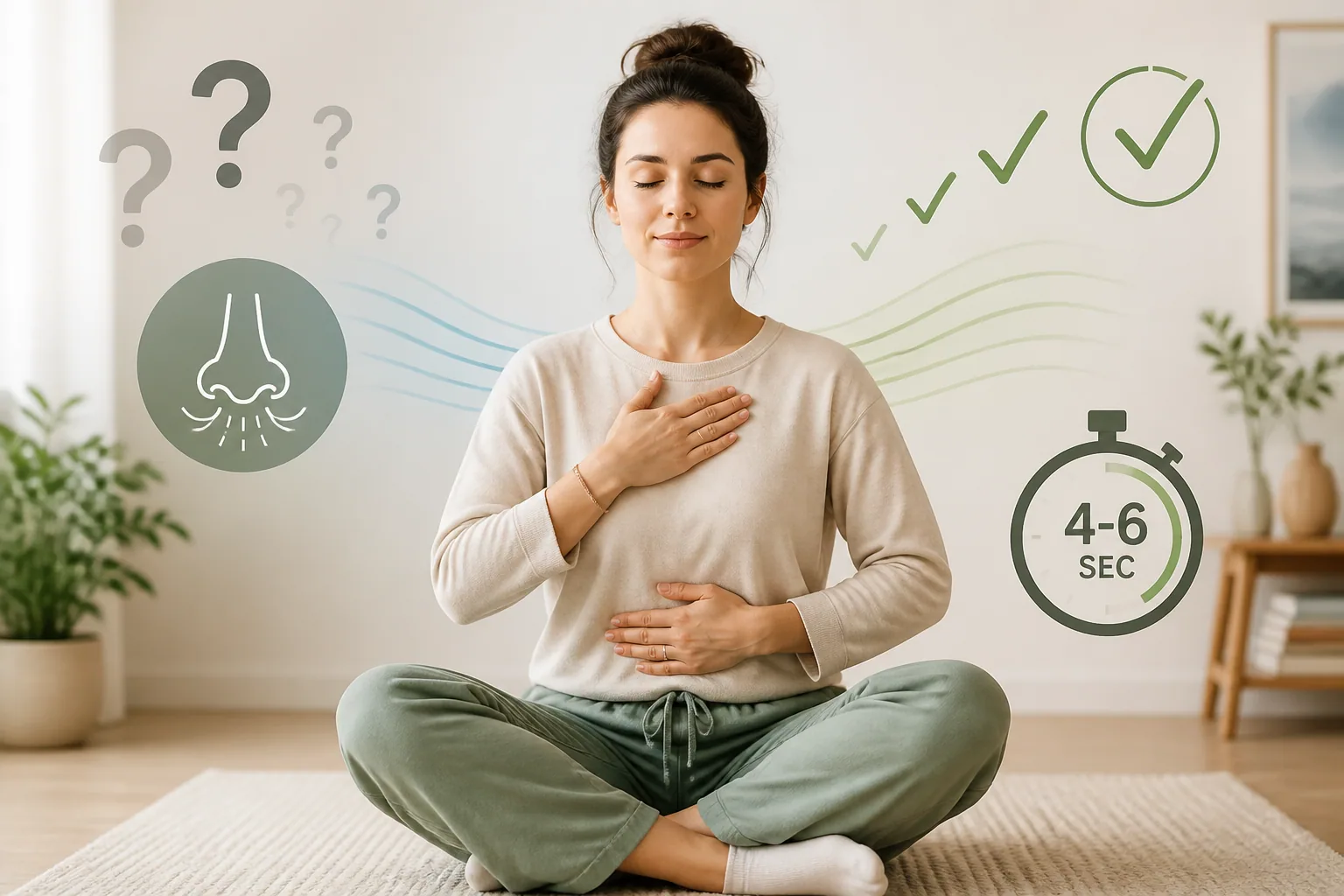
The same idea applies to inhale-exhale ratios. Some people do well with equal counts. Others respond better to a longer exhale, such as 4 seconds in and 6 seconds out. In a 2025 study, slow-paced breathing with a longer exhalation reduced state anxiety and improved markers linked to emotion regulation, with effects lasting even after exposure to aversive stimuli [https://pubmed.ncbi.nlm.nih.gov/40727675/ Again, the ratio is a tool, not a rule.
Are Long Breath Holds Overrated?
Breath holds can be useful in some methods, but they are often overhyped. Many people assume that the longer the hold, the better the result. That is not only untrue, it can also be unsafe.
Holding the breath too long can increase carbon dioxide buildup and reduce oxygen levels. In extreme situations, especially underwater or with poor technique, it can lead to loss of consciousness. In clinical or unsupervised settings, it may also create risks that simply are not worth taking. Most people can hold their breath somewhere between 30 seconds and 2 minutes, but capacity is not the same as benefit.
The more useful question is whether the hold is helping the practice. If it is creating anxiety, strain, or a need to gasp afterward, it may be too much. Breathwork should usually be scaled to your current tolerance, not your ambition.
For many beginners, a shorter hold or no hold at all is the better choice. A calmer, more consistent rhythm is often more effective than an impressive one.
What Actually Shapes Breathwork Results
If breathwork feels inconsistent, it helps to stop asking, “Does this method work?” and start asking, “What variables are shaping my response?” That shift makes the whole practice much easier to troubleshoot.
The most important factors usually include breathing pace, inhale-exhale ratio, duration, nasal versus mouth breathing, attention, stress state, baseline health, and whether the technique matches the moment you are in. These are not small details. They are the technique.
Breathing Pace, Ratio, and Duration: The Variables That Matter
Breathing pace is one of the biggest levers. Slower breathing often supports relaxation, but only up to the point that it remains comfortable and sustainable. A very slow pace may help one person settle down, while another person may need something a little quicker before they can soften into the practice.
The inhale-exhale ratio matters too. Equal ratios can support steadiness and heart rate variability, while longer exhales can support downregulation and anxiety relief. Session length matters as well. Some people respond well to just a few minutes, while others need longer repeated practice to notice a real shift.
The 2025 review on diaphragmatic breathing is useful here because it shows how wide the protocol range is in actual studies: 2 to 10 breaths per minute, sessions from 3 to 45 minutes, and interventions from one session to 12 weeks [https://www.sciencedirect.com/science/article/pii/S0965229925001931 That range is a reminder that there is no single correct dosage.
If a method is not helping, one of the first things to adjust is dose. Try a shorter session. Try a slightly slower or faster tempo. Try a less aggressive exhale. Often the problem is not breathwork itself, but the size of the step you are asking your body to take.
Nasal vs. Mouth Breathing: When the Choice Changes the Outcome
Whether you breathe through your nose or mouth can change the experience more than many people expect. Nasal breathing filters and humidifies air, supports nitric oxide release, and improves gas-exchange efficiency. It has also been linked to better vascular function and more coherent resting brain network dynamics, while oral breathing has been associated with more fragmented network activity [https://www.nature.com/articles/s41598-026-43617-2 [https://pmc.ncbi.nlm.nih.gov/articles/PMC13144297/
That does not mean mouth breathing is always wrong. If you are exercising hard, recovering from congestion, or using a specific technique that calls for mouth breathing, the context matters. But if your relaxation practice feels scattered or ineffective, nasal breathing is often worth testing first.
A good rule of thumb is simple: if the goal is calm, coherence, or recovery, nasal breathing is often the default to try. If the goal is intensity, clearance, or a specialized drill, mouth breathing may have a place. The important thing is not to treat the choice as random.
Why Attention and Mental Focus Are Part of the Technique
Breathwork is not only mechanical. Attention changes the outcome too. If your mind is wandering, braced, or silently judging the exercise, the body may not settle the way you expect. On the other hand, when attention is steady and gentle, even a simple rhythm can become much more effective.
This is one reason guided breathwork often feels easier than doing it alone. The guidance helps anchor attention, reduce decision fatigue, and prevent you from overcontrolling the breath. It also gives the mind something to follow besides its usual loops.
The body and mind are not separate here. Breath patterns can influence arousal, but your level of focus influences how fully you can receive the effect. If a technique seems “not to work,” ask whether you were actually present with it long enough to notice what happened.
How Stress State, Health, and Physiology Affect Your Experience
Your current state matters enormously. A breathing pattern that feels supportive when you are rested may feel irritating when you are exhausted or panicked. Likewise, a method that works beautifully for a healthy adult may produce weaker or mixed results in someone dealing with respiratory illness, post-surgical recovery, or other physiological constraints.
That is reflected in the research. The 2025 review found more consistent benefits for anxiety and some metabolic or post-viral conditions, but mixed findings in COPD and after cardiac surgery [https://www.sciencedirect.com/science/article/pii/S0965229925001931 In healthy young adults, even a single session of diaphragmatic breathing improved chest expansion, thoracic spine rotation, trunk flexion, shoulder mobility, and pulmonary measures like FVC and FEV1/FVC [https://pmc.ncbi.nlm.nih.gov/articles/PMC12452328/
That contrast matters. It shows that breathwork can create immediate change, but that the size and type of change depend on who is doing it and when. If you are not getting the same result as someone else, it may not be because you are doing it wrong. It may be because your body is responding to a different set of conditions.
A Troubleshooting Guide for When a Technique Doesn’t Click
When breathwork feels off, it helps to troubleshoot instead of abandoning the practice entirely. Start by asking a few simple questions. Is the rhythm too slow, too fast, or too forced? Is the exhale too long for your current tolerance? Are you holding tension in the belly, chest, jaw, or shoulders? Are you breathing through your mouth when nasal breathing might feel steadier?
Then look at context. Did you do the practice while already stressed, distracted, or tired? Were you expecting instant relief? Did you stay with it long enough for your body to adapt? Sometimes the technique is fine, but the setup was not.
You can also test whether the issue is attention rather than physiology. Try the same exercise for a shorter period with a simpler focus, such as counting the exhale or following a visual cue. If that works better, the problem may have been cognitive overload, not the breathing pattern itself.
Small Adjustments That Often Create Big Shifts
The best changes are often small. Shorten the session and see whether the body relaxes more quickly. Slightly lengthen the exhale and notice whether the nervous system settles. Switch from mouth to nose breathing and observe whether the breath feels smoother. Reduce the intensity of the hold or remove the hold entirely.
You can also adjust posture. Some people breathe better seated upright. Others do better lying down with support under the knees. If chest and shoulder tension are prominent, it may help to soften the upper body rather than trying to force more abdominal movement.
And remember that consistency often matters more than drama. A brief, repeatable practice can outperform a complicated one done once in a while. Breathwork tends to reveal its value through regular use, not through perfection.
How to Build a Breathwork Practice That Fits Your Body
A sustainable practice starts with realism. Pick one technique that matches your goal, whether that is calming down, sleeping, focusing, or gently improving mobility. Keep the first version simple. Use a comfortable rhythm. Stay within a range that feels smooth rather than ambitious. Then pay attention to what changes in your body and mood afterward.
If you like structure, guided tools can help a lot. Something like Just Breathe: Relax Daily can make it easier to stay consistent because it offers guided breathing patterns, visual pacing, ambient sounds, reminders, and progress tracking in one place: https://findthe.app/just-breathe-ujhm1e. For many people, that kind of support is what turns breathwork from an occasional experiment into an actual habit.
The key is to treat the app, the count, and the pattern as scaffolding, not as the source of the magic. The magic is in how your body responds, and that response is allowed to be individual.
Final Takeaway: Stop Chasing the Perfect Method and Start Decoding Your Response
If breathwork has felt confusing, inconsistent, or ineffective, that does not mean you failed. It usually means you were using a method that did not quite match your body, your state, or your context at that moment. Breathwork is not about finding the one perfect protocol. It is about learning how to notice what helps you, what overwhelms you, and what needs to be adjusted.
Once you shift from “What is the best technique?” to “What is my body telling me?” the whole practice becomes more useful. That is how breathwork stops being a trend and starts becoming a real skill.