How Breathwork Helps Kids and Teens Build Emotional Resilience
Kids and teens do not always have the words to explain what they feel, and that is exactly why breathwork can be so helpful. A simple breathing practice can give them a concrete way to slow down, reset, and move through stress without needing to fully understand every emotion in the moment. It is not about forcing calm. It is about helping the body feel safe enough for calm to return on its own.
For younger children, breathwork often works best when it feels playful and visual. For teens, it tends to work better when it feels practical, private, and not too childish. In both cases, the goal is the same: support emotional regulation, attention, and resilience in a way that fits development, daily routines, and real life.
Why Breathwork Works for Kids and Teens
Breathwork works because breathing is one of the few body functions that can be controlled both automatically and intentionally. That makes it a useful bridge between the mind and the nervous system. When a child is overwhelmed, their breathing often becomes shallow, fast, or irregular. Changing the breath can help interrupt that stress pattern and guide the body back toward balance.
This matters because emotional resilience is not just about coping skills. It is also about how quickly a child can recover after being upset. A child who can calm their body more efficiently may be less likely to stay stuck in anger, panic, or shutdown. Over time, that can support fewer meltdowns, better focus, and more confidence handling uncomfortable feelings.
The Brain-Body Connection: Breath, Stress, and Emotional Regulation
When a child senses stress, the sympathetic nervous system activates the fight or flight response. Heart rate can rise, muscles can tense, and thinking can get narrower. In that state, lecturing a child to calm down usually does very little. The body has already decided that something feels urgent.
Breathwork helps because slower, more intentional breathing can activate parasympathetic pathways associated with rest and recovery. In plain language, it helps shift the nervous system away from alarm and toward regulation. This is why breathing practices are often used before tests, after conflict, or at bedtime, when the body needs a signal that it is safe to settle.
The benefit is not just emotional. Breathing also affects attention and body awareness. A child who can notice the pace of their inhale and exhale is practicing interoception, or the ability to sense internal states. That awareness can become the first step in recognizing, “I am getting upset,” before the emotion reaches a full explosion.
What the Research Says About Breathwork for Young People
The research on breathwork for children and teens is encouraging, especially when the practice is simple, regular, and age appropriate. In one study of children aged 5 to 6, slow, deep breathing with equal inhalation and exhalation over eight weeks led to improvements in autonomic nervous system regulation, including better heart-rate-variability measures such as RMSSD and SDNN, as well as greater physiological complexity, which are both markers linked with self-regulation. Source: https://acervodigital.unesp.br/handle/11449/143970
There is also evidence that breathwork can help adolescents in the moment. A randomized controlled trial of 12 to 13 year olds found that one session of resonant breathing, around 6.2 to 6.7 breaths per minute, significantly lowered stress reactivity on one measure of autonomic arousal and increased heart-rate variability during the breathing exercise. Source: https://pubmed.ncbi.nlm.nih.gov/41257401/
Breathing can even improve performance under pressure. In primary school children, deep breathing before a timed math test reduced self-reported test anxiety and improved test performance, especially for children with higher autonomic reactivity. That is a useful reminder that breathwork is not only about feeling better. It can also support clearer thinking when stress would otherwise get in the way. Source: https://pubmed.ncbi.nlm.nih.gov/27666392/
Another study found that diaphragmatic breathing paired with visualization, such as imagining a balloon inflating in the belly and deflating on the exhale, lowered children’s anxiety, mood disturbance, and pain during dental procedures. It also showed signs of reduced sympathetic activation. Source: https://pmc.ncbi.nlm.nih.gov/articles/PMC9790220/
A broader review of diaphragmatic breathing for children and teens ages 6 to 18 found it can reduce stress and anxiety and improve quality of life, especially when combined with supports such as counseling or music therapy. At the same time, a systematic review of brief breathing-based interventions found mixed results when breathing is used alone, which suggests that the best outcomes often come from choosing the right technique and pairing it with age, context, and support. Sources: https://www.mdpi.com/2227-9067/12/1/59 and https://pubmed.ncbi.nlm.nih.gov/38933581/
Age-Appropriate Breathwork Techniques Kids Will Actually Try
The best breathing exercises for younger kids are the ones that feel like a game, a story, or a picture. If the practice feels too technical, children may resist it. If it feels too silly without a clear purpose, they may not use it again. The sweet spot is simple, visual, and repeatable.
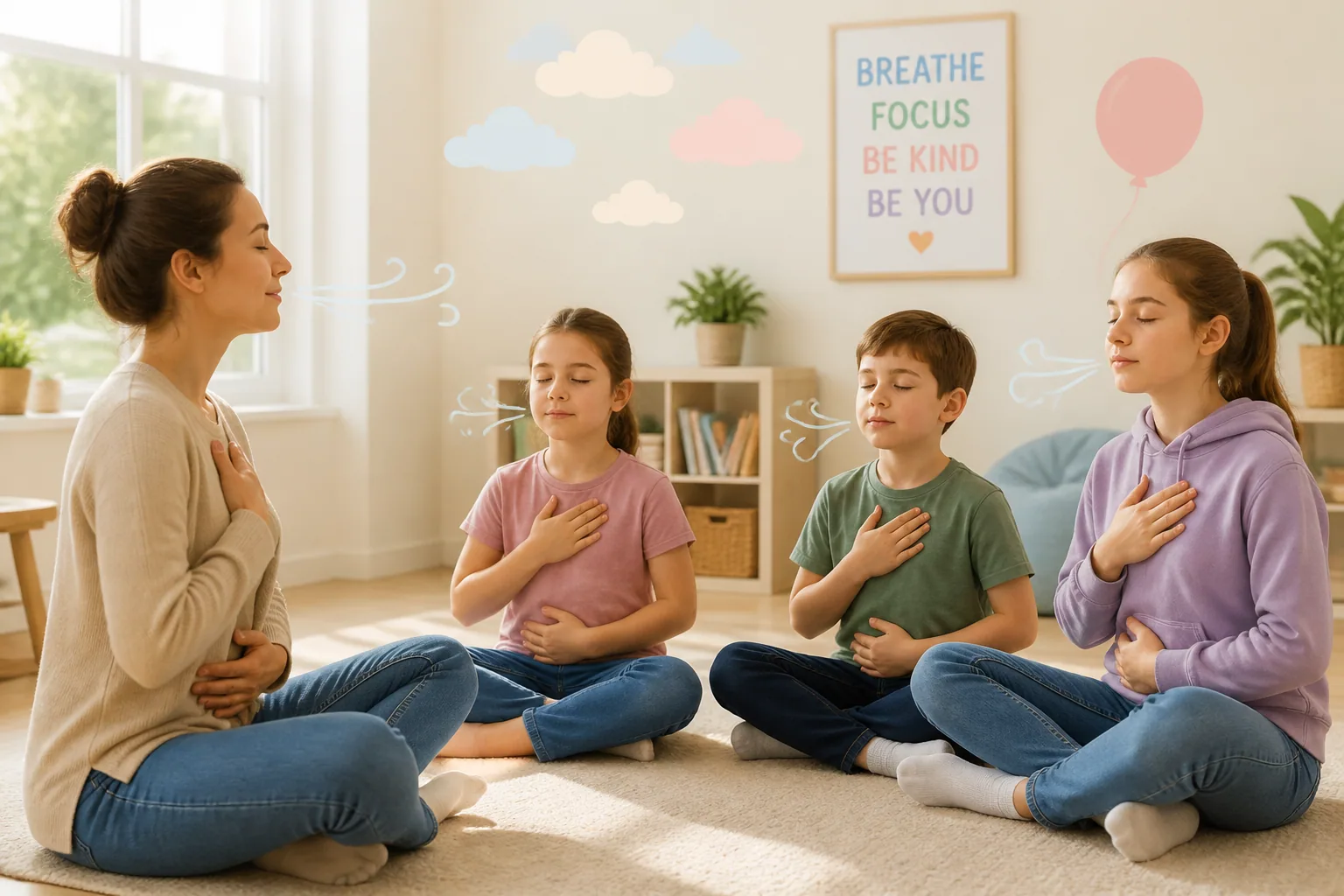
Balloon breathing is one of the easiest starting points. A child places a hand on their belly and imagines a balloon slowly inflating as they breathe in, then deflating as they breathe out. This gives the body a clear cue for diaphragmatic breathing and turns an invisible process into something easy to picture.
Mountain breath works well for kids who like structure. They can imagine climbing up a mountain on the inhale and coming back down on the exhale. This can be paired with counting or finger tracing to make the rhythm more concrete. It is especially useful when a child needs a calming reset but is too activated for a long explanation.
Rainbow breathing is another child-friendly option. Kids trace one color on the inhale and a different color on the exhale, often while moving their finger or following a visual arc. This kind of imagination-based practice is used in many school settings because it keeps attention engaged and makes repetition easier. A rainbow breathing guide from the New York State Office of Addiction Services and Supports offers a good example of how visual cues can support the rhythm. Source: https://oasas.ny.gov/system/files/documents/2021/08/rainbow_breathing.pdf
For children who like movement, count-and-blow activities can also help. They might inhale for three, exhale for three, or pretend to blow up a pretend balloon, a pinwheel, or even a small candle from a safe distance. The key is not precision. The key is consistency and enough interest that the child actually wants to do it again.
Breathwork for Teens: Low-Pressure Tools That Don’t Feel Babyish
Teens usually respond better when breathwork feels discreet, efficient, and non-patronizing. They may not want a cartoon-style exercise, but they may be very open to something that helps with test anxiety, sports pressure, social stress, or sleep. What matters most is giving them tools that feel useful, not childish.
Resonant breathing, box breathing, and quiet diaphragmatic breathing can work especially well for teens. These patterns are simple enough to remember and flexible enough to use at a desk, in a bathroom stall, before an exam, or while waiting for practice to start. The fact that resonant breathing has shown immediate benefits in adolescents is especially relevant here, because many teens want something that works quickly and does not require a long setup.
Teens may also appreciate breathwork when it is framed as a performance and recovery tool rather than an emotional one. That can reduce resistance. For example, you might say it is a way to settle the body before a big presentation, clear the mind after a difficult class, or help fall asleep after too much scrolling.
How to Introduce Breathwork at Home Without Resistance
If you want a child to keep using breathwork, the introduction matters as much as the technique. Starting during a calm moment is usually better than introducing it in the middle of a meltdown. In the middle of distress, even helpful ideas can feel like pressure.
A low-pressure approach is to model it first. Say something like, “I am going to do three balloon breaths because my body feels busy.” This normalizes the practice without making it feel like punishment. Then invite, but do not force, the child to try it with you.
It also helps to connect breathing with predictable routines. You can use it after school, before homework, before bed, or after a sibling conflict. When a breath practice becomes part of the routine, it feels less like a special intervention and more like a normal part of family life.
Avoid overexplaining in the beginning. Younger children often do better with one short cue and one visual. Older children may prefer a brief explanation about stress, focus, or sleep, but even then, simplicity wins. The practice should feel easy enough that a child can repeat it without needing a lot of adult coaching.
Using Breathwork in Classrooms, Counseling Spaces, and School Routines
Breathwork can be a valuable part of a classroom or school support plan because it is quiet, low-cost, and adaptable. Teachers may use it during transitions, before tests, after recess, or when the room energy becomes too high. School counselors may use it as a grounding skill before talking through a difficult topic.
In classrooms, the best practices are short and consistent. A one-minute rainbow breath or a few rounds of box breathing can be easier to maintain than a long guided exercise. The goal is not to interrupt learning. It is to make regulation more accessible so students can return to learning more effectively.
For children who become overstimulated easily, a breathing routine can also become part of a calm corner, check-in system, or reset routine. When students know what to expect, they are more likely to use the strategy without embarrassment. This is especially important for kids who already feel self-conscious about needing help.
Best Times to Practice: Before Bed, After School, and During Stress Spikes
The easiest way to build a habit is to tie it to moments that already happen every day. Before bed is one of the best times because many children struggle to switch off physically and mentally. A few slow breaths can help the body transition from activity to rest, especially when paired with a dim light, a soft voice, or a bedtime story.
After school is another useful window. Many kids hold it together all day and then unravel once they get home. A breathing practice can become part of the decompression routine, happening before snacks, homework, or screen time. That helps the child reset before the next demand arrives.
Breathwork can also be used during stress spikes, but the instructions should be brief. If a child is already crying, angry, or panicking, they may only be able to do one or two breaths at first. That is enough. The win is not perfection. The win is creating a tiny pause that can grow over time.
Signs Breathwork Is Helping: Sleep, Self-Awareness, and Fewer Outbursts
Progress with breathwork often shows up in small, practical ways before it shows up in dramatic emotional change. One common sign is better sleep. A child who settles more quickly at night may be responding to the body-based calming effect of the practice.
Another sign is improved self-awareness. You may hear a child say, “I need my breaths,” or notice that they start using words to describe tension before it turns into an outburst. That kind of early noticing is a major step in emotional resilience because it means the child is beginning to catch stress earlier.
You may also see fewer or shorter meltdowns, better transitions, less test anxiety, or a quicker return to baseline after frustration. These changes can take time, especially if the child is already under a lot of stress. But over repeated practice, the goal is for breathwork to become a tool the child can reach for on their own.
When Breathwork Isn’t Enough: Red Flags and When to Seek Professional Help
Breathwork is a support tool, not a replacement for professional mental health care. If a child’s anxiety, sadness, anger, sleep problems, or behavior changes are intense, persistent, or interfering with daily life, it is important to seek help from a qualified professional.
Watch for signs such as frequent panic symptoms, ongoing school refusal, self-harm talk, major changes in eating or sleep, persistent hopelessness, severe withdrawal, or aggressive behavior that feels hard to contain. If a child becomes more distressed when asked to breathe, that can also be a sign that the approach needs to be adapted or that additional support is needed.
In those cases, breathwork can still be useful, but it should be part of a broader plan that may include counseling, family support, school accommodations, or medical evaluation. The right help is the help that matches the size of the struggle.
How to Make Breathwork a Habit That Sticks
Habits stick when they are simple, predictable, and rewarding enough to repeat. That means choosing one or two breathing patterns instead of a long menu of options. It also means practicing at the same time each day, even when nobody is upset, so the skill becomes familiar before it is needed in a crisis.
Reminders can help, especially for busy families. A note on the bathroom mirror, a cue at the dinner table, or a short breathing break before homework can make the practice feel automatic. For kids and teens who like screens, a child-friendly breathing app or audio guide can provide structure without an adult having to lead every time.
This is also where consistency matters more than intensity. A short daily practice is usually more effective than an occasional long session. The nervous system learns through repetition. Over time, that repetition can build a new default response to stress.
If you want a tool that makes the habit easier, Just Breathe: Relax Daily can be a helpful companion for regular breathing sessions, with guided patterns, animations, ambient sounds, and reminders built in: https://findthe.app/just-breathe-ujhm1e
Simple Tools: Visual Prompts, Animation Guides, Music, and Ambient Sounds
Many children and teens respond better to breathwork when there is something to follow besides their own internal rhythm. Visual prompts like a rising and falling circle, a colored line, or a breathing character can make the practice easier to understand and less abstract.
Animation guides are especially useful because they give the child a pace to match. This can be a soft pulsing heart, a moon for bedtime breaths, or a simple expanding and contracting shape. The visual does some of the work, which means the child does not have to remember every instruction.
Music and ambient sounds can also deepen the experience. Gentle rain, ocean waves, forest sounds, or meditation bells may help a child stay engaged long enough to complete a short practice. For some children, the sound becomes a cue that it is time to slow down, which can make the habit easier to start.
The best tools are the ones that match the child’s age, mood, and attention span. Breathwork is most effective when it feels doable. That is true for a five year old learning balloon breathing, a middle schooler trying to handle test stress, or a teen looking for a quiet reset before bed. When the practice is easy to access and pleasant to repeat, it has a better chance of becoming a real resilience skill rather than just another thing adults suggested once.