How Breathwork Supports Mild to Moderate Asthma: Safe Techniques, Daily Tips, and Tools for Easier Breathing
Breathwork can be a helpful add-on for people with mild to moderate asthma, especially when the goal is to feel calmer, reduce overbreathing, and build better awareness of breathing patterns day to day. But it is important to say this clearly from the start: breathwork is not a replacement for prescribed asthma medication, and it should never be used to delay care during a flare-up or worsening symptoms.
Used the right way, breathing exercises may support quality of life, symptom control, and relaxation. Some techniques also encourage slower breathing, a gentler nasal inhale, and a longer, unforced exhale, which can be more comfortable for many people with asthma. In this article, we will look at what the research says, how different methods compare, when each one may be useful, and how to adapt apps and visual guides so they feel asthma-friendly instead of stressful.
Why Breathwork Matters for Mild to Moderate Asthma
Asthma is not only about the airways. It also affects how people feel about breathing itself. When breathing feels tight or unpredictable, it is very easy to start breathing too quickly, too deeply, or in a tense way. That can create a feedback loop: anxiety can increase breathing effort, and overbreathing can make symptoms feel worse.
That is where breathwork may help. The goal is not to force huge breaths or hold the breath for long periods. The goal is to make breathing more efficient, relaxed, and steady. For some people, that means learning diaphragmatic breathing. For others, it means using pursed-lip breathing during physical effort or learning to slow down the breath during calm moments at home.
The most useful breathwork for asthma is usually simple, repeatable, and low strain. If a technique leaves you dizzy, tight, panicky, or short of breath, it is not the right version for you. Asthma-friendly breathwork should feel easier, not more intense.
What the Research Says About Breathing Exercises and Asthma
The evidence is promising, but it is also nuanced. A systematic review found that diaphragmatic breathing had moderate evidence for improving quality of life in people with asthma, both in the short and long term, across three randomized controlled trials with 254 participants. That matters because better quality of life often means less day-to-day distress, better confidence, and fewer breathing-related worries. Source: https://pubmed.ncbi.nlm.nih.gov/23088703/
The Papworth method has also shown encouraging results. In a randomized trial in adults with mild to moderate asthma, it led to about a one-third reduction in asthma symptoms compared with usual care, and those improvements were maintained at 12 months. The method combines diaphragmatic breathing, nasal breathing, relaxation, breathing-rate adjustment, and the removal of dysfunctional breathing habits. Source: https://pmc.ncbi.nlm.nih.gov/articles/PMC1925219/
Buteyko breathing has also been studied. In one randomized trial, it improved asthma symptoms, reduced the use of bronchodilator rescue medication, and improved asthma control score and quality of life. However, it did not significantly change lung function measures such as FEV1 or bronchial hyperresponsiveness. A more recent study also found Buteyko breathing to be clinically effective and well accepted, with small changes in lung function. Sources: https://pmc.ncbi.nlm.nih.gov/articles/PMC1746772/ and https://pmc.ncbi.nlm.nih.gov/articles/PMC10782792/
Pursed-lip breathing has shown benefits as well, especially when paired with supportive posture. One 2025 study in mild to moderate asthma reported lower respiratory rate, better oxygen saturation, and reduced dyspnea after pursed-lip breathing with favorable positions such as prostrate or semi-Fowler posture. Another case study from Indonesia found improved oxygen saturation and less shortness of breath with pursed-lip breathing in semi-Fowler position. Sources: https://medicalforummonthly.com/index.php/mfm/article/view/5714 and https://prosiding.umy.ac.id/grace/index.php/pgrace/article/view/501
The overall pattern is fairly consistent: breathing exercises may help symptoms, comfort, and confidence, but they do not replace inhalers, controller medicines, or urgent evaluation when symptoms worsen. Clinical guidance and review summaries describe these techniques as adjuncts to standard pharmacologic care, especially for mild to moderate asthma. Source: https://buteyko.info/wp-content/uploads/2017/12/NIH_Breathing_techniques_for_asthma_study_sept_2012.pdf
Diaphragmatic Breathing: A Simple Everyday Foundation
Diaphragmatic breathing, sometimes called belly breathing, is one of the simplest and most useful techniques to start with. The idea is to let the diaphragm do more of the work so the upper chest and shoulders can relax. Instead of trying to pull in a big dramatic breath, you aim for a quieter, smoother breath that expands the lower ribs and belly gently.
For people with asthma, this can be useful because it encourages a less tense breathing pattern. It may also help reduce the habit of shallow, rapid breathing that can show up during stress or after exertion. Since the evidence base shows moderate benefit for quality of life, it is a good foundation technique to practice when you are not in distress. Source: https://pubmed.ncbi.nlm.nih.gov/23088703/
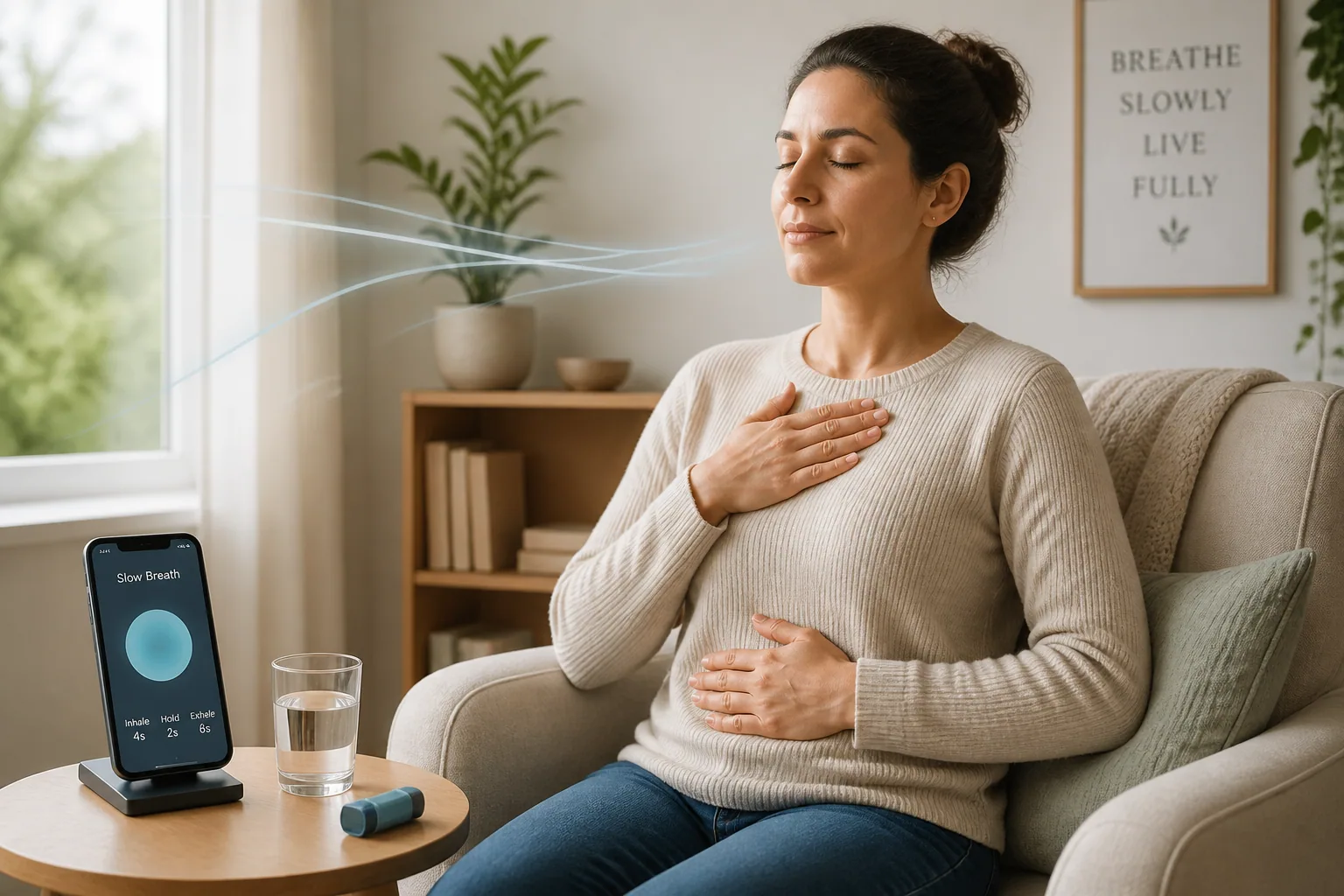
A simple way to practice is to lie down or sit upright, place one hand on the chest and one on the belly, and breathe in gently through the nose. Try to let the lower hand rise a little more than the upper hand. Then exhale slowly and softly, without pushing the air out. If your inhale starts to feel forced, shorten it. If your exhale feels strained, ease off.
This is a great daytime practice because it is discreet and low effort. It can also be paired with relaxation, before bed, or after an asthma trigger like cold air, as long as you are not having active worsening symptoms.
Pursed-Lip Breathing: When a Longer Exhale Can Help
Pursed-lip breathing is often described as breathing out through lightly pressed lips, as if you are gently blowing through a straw. The purpose is to make the exhale longer and more controlled. That can help reduce breathlessness and create a more comfortable rhythm, especially if you feel rushed, tense, or slightly air hungry.
In the asthma studies mentioned above, pursed-lip breathing combined with supportive postures reduced respiratory rate, improved oxygen saturation, and lowered dyspnea scores. It is especially interesting because it does not depend on a complicated routine. It is a simple pattern you can use while resting, recovering from activity, or trying to settle your breathing after a stressful moment. Sources: https://medicalforummonthly.com/index.php/mfm/article/view/5714 and https://prosiding.umy.ac.id/grace/index.php/pgrace/article/view/501
A practical cue is this: inhale gently through the nose for about two counts, then exhale through pursed lips for about four counts. Do not force the air out. The point is smoothness, not volume. If counting makes you tense, simply let the out-breath be longer than the in-breath in a relaxed way.
Pursed-lip breathing is often a better choice than deep breathing during mild discomfort or after exertion, because large, fast breaths can sometimes increase lightheadedness or chest tightness. Hyperventilation can cause symptoms like tingling, dizziness, and chest discomfort, which can feel alarming when you already have asthma. Source: https://www.healthline.com/health/hyperventilation
The Papworth Method: Breathing, Relaxation, and Symptom Awareness
The Papworth method is one of the more complete breathwork approaches for asthma because it does not focus on one breathing pattern alone. It combines diaphragmatic breathing, nasal breathing, relaxation, breathing-rate adjustment, and awareness of dysfunctional breathing habits. That broader structure is part of why it may feel especially helpful for people whose asthma symptoms are intertwined with tension or anxious breathing patterns.
In the randomized trial referenced earlier, adults with mild to moderate asthma who used the Papworth method experienced about a one-third reduction in symptoms compared with usual care, and the improvements lasted at least 12 months. That makes it a strong example of how breath training can support daily management without being a substitute for medical treatment. Source: https://pmc.ncbi.nlm.nih.gov/articles/PMC1925219/
The relaxation component matters. Many people with asthma unconsciously brace their chest, shoulders, or neck when they feel short of breath. That can increase the sense of effort. Papworth-style practice aims to soften this pattern while also encouraging nasal breathing and a slower respiratory rate.
This method is often best learned gradually. If you are new to breathwork, start with just the diaphragmatic and relaxation parts before trying to change your breathing rate. The goal is to make breathing feel less effortful, not to monitor every breath all day.
Buteyko Breathing: What It Is and What Asthma Patients Should Know
Buteyko breathing is a structured technique that emphasizes nasal breathing, reduced overbreathing, and a calmer breathing pattern. Many people are drawn to it because it promises better control with less respiratory effort. In research, it has been associated with better symptoms, less rescue inhaler use, and improved quality of life.
At the same time, it is important to keep expectations realistic. The Buteyko trial evidence showed symptom and medication improvements, but not major changes in objective lung function measures. In other words, people may feel better and use less rescue medication, but the technique does not replace the need to monitor symptoms and follow an asthma action plan. Sources: https://pmc.ncbi.nlm.nih.gov/articles/PMC1746772/ and https://pmc.ncbi.nlm.nih.gov/articles/PMC10782792/
Buteyko is often discussed in terms of breathing less, but that should never mean starving yourself of air or pushing into breath-holds that cause stress. For asthma, the safest framing is usually gentler nasal breathing, reduced upper-chest tension, and a calmer pace. If a version of the technique makes you feel air hungry, stop and return to a more neutral breathing pattern.
Because the method can be misunderstood, it is wise to learn it with a clinician, asthma nurse, or respiratory therapist if possible, especially if you have frequent symptoms, exercise-induced symptoms, or a history of flare-ups.
When to Use Each Technique: Daily Practice vs. Flare-Up Support
Not every breathing technique fits every moment. One of the most useful ways to think about breathwork in asthma is to separate daily maintenance practice from symptom support during mild discomfort.
Diaphragmatic breathing is ideal for daily practice because it is gentle, foundational, and easy to repeat. It also works well as a reset after stress or when you notice your shoulders creeping upward and your breathing getting shallow.
Pursed-lip breathing is especially helpful when you want a longer exhale, such as after climbing stairs, during recovery after exercise, or when you notice breathlessness creeping in. It is not a rescue treatment, but it can help you feel more controlled while you use your prescribed plan.
Papworth-style breathing is often best as a structured practice session or when you are working on longer-term breathing habits. It suits people who want a more complete method that includes relaxation and awareness training.
Buteyko is usually better treated as a guided practice for symptom management and breathing habit retraining, not as something to improvise during a severe episode. If symptoms are escalating, reach for your action plan and medications first.
A simple rule is this: if your technique is meant to calm and slow the breath, use it when you are stable or only mildly uncomfortable. If you are having significant wheezing, chest tightness, difficulty speaking, or rapid worsening, do not try to breathe your way through it alone.
How to Adapt Breathing Apps and Visual Guides for Asthma-Friendly Patterns
Breathing apps can be useful, but many are designed for general relaxation or stress reduction rather than asthma-specific needs. That means they sometimes encourage very deep inhalations, aggressive breath holds, or sharp rhythm changes that may not feel comfortable for someone with asthma.
When choosing an app or visual guide, look for one that supports gentle pacing, soft nasal breathing, and longer exhalations without force. Avoid settings that make you overfocus on the inhale or urge you to take huge breaths. The best tool is one that helps you settle, not one that makes you chase a perfect number.
This is where a flexible breathing companion can be helpful. For example, an app like Just Breathe: Relax Daily can support calm, rhythmic sessions with custom patterns, gentle reminders, and visual guidance. If you use a tool like that, the asthma-friendly approach would be to choose softer routines, keep breath depth moderate, and favor longer, unforced exhales rather than intense breathwork styles. Product link: https://findthe.app/just-breathe-ujhm1e
You can also make your own custom pattern that feels more asthma-aware. A good starting point might be a comfortable nasal inhale, a longer exhale, and no breath holds. If the animation or timer speeds you up, shorten the session or simplify it until it feels natural.
The goal is to let technology support consistency. Visual guides, timers, and reminders are most useful when they help you practice a small amount every day instead of pushing you into a hard session once in a while.
Safety Considerations, Triggers, and When to Call a Healthcare Provider
Safety always comes first with asthma. Breathwork may be helpful, but it should not be used to ignore warning signs. If you have worsening wheeze, chest tightness, trouble speaking full sentences, blue lips, severe shortness of breath, or symptoms that do not improve with your usual rescue medication and action plan, seek urgent medical help.
It is also important to avoid hyperventilation. Rapid or deep breathing can trigger lightheadedness, tingling in the hands or face, chest tightness, and a sense of panic. In asthma, that can be confusing because those sensations can overlap with breathing distress. Source: https://www.healthline.com/health/hyperventilation
If a breathing exercise makes you dizzy, shaky, more breathless, or anxious, stop and return to normal breathing. Choose a simpler pattern next time, or practice under supervision. For some people, even a seemingly mild breath-hold or aggressive counting method can create more tension than benefit.
You should also speak with a clinician before starting a new practice if you have frequent attacks, a recent hospitalization, severe exercise symptoms, pregnancy, other lung disease, or uncertainty about whether your symptoms are asthma-related. A respiratory therapist or asthma nurse can help you tailor the technique to your situation.
How to Build a Sustainable Daily Breathwork Routine
The best breathing routine is the one you will actually keep doing. For asthma, that usually means short sessions that are easy to remember and easy to perform. Five minutes can be enough if you do it consistently.
You might start with one session in the morning to set a calm breathing pattern, then one short session in the evening to unwind. If that feels like too much, start with two or three minutes once a day. Consistency matters more than duration.
It can help to anchor the practice to an existing habit. For example, do diaphragmatic breathing after brushing your teeth, before your shower, or while waiting for your coffee. Adding breathwork to an established routine makes it feel less like another chore.
You can also track how it feels. Notice whether your shoulders relax, whether your exhale becomes easier, or whether you feel less reactive to triggers. Keep the feedback simple. The point is not to become obsessed with data, but to learn what supports your breathing.
A sustainable routine is also one that respects variation. On stressful days, a very short practice may be enough. On good days, you may enjoy a longer relaxation session. Either is fine as long as the technique stays gentle.
Helpful Tools, Reminders, and Guided Resources to Try
People often do better with breathwork when they have some kind of structure. That can be a timer, a reminder, a breathing app, a visual animation, or a written card with a simple cue like breathe softly through the nose, then exhale a little longer.
Smart reminders can be especially useful because they take the pressure off memory. A gentle prompt can help you practice before stress builds or before you get too tired to think about it. Tracking a streak can also encourage consistency, as long as it does not become a source of pressure.
If you use visual animations, look for ones that move slowly and do not demand big breaths. Simple, calm visuals are usually better than flashy ones. Ambient sound can also help some people settle into a steady rhythm, especially if noise or stress is a trigger.
For guided resources, ask whether the cueing supports asthma-friendly breathing. Good cues include nasal inhale, soft shoulders, longer exhale, and no strain. Less helpful cues include deeply filling the lungs, forcing air out, or pushing through discomfort.
A Balanced Plan: Using Breathwork Alongside Your Asthma Treatment
The healthiest way to think about breathwork is as support, not substitution. The research suggests that techniques like diaphragmatic breathing, the Papworth method, Buteyko breathing, and pursed-lip breathing may improve symptoms, comfort, and quality of life for people with mild to moderate asthma. But they are best used alongside the treatment plan you already have.
That means continuing prescribed controller medication if you have it, keeping your rescue inhaler accessible, following your asthma action plan, and knowing your personal warning signs. Breathwork can be part of the routine that helps you feel more in control, but it should never be the only tool you depend on.
If you want a simple starting point, begin with a few minutes of diaphragmatic breathing once a day, use pursed-lip breathing when you need a longer exhale, and keep all practices gentle enough that they never leave you feeling short of air. From there, you can build toward a more structured method like Papworth or Buteyko with professional guidance if needed.
Done carefully, breathwork can become a practical and reassuring part of asthma self-management. It may not change every lung test, but it can change how breathing feels in daily life, and for many people, that makes a meaningful difference.