How Much Breathwork Is Too Much? Finding Your Ideal Frequency, Duration, and Rhythm
Breathwork can be one of the simplest ways to calm your system, sharpen your focus, or support deeper regulation. But like most helpful practices, it works best when it is sustainable. More is not always better. In fact, the right amount of breathwork depends on your goal, your current stress load, your physical health, and the style of breathing you are doing. A short daily session may be ideal for one person, while another may benefit more from less frequent but more intentional deeper work.
The good news is that you do not need to guess. Recent research on slow-paced breathing gives us useful clues about frequency, duration, and rhythm, including the commonly studied 5 to 7 breaths per minute range. In this article, we will break down how to build a routine that supports you rather than drains you, how to tell when you are overdoing it, and how to choose a practice schedule that fits real life.
Why More Breathwork Is Not Always Better
Breathwork is often discussed as if the answer to every problem is simply to do more of it. But the body does not always respond linearly. A gentle five-minute reset can sometimes be more effective than a long, intense session, especially if your goal is to lower day-to-day stress and stay consistent. Breathwork works through the nervous system, and nervous system work is not only about stimulation. It is also about recovery, integration, and timing.
Research supports this idea. A meta-analysis of randomized controlled trials found that breathwork interventions produced small to medium improvements in self-reported stress, anxiety, and depressive symptoms compared with controls. That is encouraging, but it also suggests that breathwork is best understood as a useful tool, not a magic switch. The benefits come from the right dose, repeated consistently, rather than from pushing harder every time.
This is especially important when you are using more activating methods, such as fast breathing or breath holds. These practices can feel powerful, but they can also push you past your comfort zone if you overuse them. For many people, the smartest approach is to match the intensity of the session to the purpose of the session.
What Your Goal Changes: Calm, Energy, or Deep Regulation
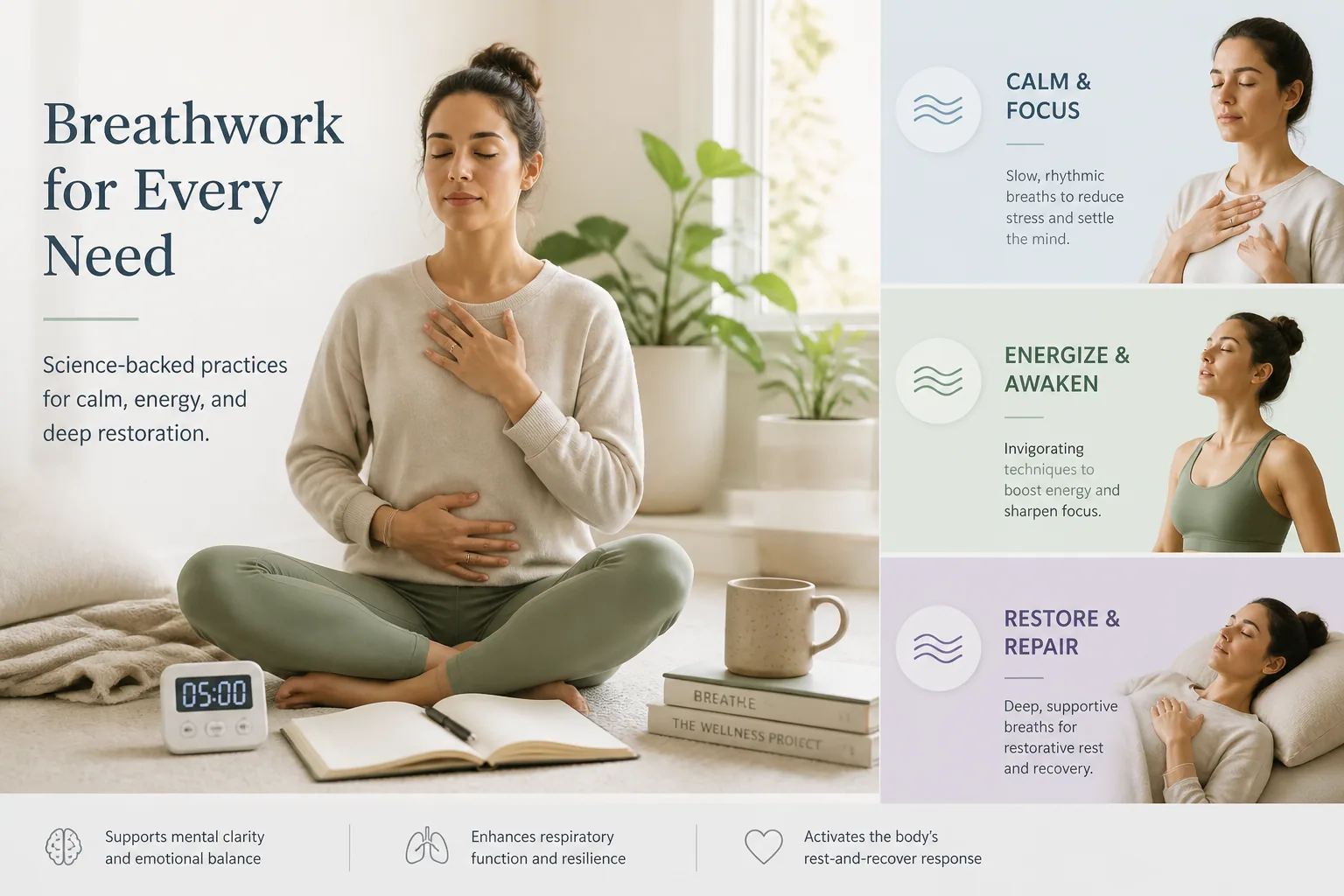
Before deciding how often to practice, ask a simple question: what do you want breathwork to do for you? If you want quick calm during a stressful day, the best routine is usually short, repeatable, and easy to access. If you want more energy and alertness, you may use a different rhythm and place the session earlier in the day. If your goal is deeper nervous system regulation, that usually takes more than one technique and more than one moment of practice.
For stress relief, modest daily practice often makes sense. For energy, a short activating session can be useful, but too much of it can leave you jittery or fatigued. For deeper regulation, slower sessions with more attention to exhale length, body awareness, and recovery time may be more appropriate. In other words, the goal changes the dose.
This is where many practitioners get stuck. They try to use the same practice for every situation. A down-regulating practice is not the same thing as an activating one, and a session used to support sleep should not be scheduled like one meant to wake you up.
How Often Should You Practice? Daily, Weekly, and Everything In Between
For many people, daily practice is the most realistic way to build results. Research has shown that daily five-minute breathwork sessions, including cyclic sighing or box breathing, can improve mood, reduce anxiety, and lower physiological arousal over a month. Short sessions work because they are easier to repeat, easier to remember, and easier to fit into ordinary routines.
That does not mean daily practice is mandatory for everyone. If you are doing gentler breathing for maintenance, three to five times per week may be enough. If your sessions are deeper, more intense, or emotionally evocative, less frequent practice may actually be wiser. The key is matching frequency to intensity. High frequency works well with modest duration. Deeper work usually needs more space.
Research on slow-paced breathing around 6 cycles per minute, or about 0.1 Hz, shows reliable improvements in heart rate variability, which is associated with better parasympathetic activation and lower stress compared with faster control breathing rates. But even there, consistency matters. A practice done regularly tends to train the system more effectively than occasional heroic sessions.
Activating vs. Down-Regulating Breathwork: Different Schedules, Different Effects
Not all breathwork is trying to do the same thing. Down-regulating breathwork aims to calm the system, support recovery, and promote relaxation. Activating breathwork aims to increase alertness, shift energy, or create a stronger physiological response. Because these outcomes are different, the scheduling should be different too.
Down-regulating practices, such as slow coherent breathing or gentle relaxation breath patterns, can often be used daily. They tend to work well in the morning, during a stressful break, or before bed, depending on the style. Activating practices, by contrast, are often better used selectively. If they are too stimulating, too frequent, or too close to bedtime, they may leave you wired rather than balanced.
The research also suggests that extending the exhale relative to the inhale can enhance psychophysiological benefits, including better cardiac vagal activity and greater relaxation. That is one reason longer exhale patterns are often preferred for calming work. They are not necessarily meant to be done in long, repeated intense blocks. Their value often comes from rhythm, not force.
How Long Should a Session Be? Short Resets vs. Longer Deep Work
Session length depends on what you are trying to achieve. For quick regulation, five minutes can be enough. For a more noticeable shift, ten minutes is often a practical sweet spot. For deeper work, some people prefer fifteen to twenty minutes, but longer is not automatically better. In one study, slow-paced breathing sessions of 5, 10, 15, and 20 minutes all significantly increased cardiac vagal activity compared with rest, and the immediate differences between durations were not especially strong.
That means a shorter session can still do meaningful work. If you are busy, prone to distraction, or building the habit from scratch, five to ten minutes may be the best entry point. If you already have a stable practice and want more time to settle in, longer sessions may help you feel the aftereffects more fully. The main question is whether the session leaves you clearer and more regulated, or simply more tired.
For daily life, short sessions often outperform occasional long ones. This is because breathwork benefits accumulate through repetition. A brief session after waking, before a difficult meeting, or before sleep can create more usable change than a once-a-week marathon.
What Research Says About Breathing Rate: Why 5 to 7 Breaths Per Minute Matters
Slow-paced breathing is one of the most studied breathwork approaches for regulation. A common target is around 6 breaths per minute, which is slower than ordinary resting breathing for most adults. Research shows that breathing below 10 breaths per minute, often in the 4 to 7 breaths per minute range, better engages cardiovascular resonance, improves baroreflex sensitivity, and tends to maximize heart rate variability compared with typical breathing rates around 12 to 20 breaths per minute.
This matters because heart rate variability is often used as a marker of parasympathetic, or rest-and-digest, activity. In simple terms, slower paced breathing can help create a steadier physiological rhythm that supports relaxation and stress recovery. Studies also show that extending the exhale can add to these effects, which is why many slow breathing protocols emphasize an easy, slightly longer out-breath.
Still, the perfect rate is not identical for everyone. Some people feel best at 5 breaths per minute. Others do better at 6 or 7. The most important thing is that the pace feels smooth, not strained. A breath rate that is technically ideal but uncomfortable is not sustainable.
When Super-Slow Breathing Helps and When It Does Not
Super-slow breathing can be useful, especially when someone is trying to settle into a deep parasympathetic state or explore more advanced regulation work. But slower is not automatically better. If a pace is so slow that it becomes effortful, air hunger can increase, attention can become unstable, and the practice may feel more agitating than calming.
This is one reason slow breathing should be personalized. Some people respond well to the classic 5 to 7 breaths per minute range. Others may need to move a little faster at first and gradually slow down over time. People who are anxious, fatigued, dizzy, or medically fragile should be especially cautious about forcing a very slow pace.
The best sign that a pace is helping is not how advanced it sounds. It is whether you can remain relaxed, steady, and present. If the rhythm feels difficult, your body may be telling you to scale back.
Signs You May Be Overdoing Breathwork
Breathwork is often marketed as safe and gentle, but intense forms can create side effects, especially when practiced too often or too forcefully. Fast, forceful breathing or breath holds may trigger tingling in the extremities, lightheadedness, sweating, muscle cramps, or emotional overwhelm. People with trauma histories, anxiety, or certain medical conditions may be more vulnerable to these reactions.
Overdoing breathwork can also show up more subtly. You might notice emotional flooding, where strong feelings like panic, shame, or anger come on too quickly. You might feel dissociated, unusually tired, or physically drained after a session. You might expect relief but instead feel worse, more fragile, or less grounded.
Those are signals to pause, reduce intensity, and build in more recovery. Breathwork should ideally leave you more available for your day, not less. If the aftereffects are consistently rough, the practice is probably too strong, too long, or too frequent for your current state.
Why Integration and Rest Matter After Intense Sessions
Deep breathwork is not only about what happens during the session. What happens afterward matters just as much. Strong emotional or physical responses often need time to settle. Integration gives the nervous system a chance to process what was activated instead of immediately piling on another session or another stressor.
That is why rest between deeper sessions is important. Even if a particular method feels productive, it may still be wise to avoid repeating it daily. You are not trying to overwhelm the system into change. You are trying to support adaptation. Recovery is part of that process.
A simple way to think about it is this: calming breathwork can be a daily habit. Deep release work should be treated more like a workout for the nervous system, with time to recover between rounds.
Sample Breathwork Schedules for Different Lifestyles and Stress Levels
If you are new to breathwork and want something sustainable, start small. A five-minute daily routine of slow breathing is often enough to build awareness and produce noticeable calm. For example, you might do coherent breathing in the morning, then a shorter down-regulating session before bed if needed.
If your work is stressful and your energy is scattered, you might choose two short sessions per day. One could be a morning energizing or centering practice, and the other could be an evening relaxation practice. This gives you support at both ends of the day without overwhelming your schedule.
If you are doing deeper nervous system work, you may prefer one or two longer sessions each week, with gentler daily breathing in between. That could look like daily 5-minute regulation work, plus one more intentional 15 to 20 minute session on a day when you have time to rest afterward. The point is not to maximize volume. It is to create a rhythm you can actually maintain.
For highly stressed or sleep-deprived people, gentler and shorter is often better at first. For people who feel flat, anxious, or under-activated, a carefully chosen energizing pattern may be helpful, but it should be followed by observation, not repetition just because it feels dramatic.
How to Personalize Your Rhythm, Pace, and Practice Style
Personalizing breathwork starts with paying attention to your state before and after each session. Do you feel calmer? More alert? More grounded? More tired? The answer helps you decide whether to keep the same pace or adjust it. This is where a simple breathing tracker or notes app can be surprisingly useful, because patterns become easier to see over time.
You can also use your lifestyle as a guide. If your days are full and unpredictable, keep the practice short and easy to repeat. If you have more stable time and want deeper work, choose longer sessions when you can rest afterward. If stress is high, choose down-regulating styles more often. If you need focus or energy, use activating work sparingly and earlier in the day.
Tools like Just Breathe: Relax Daily can help make this kind of personalization easier, especially if you want guidance without overthinking the timing. You can explore it here: https://findthe.app/just-breathe-ujhm1e. Guided patterns, reminders, and session tracking can all support consistency without turning the practice into another task to manage.
A Simple Rule for Finding Your Sustainable Breathwork Routine
If you want one practical rule to follow, use this: choose the smallest dose that reliably gives you the result you want, then repeat it consistently enough for it to matter. For calming and stress relief, that often means five to ten minutes most days at a slow pace, around 5 to 7 breaths per minute. For activating work, keep it shorter and less frequent. For deeper regulation, leave more room for recovery and integration.
In the end, the best breathwork routine is not the most impressive one. It is the one you can do without strain, without dread, and without needing to recover from the practice itself. If you finish a session feeling clearer, steadier, and more able to continue your day, you are probably in the right range. If you feel drained or flooded, scale down.
Breathwork should help your life feel more manageable, not become another source of pressure. When you find the right frequency, duration, and rhythm, it can become one of the most reliable tools you have for stress relief, energy, and long-term regulation.