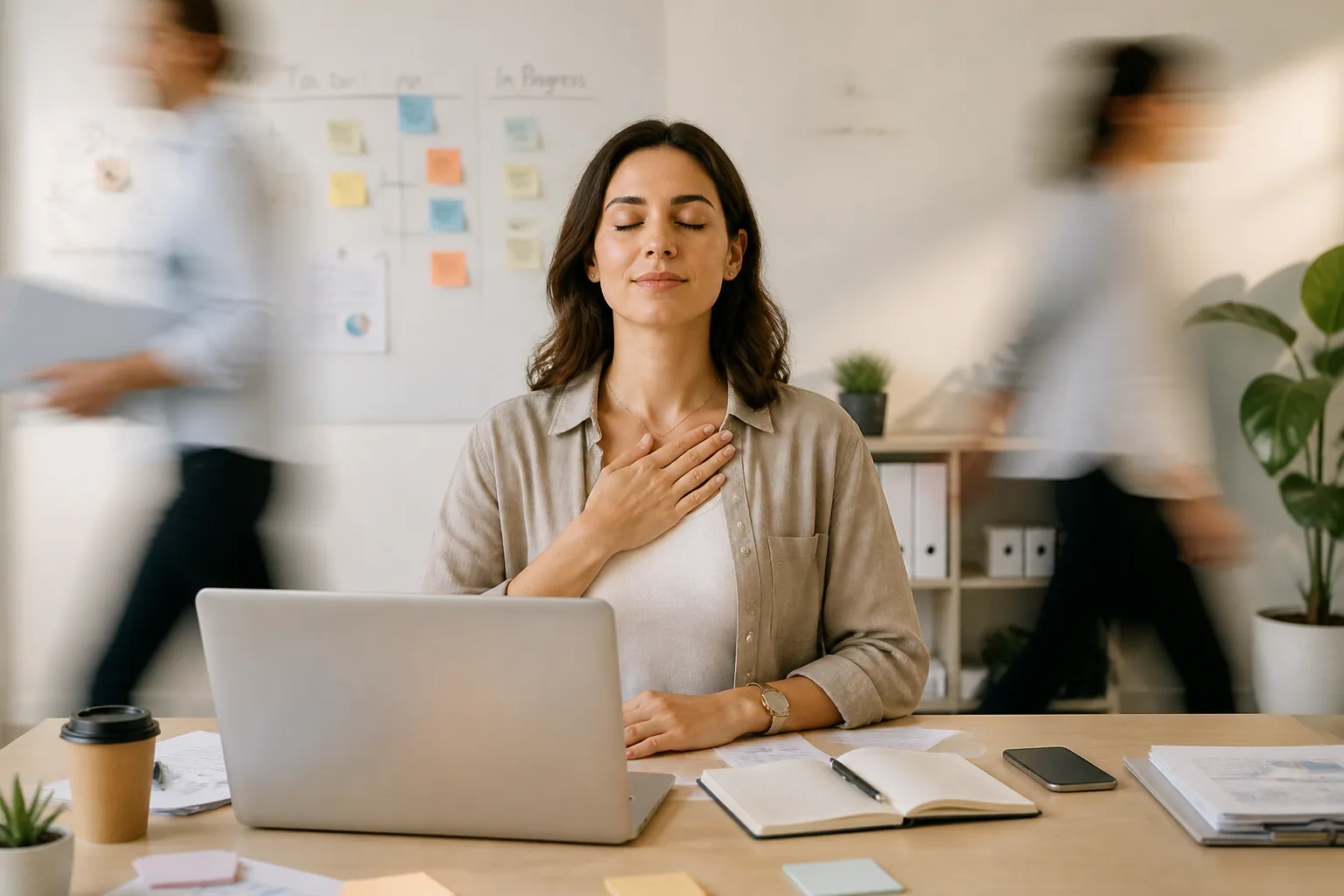
Micro-Breaths, Mega Impact: How 30-Second Breathing Exercises Can Transform Your Day
If your day feels too packed for meditation, journaling, or a full wellness routine, breathing might be the simplest place to start. The best part is that it does not need to take long. In under 30 seconds, a few intentional breaths can help you shift out of stress mode, clear mental fog, and create just enough space to respond instead of react.
That is the power of micro-breaths. They are short enough to fit between meetings, before a difficult conversation, while waiting in the car, or the moment you notice your shoulders creeping up toward your ears. And while they may seem small, they can trigger real physiological changes that influence your heart rate, nervous system, and emotional state.
This is not about replacing sleep, exercise, or deeper breathwork practice. It is about making calm more accessible. When used consistently, these tiny pauses can become a practical reset button for busy professionals, parents, students, and anyone who feels like they do not have time to breathe properly in the first place.
Why 30 Seconds of Breathing Can Change How You Feel
A 30-second breathing exercise may not sound dramatic, but it can interrupt a stress spiral fast. A few slow, intentional breaths can lower the intensity of your body’s immediate stress response and give your brain a different signal than the one it is getting from rushing, multitasking, or worrying.
What makes these short practices so useful is that they are easy to repeat. When something is simple enough to do often, it becomes more realistic to use it in the moments that matter most. Over time, those moments add up. Instead of waiting for a rare hour of calm, you can create tiny pockets of regulation throughout the day.
Research supports the value of breathwork more broadly. A 2023 meta-analysis in Scientific Reports found that breathwork interventions reduced anxiety, depression, and perceived stress in non-clinical populations: https://www.nature.com/articles/s41598-022-27247-y
The Science Behind Micro-Breaths and the Nervous System
Breathing is one of the few automatic body functions you can also control voluntarily, which makes it a direct bridge between your mind and your physiology. When breathing is shallow, fast, or irregular, the body often interprets that as a signal that something is wrong. When breathing slows and lengthens, especially on the exhale, the body tends to move toward a more regulated state.
That regulation matters because the autonomic nervous system is constantly balancing sympathetic activation, the fight or flight response, with parasympathetic activity, the rest and digest response. Breath is one of the fastest ways to influence that balance. In particular, slower paced breathing has been shown to increase parasympathetic activity, improve heart rate variability, and enhance baroreflex sensitivity.
A review in the European Respiratory Society noted that breathing around 6 breaths per minute can maximize heart rate variability and baroreflex sensitivity, which is one reason slow breathing is often used for calming and stress recovery: https://publications.ersnet.org/content/breathe/13/4/298
There is also measurable cardiovascular impact. A meta-analysis of 15 randomized controlled trials found breathing exercises produced average reductions of about 7.06 mmHg in systolic blood pressure, 3.43 mmHg in diastolic blood pressure, and 2.41 beats per minute in heart rate: https://pmc.ncbi.nlm.nih.gov/articles/PMC10765252/
Even when the effect feels subtle in the moment, your body is registering the change. That is why a micro-breath can be enough to interrupt tension, reduce physiological arousal, and create a small but meaningful reset.
What Makes Short Breathwork So Effective for Busy People
Short breathwork works because it removes the usual friction. You do not need a quiet room, a mat, or a long attention span. You just need a cue and a few seconds. That makes it far easier to use in real life, which is the difference between a helpful technique and a practice that sits unused.
Micro-breaths are also effective because they target the moments when people most need support. Stress tends to spike in ordinary places: in a crowded commute, while opening an email thread you have been avoiding, when your child is melting down, or right before you walk into a presentation. In those moments, a long wellness routine may be unrealistic, but 20 to 30 seconds of breathing is possible.
Another reason short practices are appealing is that they offer immediate feedback. Many people notice a softer jaw, less chest tightness, slower breathing, or a brief sense of mental space after just one round. That quick payoff helps with consistency, because the brain is much more likely to repeat something that feels useful right away.
There is also a growing body of research showing that even a few minutes of breathing can influence mood and arousal. In a remote randomized controlled trial, three 5-minute breathing practices over one month, including exhale-focused cyclic sighing, improved mood and reduced physiological arousal more than mindfulness meditation: https://pmc.ncbi.nlm.nih.gov/articles/PMC9873947/
If five minutes can shift state, then a 30-second version can absolutely serve as a bridge in the middle of a demanding day.
The Best 30-Second Breathing Techniques to Try
The goal with micro-breaths is not perfection. It is choosing a pattern that is easy enough to remember and effective enough to use. The best techniques are the ones you will actually reach for when you are stressed, tired, or distracted.
Three of the most practical options are the physiological sigh, a shortened version of 4-7-8 breathing, and simple inhale-hold-exhale patterns. Each one emphasizes the exhale or uses a brief pause to help reset your nervous system.
A useful rule of thumb is this: if you need immediate calming, choose the physiological sigh or a slower exhale pattern. If you want a bedtime-friendly reset, 4-7-8 is often a good fit. If you want something very discreet and easy to do anywhere, an inhale-hold-exhale pattern can be enough.
How to Do the Physiological Sigh
The physiological sigh is one of the fastest ways to settle the body. It uses two quick inhales through the nose, followed by a longer exhale through the mouth. That second inhale helps fully expand the lungs, while the extended exhale encourages release and downshifting.
Try this for about 30 seconds: inhale through your nose, take a second smaller inhale to top off the lungs, then exhale slowly and fully. Repeat two to three times. Keep the exhale longer than the inhale, and let your shoulders drop on the out-breath.
This works especially well because sighs are natural physiological resetters. A review in Biological Psychology describes sighs as helping improve lung compliance, reduce alveolar collapse, and support emotional regulation and relief: https://www.sciencedirect.com/science/article/pii/S0301051122000552
A study in Physiology & Behavior also found that a single deep breath or spontaneous sigh reduced muscle tension and subjective distress more than simple breath holds in high anxiety-sensitive individuals: https://www.sciencedirect.com/science/article/pii/S0031938416305121
If you want one technique to use when you are abruptly overwhelmed, start here.
Quick Versions of 4-7-8 and Inhale-Hold-Exhale Patterns
The traditional 4-7-8 pattern can be shortened to fit a micro-break. You do not need to force exact counts if that makes the practice stressful. Instead, think of it as a longer exhale relative to the inhale.
A simple version is: inhale for 4 counts, hold for 2 to 4 counts, exhale for 6 to 8 counts. Do that two or three times. If 4-7-8 feels too long, use a 3-3-6 rhythm or even 3-2-5. The point is to keep the exhale longer than the inhale.
This pattern can be especially helpful at night. Research on 4-7-8 breathing showed that nightly practice improved sleep quality over four weeks in undergraduate nursing students, including subjective sleep quality, sleep latency, disturbances, and daytime functioning: https://www.sciencedirect.com/science/article/pii/S1876382026000119
Another study found that doing 4-7-8 breathing twice daily for 14 days reduced PSQI sleep scores from 9.5 to 5.7 in Indonesian university students, suggesting a strong improvement in sleep quality: https://ejournal2.unud.ac.id/index.php/mifi/article/view/1111
If holding the breath feels uncomfortable, skip the hold and use a simple inhale-exhale pattern with a longer exhale. Consistency matters more than exact numbers.
When to Use Micro-Breaths During Your Day
The most effective breathing practice is the one you use at the right moment. Micro-breaths work best when they are tied to real-life situations, not just added to an already crowded to-do list.
Think of your day in terms of pressure points and transitions. Those are the easiest moments to interrupt tension and create a small reset. The beauty of a 30-second practice is that it can fit into almost every transition you already have.
Breathing Before Meetings, During Commutes, and in Stress Spikes
Before a meeting, try one physiological sigh or three rounds of a longer exhale pattern. It can help reduce pre-performance tension and make you feel more anchored before you speak. If you are walking into a difficult conversation, the same approach can help you show up less reactive.
During a commute, breathing can be a way to reclaim a moment that otherwise disappears into scrolling or ruminating. At a red light, on a train platform, or while parking, take 20 seconds to slow the exhale and relax the jaw. Even one mini reset can change the tone of the next part of your day.
In a sudden stress spike, the fastest response is often to stop trying to think your way out of it and instead regulate the body first. A few rounds of deliberate breathing can reduce the sense of immediate threat and make problem-solving easier afterward.
You can also use micro-breaths at waking and bedtime. In the morning, they help you ease into the day instead of launching straight into urgency. At night, they can help you transition out of stimulation and toward sleep.
How to Build a Micro-Breath Habit That Actually Sticks
The most common reason breathwork routines fail is not lack of benefit. It is lack of follow-through. A technique that takes 30 seconds is already easier than most habits, but it still needs a system if you want it to last.
Start by attaching the practice to something you already do. This is often called habit stacking. For example: after you open your laptop, do one round of breathing. After you buckle your seatbelt, take three slow exhales. After brushing your teeth at night, do a quick 4-7-8 cycle.
Reminders help too. A gentle notification can serve as a cue until the practice becomes automatic. The key is to make the reminder specific enough to trigger action, not vague enough to be ignored. Instead of saying “breathe more,” tie it to a real moment like “before your first meeting” or “when lunch ends.”
This is one place where a tool like Just Breathe: Relax Daily can be useful, since it offers guided breathing patterns, smart reminders, and progress tracking in one place: https://findthe.app/just-breathe-ujhm1e
Consistency also improves when the practice feels rewarding. If you track your breathing streak, note your mood afterward, or simply write down whether your focus improved, you are giving your brain proof that the habit is working.
How to Track Calm, Focus, and Mood for Fast Motivation
One of the smartest ways to stick with micro-breaths is to pay attention to what changes after you do them. You do not need a complicated system. A few simple notes can be enough to show patterns over time.
Before and after a breathing session, ask yourself three questions: How tense do I feel? How focused am I? How emotionally steady do I feel? Rate each one from 1 to 10, or use a simple word like scattered, steady, tense, or calm. The goal is to make the effect visible.
This kind of tracking can be especially motivating because the payoff from micro-breaths is often subtle in the moment but meaningful across repeated use. You may notice that your recovery time after stress gets shorter, your evenings feel less reactive, or you fall asleep a bit more easily.
If you prefer a more intuitive approach, keep a short note like “before presentation,” “after commute,” or “helped me settle.” The main point is to connect the practice with a real-life result so it feels worth repeating.
A Simple 7-Day Micro-Breath Challenge to Get Started
If you want to make this real without overcomplicating it, try a one-week challenge. The goal is not to master every technique. It is to build enough repetition that breathing becomes a natural response instead of an afterthought.
Day 1: Do one physiological sigh before opening your inbox. Notice how your body feels afterward.
Day 2: Try a shortened 4-7-8 pattern before bed. Use 4 seconds in, a brief hold, and 6 to 8 seconds out.
Day 3: Use three slow exhales before a meeting or class. Focus on relaxing your jaw and shoulders.
Day 4: Practice one reset during your commute or while transitioning from work to home.
Day 5: Use a breathing cue at the moment you feel stress rising, even if it is just one round.
Day 6: Try the same technique twice in the same day and compare your before-and-after mood.
Day 7: Reflect on what felt easiest, what helped most, and when you are most likely to keep using it.
If you keep going after the week, you do not need to do more. You only need to keep showing up for the tiny moments that matter. That is what makes micro-breaths powerful: they fit real life, and because they fit real life, they can actually change it.