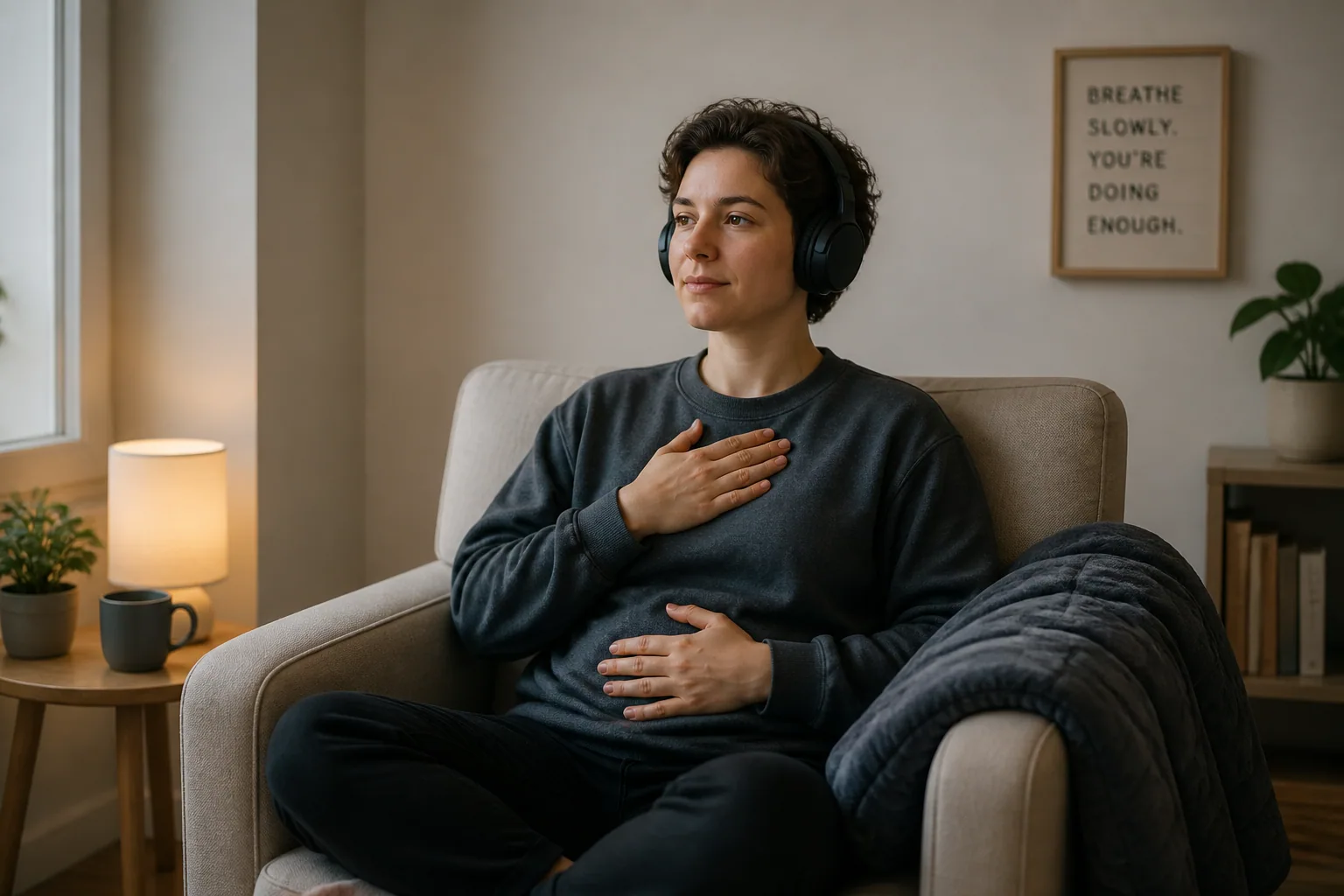
Neurodivergence & Breathwork: How to Design Practices That Feel Safe, Clear, and Sustainable
Breathwork is often presented as something simple: sit down, follow the rhythm, and feel better. But for many neurodivergent adults, that kind of standard approach can feel anything but simple. A room that is too bright, instructions that are too vague, a pace that feels forced, or a group format with no room to opt out can quickly turn a calming practice into an overwhelming one.
If you are autistic, have ADHD, live with sensory sensitivities, or navigate trauma alongside neurodivergence, the difference between helpful breathwork and inaccessible breathwork is often not the technique itself. It is how the practice is designed. When breathwork is made more explicit, flexible, and low-stimulation, it can become something much more usable and supportive.
This article explores why many mainstream breathwork sessions miss the mark, what safety can look like for neurodivergent nervous systems, and how to adapt breathing practices so they feel clear, sustainable, and actually worth returning to.
Why Standard Breathwork Doesn’t Work for Everyone
A lot of breathwork culture assumes a fairly narrow version of comfort. It assumes you can tune out background noise, follow metaphor-heavy guidance, sit still for a set amount of time, and keep breathing in the prescribed way without much friction. That might work for some people. It does not work for everyone.
For neurodivergent people, the problem is often not resistance to breathwork. It is mismatch. The environment may be too loud or visually busy. The instructions may be too abstract. The pace may be too slow or too fast. The session may require more executive function than the person has available that day. In other words, the structure can create stress before the actual breathing even begins.
Research on sensory processing helps explain why. A 2024 meta-analysis of 63 studies involving 11,659 autistic individuals found that sensory processing differences, including hypersensitivity, hyposensitivity, and low sensory registration, were strongly associated with greater mental health difficulties. A separate meta-analysis of 30 studies with 5,374 participants found that people with ADHD report significantly higher levels of sensory sensitivity, sensory avoidance, sensory seeking, and low sensory registration than control groups. In autism, ongoing sensory sensitivities may affect daily life for about 70 to 90 percent of individuals, including responses to sound, light, texture, and even interoceptive cues like hunger and pain. Sources: https://neurobetter.org/advice-hub/neurodiversity/sensory-processing and https://www.chelwest.nhs.uk/services/childrens-services/community-services/cheyne/conditions-and-developmental-differences/sensory-processing-difficulties
That means a traditional breathwork class may ask a neurodivergent person to regulate in a setting that is already dysregulating. If we want breathwork to be supportive, we have to design for sensory reality, not for an idealized version of it.
Neurodivergent Nervous Systems: What Safety Can Look Like
Safety is not just an emotional concept in breathwork. It is also sensory, cognitive, and physical. For many neurodivergent people, a practice feels safe when it gives enough information, enough choice, and enough predictability to reduce the load on the nervous system.
That may look like a teacher saying exactly what will happen next instead of speaking in poetry. It may mean the participant can keep their eyes open, leave their feet on the floor, or stop at any time without explanation. It may mean the session is short, the room is quiet, and the breath pattern is easy to understand without having to hold several steps in working memory.
Trauma-informed breathwork frameworks point in the same direction. They emphasize safety and consent, clear literal instructions, breaks, choice, open eyes, different postures, and avoiding pressure to hold the breath or go beyond comfort. In group settings, readiness checks and environmental changes like low even lighting, minimal sensory distractions, and a predictable layout are linked with less overwhelm and more safety. Sources: https://inspire-breathwork.org/articles/can-breathwork-trigger-trauma-an-honest-answer-for-2026 and https://naturalistico.com/en/learn/blog/trauma-informed-guided-breathwork-sessions-that-stay-safe-6-steps
For neurodivergent adults, this kind of safety is not a bonus. It is the foundation that makes practice possible.
Common Barriers in Breathwork for ADHD, Autism, and Sensory Sensitivities
There are a few recurring barriers that make mainstream breathwork hard to access. One is sensory overload. A room with music, dim light, incense, people moving around, and a long spoken introduction may be too much all at once. Someone may spend the whole session trying to manage discomfort rather than noticing the breath.
Another barrier is executive function. People with ADHD often need practices that reduce setup time and decision fatigue. If a breathwork session requires remembering a complicated sequence, waiting through long explanations, or keeping track of multiple instructions at once, it can become exhausting. Research on mind-body interventions, including mindfulness, yoga, tai chi, and qigong, shows moderate positive effects on executive function in people with ADHD, and these practices often include breath awareness components. Source: https://journals.sagepub.com/doi/10.1177/10870547231154897
A third barrier is interoceptive sensitivity. Breathwork asks people to pay close attention to internal sensations, but that is not always neutral. For some autistic and ADHD adults, attention to the breath can quickly become distracting, uncomfortable, or even activating, especially if there is a history of anxiety, panic, or trauma. Breathwork should never assume that more internal attention is automatically better.
Finally, there is social pressure. In group settings, people may feel pushed to keep pace with everyone else, imitate a breathing style that does not feel right, or ignore their own discomfort because the facilitator seems confident. That pressure alone can make a practice feel unsafe.
The Problem With Metaphor-Heavy or Vague Instructions
A lot of wellness language relies on metaphor. You may be asked to breathe into your heart, let your breath flow like waves, expand your energy field, or soften into the exhale. For some people, that language feels inspiring. For others, it creates confusion.
Literal instruction is often much more supportive for neurodivergent people. Saying breathe in through the nose for four counts, then breathe out through the nose or mouth for six counts is clearer than asking someone to “ride the tide of their breath.” Specific instructions reduce cognitive load and make it easier to know whether you are doing the practice correctly.
This matters because unclear guidance can create a kind of hidden stress. If a person is busy decoding the instruction, they are less likely to settle into the experience. And if they are unsure whether they are “doing it right,” breathwork can start to feel like another performance instead of a support.
The best instruction style for accessibility is usually not the most poetic one. It is the one that is concrete, repeatable, and easy to follow even on a low-energy day.
Why Choice Matters: Posture, Pace, Eyes Open or Closed
Choice is one of the simplest and most important accessibility tools in breathwork. People regulate better when they can make small adjustments instead of being locked into a single format.
Posture is a good example. Some people regulate best sitting upright. Others need to lie down. Others may prefer standing, leaning against a wall, or sitting in a chair with their feet planted. There is no universally correct position. The right posture is the one that helps the body feel supported enough to breathe without strain.
Pace matters just as much. A slower breath pattern is often more regulating, but not if it feels restrictive or difficult to maintain. Some people need a gentler starting point, such as simply noticing the exhale, rather than jumping straight into structured breath counting. Others may do better with a pattern that has a clear beat and predictable rhythm. Techniques that emphasize slow exhale, diaphragmatic breathing, rhythmic repetition, and resourcing are often especially useful for trauma-affected or neurodivergent individuals. Source: https://www.alysebreathes.com/knowledge/breathwork-articles/trauma-informed-breathwork
Eyes open or closed is another small but meaningful choice. For some people, closing the eyes makes it easier to focus. For others, it increases vulnerability or disorientation. Giving permission to keep the eyes open can make the practice much more accessible without reducing its effectiveness.
Designing Low-Sensory, Flexible Breathwork Sessions
If you are designing breathwork for neurodivergent adults, think low-sensory first. That does not mean sterile or empty. It means intentional.
A supportive environment usually has even lighting, predictable seating, minimal background noise, and as few competing sensory inputs as possible. If music is used, it should be optional, low volume, and not layered with strong verbal instruction unless participants can easily manage both. In group settings, the layout should be easy to read at a glance so that nobody has to spend energy figuring out where to sit or what to do next.
Flexibility should be built in from the beginning. That includes the option to pause, step out, change posture, use a shorter round, or simply observe. It also includes a readiness check at the start, so participants can notice whether they are arriving regulated, activated, tired, or somewhere in between. That kind of quick self-assessment helps prevent the common mistake of treating all bodies as if they are ready for the same practice.
It can also help to offer one clear pattern at a time. Too many options can be as overwhelming as too few. A simple structure with clear choice points is often better than a complex menu of techniques.
If you want an easy way to support this kind of practice at home, a tool like Just Breathe: Relax Daily can help keep sessions simple and consistent. It offers guided breathing patterns, gentle visual animations, ambient sounds, reminders, and tracking features in one place: https://findthe.app/just-breathe-ujhm1e
Shorter Practices, Better Outcomes: Sustainable Over Intense
More is not always better. In fact, for many neurodivergent people, shorter breathwork practices are more sustainable and more likely to be repeated. A five-minute practice that feels manageable will usually do more good over time than a 30-minute practice that becomes overwhelming and is abandoned after two tries.
This is especially true when energy is variable, which is common for people with ADHD, autistic burnout, chronic stress, or co-occurring anxiety. A practice that only works on “good days” is not very supportive. Breathwork should ideally meet people where they are, not where a wellness ideal says they should be.
Short sessions also reduce the chance that a person will drift into overload, zoning out, or agitation. If the aim is regulation, then a sustainable dose matters. You want enough repetition to make the pattern familiar, but not so much intensity that the nervous system treats the practice itself as another demand.
In many cases, a few slow cycles with a long exhale are enough to create a noticeable shift. The goal is not to prove endurance. The goal is to make the practice repeatable.
What the Research and Clinical Practice Suggest About Regulation and Executive Function
The research on breathwork is not saying that breathing exercises solve everything. But it does suggest that they can be meaningful when used carefully.
A scoping review of breathwork interventions for adults with clinically diagnosed anxiety disorders found that slow diaphragmatic or deep breathing techniques can reduce anxiety symptoms, improve physiological markers such as heart rate variability, and enhance psychosocial functioning. Source: https://www.ncbi.nlm.nih.gov/pmc/articles/PMC9954474/
Other research suggests that interoceptive interventions around breathing, including breath-focused meditation or slowing the breath rate to around five breaths per minute, engage brain networks involved in interoception, attention, emotion regulation, and executive function, including the insula, anterior cingulate cortex, and prefrontal cortex. Source: https://pmc.ncbi.nlm.nih.gov/articles/PMC7805576/
A separate fMRI study found that interoceptive attention to breath reduced widespread cortical activity while preserving connectivity in executive control networks, and that higher self-reported interoceptive awareness was linked to preserved activation in the ACC and language areas. Source: https://pmc.ncbi.nlm.nih.gov/articles/PMC10295813/
Taken together, these findings suggest a useful idea: breathwork may support self-regulation not by forcing the body into a fixed state, but by creating a more workable relationship between attention, sensation, and recovery. For neurodivergent adults, that relationship has to be tailored carefully. The same breath pattern that helps one person settle may be too much for another if it comes with pressure, sensory overload, or unclear instructions.
How Therapists, Caregivers, and Facilitators Can Make Breathwork More Inclusive
If you work with neurodivergent adults, inclusion starts before the practice begins. Explain the purpose of the exercise in plain language. Tell people how long it will take. Describe the posture options. Say explicitly that they can keep their eyes open, skip any part, or stop whenever they need to.
It also helps to normalize adaptation. Do not present modifications as exceptions or failures. Make them part of the practice. If someone needs to breathe more gently, use a smaller range, or simply notice the breath without changing it, that is still participation.
Facilitators should also be mindful of tone. Gentle does not mean vague. Calm does not mean mysterious. Clear instructions delivered in a steady, respectful way are often more soothing than elaborate spiritual language. And if a participant appears overwhelmed, the response should be to reduce demands, not increase encouragement.
Caregivers and therapists can use breathwork as a regulation tool, but only when it is paired with consent and observation. If breathing exercises consistently trigger distress, try a different regulation strategy first. Breathwork should be one option among many, not a rule that everybody has to follow.
A Simple Neurodivergent-Friendly Breathwork Template to Try
Here is a simple template that aims for clarity, choice, and low sensory demand.
Sit or lie down in a position that feels comfortable. Keep your eyes open or closed, whichever feels better.
Notice the room around you for a moment. If it helps, choose one anchor, such as a foot on the floor, the feeling of your hands, or a sound in the distance.
Breathe in through your nose for a count of four. Breathe out for a count of six. If that feels too long, shorten the count.
Repeat for five breaths. If you lose track, start again or simply return to noticing the exhale.
At the end, check in with yourself. You do not need to feel dramatically different. Even a small shift toward steadiness counts.
This kind of practice is intentionally uncomplicated. It does not require peak focus, perfect posture, or a special mood. It just gives the nervous system a clear rhythm and enough freedom to stay within comfort.
That is the core idea behind neurodivergent-friendly breathwork: not intensity, but adaptability. Not forcing the breath, but supporting the person. When breathwork is designed this way, it becomes more than a wellness trend. It becomes a genuinely usable tool for regulation, reflection, and everyday care.