Breathwork & Biofeedback: How Real-Time Data Can Improve the Way You Breathe
Breathwork can feel surprisingly subjective at first. Some days it feels calming right away, other days it feels awkward, and sometimes it is hard to know whether you are actually doing it well. That is where biofeedback changes the experience. Instead of guessing, you can see what your breathing is doing in real time and use that information to adjust your rhythm, depth, and pace. For many people, that makes practice more motivating, more measurable, and easier to repeat consistently.
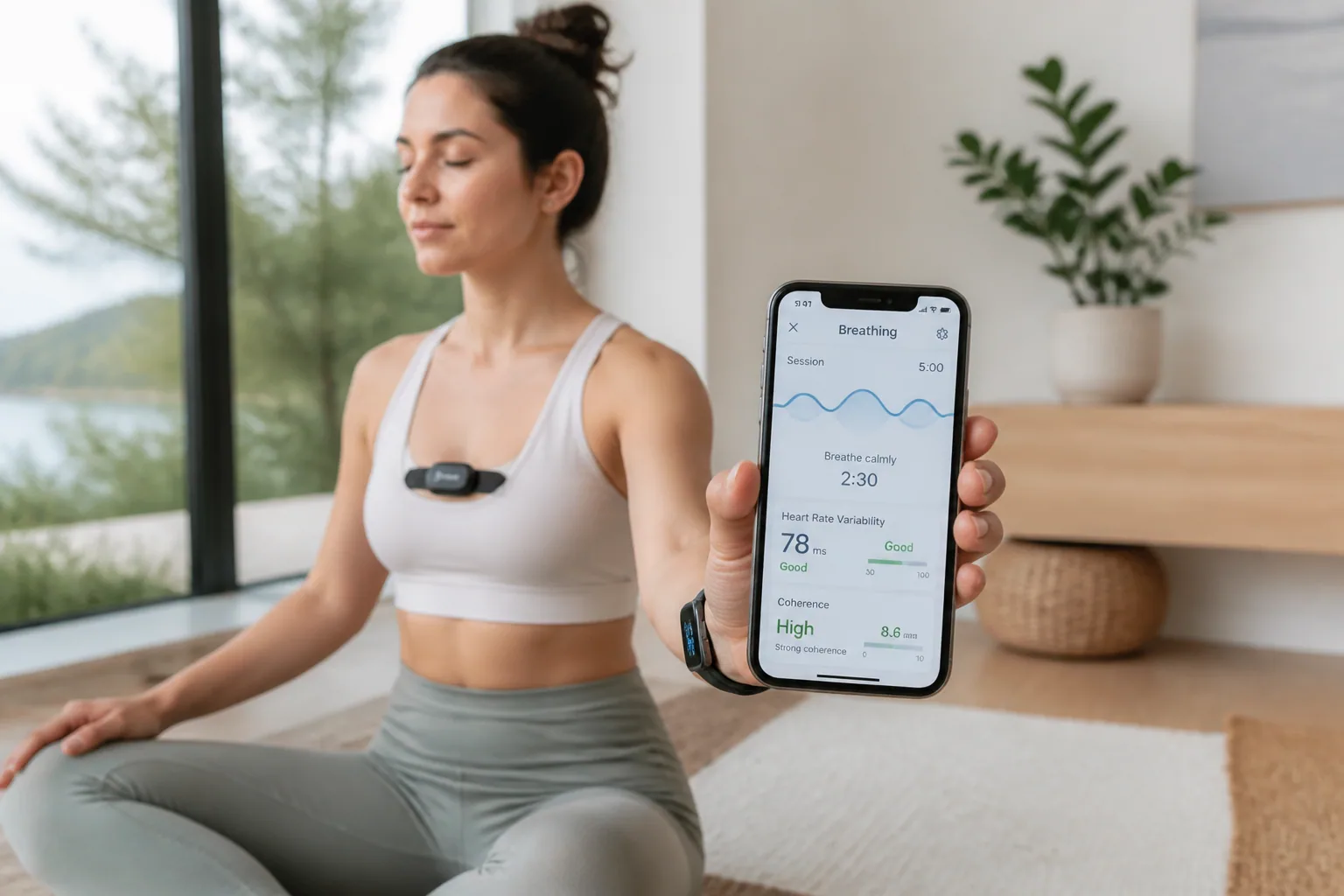
Real-time feedback does not replace body awareness. It sharpens it. When you can observe changes in respiratory rate, heart rate variability, or coherence as you breathe, the practice becomes more concrete. You start noticing patterns: which pace helps you settle, which exhale length feels smooth, and when your system is being pushed too hard. That combination of inner sensing and outside data is what makes breathwork and biofeedback such a powerful pair.
Why Breathwork Feels Different When You Can See It
A lot of people begin breathwork with a simple goal: feel calmer, sleep better, or reduce stress. But without feedback, it can be difficult to know whether your breathing pattern is actually moving you in that direction. Biofeedback makes the process visible. Seeing a heart rate settle, a rhythm stabilize, or a breathing trace smooth out gives you immediate confirmation that something is working.
That matters because breathwork is partly a skill. Like learning a musical instrument or refining a workout, progress often happens through tiny adjustments. Real-time data helps you notice those adjustments sooner. You may discover that a slightly slower pace feels better than a very slow one, or that longer exhales help you relax without forcing the breath. In other words, feedback shortens the learning curve.
It also creates a sense of engagement. A practice that is easy to drift through becomes easier to stay with when you have a clear signal to follow. Whether it is an animation, a pulse cue, or a live reading on a wearable, the feedback gives your attention something specific to anchor to.
What Biofeedback Means in Breathwork
Biofeedback simply means using information from your body to influence your behavior. In breathwork, that usually means tracking signals like heart rate, breathing rate, or heart rate variability while you practice. The goal is not to chase perfect numbers. The goal is to use those numbers as a mirror.
When people talk about breathwork biofeedback, they are often referring to tools that show how your breathing affects your nervous system. Slow breathing, especially when paced near your resonance frequency, tends to amplify signals related to parasympathetic activity and cardiovascular regulation. This is one reason it is so commonly used in stress management and relaxation training.
Research supports this connection. A meta-analysis of 223 studies found that voluntary slow breathing, paced around 4.5 to 6 breaths per minute, increased vagally mediated heart rate variability during breathing, right afterward, and across multi-session interventions, suggesting stronger parasympathetic function over time. Source: https://www.sciencedirect.com/science/article/pii/S0149763422002007
Biofeedback makes that effect easier to access because you are not relying only on how the breath feels. You can see whether the technique is producing the pattern you want, which can be especially useful for beginners or for anyone who wants a more structured practice.
The Key Metrics: Respiratory Rate, HRV, RSA, and Coherence
If you are new to breathing metrics, the terms can sound more technical than they really are. Here is the simple version. Respiratory rate is how many breaths you take per minute. Heart rate variability, or HRV, is the natural variation in time between heartbeats. Respiratory sinus arrhythmia, or RSA, is the heart rate pattern that rises during inhalation and falls during exhalation. Coherence is a broader term used to describe a smooth, regular breathing-heart rhythm pattern that many people aim for in paced breathing.
Respiratory rate is the easiest to understand and often the easiest to track. It tells you whether you are breathing fast, slow, or somewhere in between. In breathwork, slower is often used for relaxation, but slower does not automatically mean better. The key is finding a pace that your system responds to well.
HRV is one of the most talked-about wellness metrics because it is associated with autonomic flexibility. In simple terms, higher vagally mediated HRV often suggests that your body can shift more easily into a calmer state. A recent review of six studies on slow breathing plus HRV biofeedback found significant improvements in HRV parameters, especially in the high-frequency band linked to parasympathetic activity, along with increases in RSA and better cardiovascular regulation. Source: https://pubmed.ncbi.nlm.nih.gov/40252198/
RSA deserves special attention because it is closely tied to the breathing rhythm itself. A perspective article from 2026 explains that Respiratory Heart Rate Variability, also called RSA, arises from brainstem modulation of cardiac vagal neurons linked to breathing rhythm, and accurate measurement requires recording both respiratory and heart signals. It also notes that HF-HRV and peak-to-valley methods are commonly used. Source: https://www.sciencedirect.com/science/article/abs/pii/S0301051126001122
Coherence is a little less standardized as a scientific term, but in practical breathwork it usually refers to a stable, even rhythm that supports smoother heart and breathing patterns. Many systems aim for around 5 to 6 breaths per minute, which is close to resonance frequency for many people.
That resonance idea matters. Breathing at resonance frequency, often around 5 to 6 breaths per minute, has been shown to produce maximal amplitudes of RSA and HRV compared with slightly faster or slower rates. Source: https://www.frontiersin.org/journals/public-health/articles/10.3389/fpubh.2017.00222/full
How Breath Tracking Tools Actually Measure Your Signals
Different tools measure different things, and that affects how useful they are for your practice. Some estimate breathing rate directly from motion or airflow. Others infer breath effects through heart patterns. Some combine both. The best tool depends on whether your main goal is relaxation, training accuracy, sleep support, or learning more about your own physiology.
Wearables often use optical heart sensors and motion data to estimate trends in heart rate and sometimes breathing rate. They are convenient, but they are not always precise for nuanced breathwork. App-based tools can guide rhythm well and make practice easier to follow, but many of them are not measuring physiology directly. Chest sensors and dedicated respiratory devices tend to be more accurate for tracking breathing itself because they can capture expansion and contraction more directly.
The practical takeaway is simple: if you want a gentle guided practice, a visual app may be enough. If you want more exact feedback on resonance frequency or respiratory patterns, a chest-based or respiration-aware setup is often better. If you want both convenience and a reasonable sense of progress, a wearable can be a good middle ground.
Wearables vs Apps vs Sensors: Which Tool Fits Which Goal
Wearables are best when you want breathwork to fit into daily life. They are portable, familiar, and often already part of your routine. If your goal is stress reduction, habit building, or seeing broad trends over weeks, a wearable may give you enough information to stay engaged without overcomplicating the process.
Apps are best when the rhythm itself matters. A guided breathing app can pace your inhale and exhale, show simple animations, and help you stay on track. That is especially useful if you are practicing box breathing, coherent breathing, or relaxation breathing before sleep. For many people, the visual cue is the main reason the practice stays consistent.
Sensors are best when precision matters. If you are trying to identify your resonance frequency, compare different inhale-to-exhale ratios, or study how your body responds to a specific pattern, more direct measurement is helpful. A chest sensor or other respiration-focused setup can give you a cleaner signal than a general-purpose wellness tracker.
The newest research also suggests that adaptive biofeedback may improve the experience further. A 2026 study reported that a system using guided breathing, real-time heart rate, HRV, and respiration feedback, while adapting breathing rate toward resonance frequency, reduced respiration rate and electrodermal activity and increased HRV. That supports the idea that feedback can be both technically feasible and physiologically meaningful. Source: https://www.nature.com/articles/s41598-026-46105-9
Best At-Home Biofeedback Setups for Beginners and Data Lovers
For beginners, the best setup is usually the one you will actually use. A simple app with a calming visual guide can be enough to build consistency and teach pacing. If you like structure, choose something that includes reminders, history, and session tracking so you can notice patterns over time.
For data lovers, a more layered setup can be more satisfying. One option is to use a guided breathing app alongside a wearable or chest sensor, then compare how different sessions feel and what the numbers show. That gives you both the subjective side of practice and the objective side, which is often where the most useful insights appear.
A good home setup should answer three questions: What pace am I using? How is my body responding? Am I consistent enough to notice change? If your tools can help with those, you have enough to get started without building a lab in your living room.
If you want a simple place to begin, a guided app like Just Breathe: Relax Daily can make the practice easier to stick with because it combines visual breathing cues, timed patterns, ambient sounds, and session tracking in one place. You can explore it here: https://findthe.app/just-breathe-ujhm1e
Using Real-Time Feedback to Improve Technique
The biggest advantage of real-time feedback is that it helps you make micro-adjustments. If your breathing is too shallow, too fast, or irregular, you can see it immediately and soften the effort. If your heart rate settles when your exhale lengthens, that can guide you toward a more effective pattern.
One of the most useful techniques is slowing down gradually instead of forcing a target pace right away. Many people do better when they ease toward 5 to 6 breaths per minute rather than jump straight there. This lets the nervous system adapt without feeling strained. In fact, slow breathing studies often show benefit when the practice is paced gently and sustained long enough to settle the system.
Longer exhales can also help. Several studies have found that an inhale-to-exhale ratio such as 1:2 may improve HRV metrics, although not every study finds the same effect. That means the ratio is worth exploring, but it is not a universal rule. Your own response matters.
The best way to use feedback is as a guide, not a grade. If the data show that a certain pattern produces smoother breathing and a calmer heart rhythm, lean into it. If the same pattern feels strained, adjust. Good breathwork is rarely about perfection. It is about finding a rhythm your body can accept and repeat.
How to Spot Progress Without Overtraining Your Nervous System
It is possible to overdo breathwork, especially if you treat every session like a performance test. Pushing too hard can make the practice feel uncomfortable or overly stimulating. Some people chase a number and lose sight of the actual goal, which is often nervous system regulation, not optimization for its own sake.
Progress usually looks subtler than people expect. You may recover faster after stress, settle into a breathing rhythm more quickly, or need less effort to reach a calm state. Over time, you might notice steadier energy, easier sleep onset, or fewer moments of shallow, anxious breathing during the day.
The research points toward a few sensible guardrails. A systematic review of 58 clinical trials found that effective breathing interventions for stress and anxiety usually included slower-than-usual breath pacing, sessions lasting at least 5 minutes, multiple sessions, and some human guidance. By contrast, very short sessions, fast-only pacing, and lack of guidance were linked to weaker effects. Source: https://pubmed.ncbi.nlm.nih.gov/38137060/
That is a helpful reminder that more intensity is not better. A regular, moderate practice is usually more sustainable than an aggressive one. If you feel lightheaded, tense, or fixated on the numbers, the practice needs to be softened.
When the Numbers Help and When They Get in the Way
Numbers help when they create clarity. They tell you whether you are breathing too quickly, whether a certain pace seems to support HRV, and whether your sessions are becoming more consistent over time. They can also reinforce motivation when your subjective sense of progress is slow.
But numbers get in the way when they become the only thing that matters. A session can be successful even if the metrics are imperfect. You might feel more present, sleep better, or exit a session with less mental clutter without seeing a dramatic chart change. That still counts.
There is also a danger in becoming too dependent on devices. If you can only relax when a screen tells you that you are doing it right, the practice can lose some of its simplicity. A healthy approach is to let the data teach you, then gradually internalize the pattern so you can breathe well even when the device is off.
How to Build a Daily Practice Without Becoming Device-Dependent
The best breathwork practice is one you can keep doing. To build that kind of consistency, start with a simple routine and use biofeedback as training wheels, not a permanent crutch. For example, practice once a day for 5 to 10 minutes, at the same time if possible, and choose one clear goal such as calming down, focusing, or preparing for sleep.
As you practice, notice how the body feels before, during, and after the session. The device can show you the pattern, but your own sensations tell you whether the pattern is useful. Over time, try to reduce your reliance on the screen by checking the data less often and paying more attention to breath comfort, posture, and ease.
A good rhythm for habit-building is to use feedback frequently at first, then more selectively. That way, the data helps you learn the skill without becoming the skill itself. The end goal is to breathe well in real life, not only during a guided session.
What the Research Says About Stress, Sleep, Energy, and Consistency
The evidence for breathwork is encouraging, especially for stress regulation. Slow breathing has repeatedly been associated with improved parasympathetic activity and better HRV markers, which supports a calmer physiological state. The combination of slow breathing and biofeedback appears especially promising because it makes the intervention more precise and easier to repeat.
That said, the science is not magical or uniform. A large randomized trial of about 400 adults found that coherent breathing at around 5.5 breaths per minute improved mental health, stress, anxiety, and wellbeing, but it was not significantly more effective than a faster breathing placebo for most outcomes over 4 weeks with 10 minutes per day. Source: https://pmc.ncbi.nlm.nih.gov/articles/PMC10719279/
This is important because it shows both the promise and the limits of breathwork. Breathing exercises can help, but not every named pattern is dramatically superior in every context. Benefits often come from consistency, attention, and the simple fact of slowing down to regulate the system.
In everyday life, that can translate into practical wins. A short session before bed may help you unwind. A few minutes during the workday may help you reset after stress. A steady practice over weeks may make your baseline state feel more stable. Even when the effect is subtle, repetition can compound.
Simple Ways to Start Using Biofeedback in Your Breathwork This Week
If you want to begin without overcomplicating things, start small. Pick one breath pattern, one time of day, and one signal to watch. For most beginners, a paced breathing session of 5 minutes is enough to learn something useful. Slow the breath gently, aim for comfort, and notice what happens to your body.
Here is a simple approach: first, breathe at a natural pace and observe. Then slow slightly and see whether the breath feels smoother. If you are using a biofeedback tool, watch whether the heart rhythm steadies or the session feels more relaxed. If the pattern feels good, repeat it for several days before changing anything.
You can also experiment with longer exhales, especially if your goal is relaxation or sleep support. If you like structure, try a session with a visual guide, a breathing reminder, or a calm audio track to make the practice easier to sustain. The point is not to chase every metric at once. The point is to use feedback to make breathing clearer, calmer, and more consistent.
Over time, biofeedback can turn breathwork from a vague wellness habit into something more tangible. You can see your progress, refine your technique, and learn what truly works for your body. And as your confidence grows, the best result is often this: you become less dependent on the device because you have learned to recognize the feeling of a good breath from the inside.