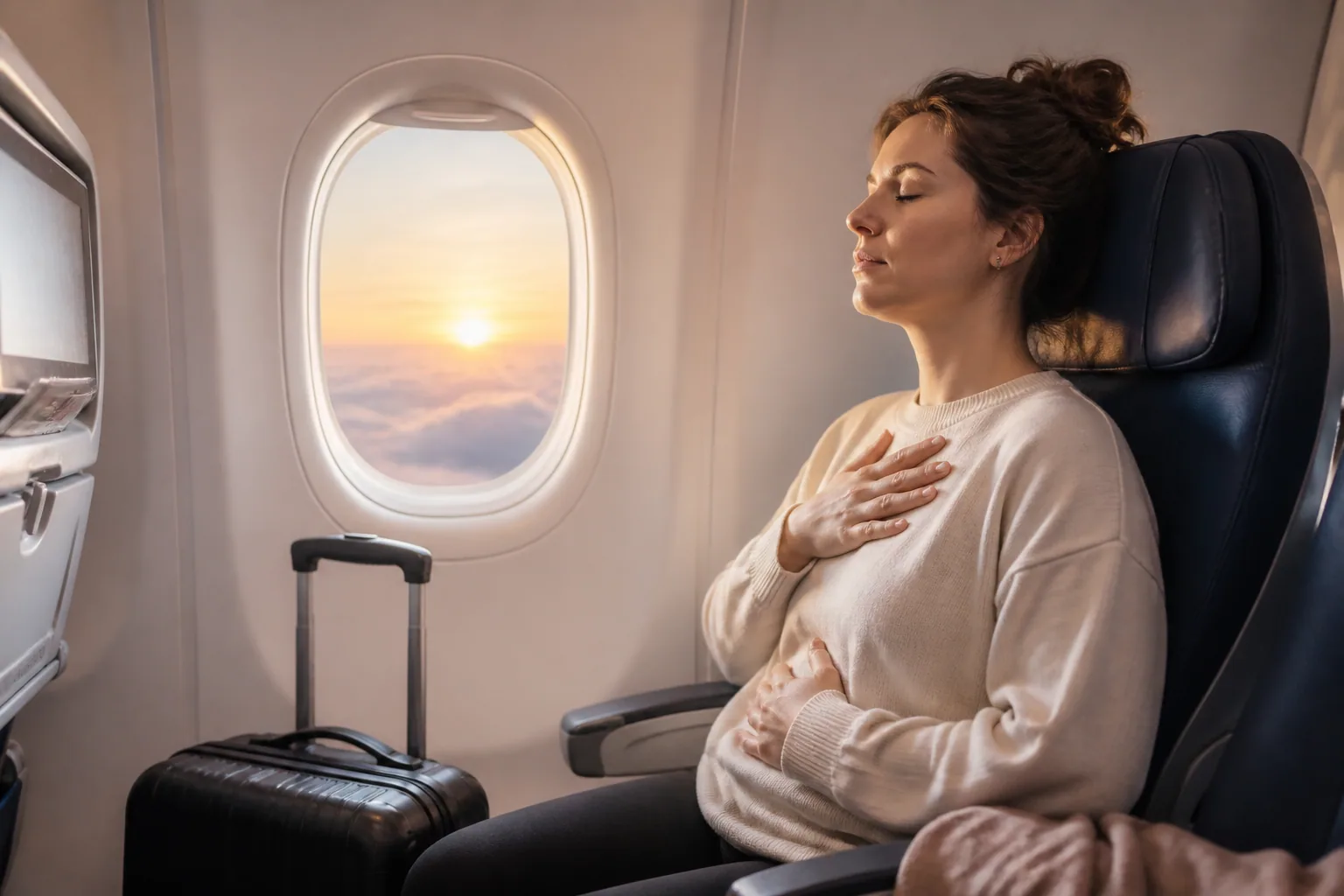
Optimal Breathwork for Travel: Simple Routines to Beat Jet Lag and Recover Faster
Long flights can do more than leave you tired. Between cabin pressure changes, very low humidity, stress, cramped seating, sleep disruption, and dehydration, travel can quietly push your breathing out of balance and make jet lag feel even worse. The good news is that a few simple breathwork practices can help you feel calmer before boarding, steadier in the air, and more resilient after landing. When you pair breathing with light exposure, hydration, and movement, you give your body a better chance to recover quickly and reset its clock.
Why Flying Disrupts Your Breathing and Energy
Flying changes the environment in ways the body notices immediately. During long-haul flights, cabin air is usually pressurized to about 6,000 to 8,000 feet, which lowers oxygen partial pressure and can mildly reduce blood oxygen levels. According to the CDC Yellow Book, that mild hypoxia can contribute to fatigue and a heavier, more sluggish feeling in the body: https://www.cdc.gov/yellow-book/hcp/travel-air-sea/air-travel.html
Humidity is another major issue. Aircraft cabins are typically very dry, often around 10 to 20 percent relative humidity. Research summarized in PMC found that resting ventilatory water loss can rise from about 160 mL/hour at 60 percent humidity to about 360 mL/hour at 12 percent humidity. That extra water loss can leave you feeling drier, more tired, and less sharp than you expected: https://pmc.ncbi.nlm.nih.gov/articles/PMC7551461/
On top of that, travel fatigue is not only about crossing time zones. A systematic narrative review on travel fatigue notes that sleep loss, cramped seating, mild hypoxia, and dehydration can all contribute, even when jet lag is not the main issue: https://www.mdpi.com/2075-4663/14/3/93
The Link Between Shallow Breathing, Stress, and Jet Lag
When you are stressed, uncomfortable, or trying to sleep upright in a seat, it is easy to shift into shallow chest breathing. That usually means a faster respiratory rate, less efficient oxygen exchange, and more tension through the shoulders and upper chest. Over time, that breathing pattern can reinforce the sense that you are wired, foggy, and unable to settle.
This is where breathwork becomes useful. Slow, diaphragmatic breathing helps lower respiratory rate, increases tidal volume, activates the parasympathetic nervous system, and reduces muscle tension. In plain terms, it helps the body move from a travel-stressed state toward a calmer, more recoverable one. A review on breathwork and mental health describes these benefits as especially relevant for relaxation and stress relief during everyday life, and the same logic applies in transit: https://www.simplypsychology.com/articles/breathwork-types-mental-health
Jet lag itself is driven by circadian misalignment, but the travel process often makes it worse. If you land already dehydrated, overactivated, and under-rested, your body has a harder time adapting to the new time zone. That is why short breathing routines can be so effective. They do not replace sleep, but they can lower the stress load your system carries into the trip.
Breathwork Basics: What Actually Helps During Travel
For travel, the most useful breathwork practices are simple, portable, and easy to do in a seat. The best options are usually the ones that slow you down without making you dizzy or uncomfortable. In general, you want practices that support calm, improve breathing efficiency, and regulate the nervous system.
Three methods stand out. First is slow diaphragmatic breathing, which helps you breathe lower and deeper instead of high and tight in the chest. Second is coherent or resonance breathing, usually around 5 to 6 breaths per minute, which is often used to support heart rate variability and emotional steadiness. Third is the physiological sigh, a double inhale followed by a long exhale, which can quickly reduce tension and help reset breath mechanics during stressful moments.
There is also encouraging evidence that structured breathwork can work quickly. In a randomized controlled trial comparing three 5-minute daily breathwork routines with mindfulness meditation, the breathwork practices, especially exhale-focused cyclic sighing, led to greater improvements in mood and reductions in respiratory rate and physiological arousal over one month. That makes breathwork especially practical for travel, where time and space are limited: https://pmc.ncbi.nlm.nih.gov/articles/PMC9873947/
Slow Diaphragmatic Breathing for Pre-Flight Calm
If you tend to feel anxious at the airport, slow diaphragmatic breathing is one of the easiest ways to settle yourself before boarding. The goal is to let the abdomen expand on the inhale and soften on the exhale, while keeping the shoulders relaxed. You are not trying to force very deep breaths. You are trying to make the breath smooth and easy.
A simple version is this: inhale through the nose for 4 counts, letting the belly rise; exhale for 6 counts, letting the belly fall; repeat for 3 to 5 minutes. A slightly longer exhale often encourages relaxation without creating strain. If your mind is busy, count each breath cycle or focus on the physical feeling of your lower ribs moving.
This kind of breathing works well before security, during long boarding delays, or while sitting at the gate. It can also help if you are already feeling that familiar pre-travel tightness in the chest. The main advantage is that it is subtle enough to do almost anywhere, including crowded terminals.
Nasal Coherence Breathing to Stay Steady In-Flight
Coherent breathing, sometimes called resonance breathing or cardiac coherence, is especially useful in the air because it is steady, predictable, and easy to pair with listening to music or watching a screen. The basic pattern is smooth nasal breathing at around 5 to 6 breaths per minute, with inhalation and exhalation of similar length. Research has shown that breathing at about 5.5 breaths per minute with an equal inhale-to-exhale ratio can increase HRV, which is associated with greater autonomic flexibility and less anxiety: https://www.sciencedirect.com/science/article/pii/S0167876013003346
In practice, a travel-friendly version might look like this: inhale through the nose for 5 seconds, exhale through the nose for 5 seconds, and continue for 3 to 5 minutes. If that feels too slow, try 4 seconds in and 4 seconds out. The key is consistency, not perfection.
Nasal breathing has another advantage during flights because it naturally slows and filters the breath. For many travelers, this makes it easier to stay centered while the cabin environment feels dry, noisy, and overstimulating. If you use a breathing app or a visual guide, coherent breathing becomes even easier to maintain.
If you want a simple tool for this, Just Breathe: Relax Daily can be a helpful companion for travel routines. It includes guided breathing patterns like Cardiac Coherence and Box Breathing, plus gentle visual animations and reminders that make it easier to stay consistent on the road: https://findthe.app/just-breathe-ujhm1e
Physiological Sighs for Layovers, Delays, and Mid-Flight Stress
Sometimes you do not need a long practice. You just need a fast reset. That is where the physiological sigh comes in. It is a double inhale, usually through the nose, followed by a long exhale. This pattern can help re-expand partially collapsed air sacs in the lungs, improve lung mechanics, and reduce stress quickly.
A review on the psychophysiology of the sigh explains that sighing plays a role in restoring lung function and reducing stress, while experimental work has linked sigh-based breathing patterns to better respiratory stability. For travelers, that makes physiological sighs a useful tool during turbulence, unexpected delays, or moments when you feel trapped and tense.
Try 1 to 3 physiological sighs when you feel your body spike into stress. Take one inhale through the nose, top it off with a second small inhale, then exhale slowly and fully through the mouth or nose. After that, return to normal breathing. You do not need to repeat it endlessly. A few cycles are often enough to change how you feel.
A 3-Minute Pre-Flight Breathwork Routine
Before boarding, keep it simple. The point is to lower baseline stress so your nervous system is less reactive once the trip begins. Here is a quick 3-minute routine that works well in an airport lounge, at the gate, or even standing quietly near your bag.
Minute 1: Sit or stand tall and do slow diaphragmatic breathing. Inhale through the nose for 4 counts and exhale for 6 counts. Let your belly move more than your chest.
Minute 2: Shift into coherent breathing. Inhale for 5 counts and exhale for 5 counts through the nose. Try to smooth out the breath so there are no sharp edges or pauses.
Minute 3: Finish with 3 physiological sighs if you still feel keyed up, or continue the 5-second rhythm if you want to stay calm and focused. This is especially helpful before a red-eye, a business trip, or any flight where you want to arrive with more emotional bandwidth.
A 5-Minute In-Seat Routine for Long-Haul Flights
Once you are in your seat, comfort and discretion matter. A good in-seat routine should be subtle enough to do without drawing attention. It should also avoid over-breathing, which can make you feel lightheaded if you push too hard.
Start with 2 minutes of nasal coherent breathing at about 4 to 5 seconds in and 4 to 5 seconds out. Then do 1 minute of diaphragmatic breathing with a slightly longer exhale, such as 4 in and 6 out. Follow that with 1 minute of normal breathing while you relax your jaw, shoulders, and hands. End with 1 minute of slow exhale-focused breathing or 2 to 3 physiological sighs if you need to release stress.
If you can, combine the routine with a brief posture reset. Unclench your stomach, place both feet on the floor, and gently lengthen your spine. Breathwork works better when the body is not bracing against itself. Even a few minutes can make the cabin feel more manageable.
A Post-Landing Breath Reset to Support Circadian Recovery
After landing, your main goal is not only to feel calmer but also to help your body switch into the new time zone. Breathwork can support that transition by reducing stress and preventing the arrival day from feeling like a full nervous system crash.
A good post-landing reset is 5 minutes long. Begin with 2 minutes of slow nasal breathing. Then do 2 minutes of coherent breathing at a comfortable 5 to 6 breaths per minute. Finish with 1 minute of normal breathing while you notice your surroundings, the temperature, and your posture. This gives your body a signal that the flight is over and the new environment is real.
Then pair the breathwork with circadian strategies. Timed bright light exposure helps reset the body clock, especially when aligned to the direction of travel. The CDC recommends using light strategically after jet lag, and research shows that bright light after transatlantic travel can reduce subjective jet lag symptoms over the following days: https://www.cdc.gov/yellow-book/hcp/travel-air-sea/jet-lag-disorder.html and https://pubmed.ncbi.nlm.nih.gov/25945550/
How to Pair Breathwork With Light, Hydration, and Movement
Breathwork is strongest when it is part of a small recovery system. The three biggest companions are light, hydration, and movement. Light tells the brain when to be awake. Hydration helps counteract the very dry cabin air. Movement helps circulation after long periods of sitting.
If you are traveling east, the body usually needs to advance its clock, which is biologically harder than delaying it. A Frontiers in Physiology review notes that eastward recovery often takes longer than westward recovery because phase advances are harder to achieve. That is why morning light, sleep timing, and even melatonin may be more useful on eastbound trips than on westbound ones: https://www.frontiersin.org/journals/physiology/articles/10.3389/fphys.2019.00927/pdf?isPublishedV2=false
For eastward travel, some studies suggest that combining morning bright light, afternoon melatonin, and shifting sleep about one hour earlier for several days before departure may help the body adjust faster. The idea is not to obsess over every minute but to create a clear rhythm that supports recovery: https://pubmed.ncbi.nlm.nih.gov/25620199/
Hydration matters too. Because cabin humidity is so low, your body loses more water through breathing than usual. Sipping water regularly, rather than waiting until you feel thirsty, can help reduce that dry, drained feeling that often gets mislabeled as jet lag alone. And short walks, ankle circles, and standing up when possible can help restore circulation after long stretches of sitting.
Adjustments for Economy Seats, Business Class, and Red-Eye Flights
In economy, the goal is compact and discreet. Favor nasal breathing, a slightly longer exhale, and gentle posture changes. Avoid big breaths that force your ribcage open against the seatback. In tighter spaces, even 2-minute breathing resets can be enough.
In business class, you may have enough room to lie back or recline more deeply, which makes diaphragmatic breathing easier. Use the extra space to soften your abdomen and lower ribs, and try a longer coherence session if you are preparing to sleep. The added comfort can make breathwork feel closer to a rest practice than a survival tool.
For red-eye flights, the main priority is often downshifting. Keep stimulation low, dim your screen brightness, and use slow exhale-focused breathing or a relaxation pattern. If sleep is the goal, avoid aggressive breathwork techniques that feel energizing. The right breathing style depends on whether you need alertness or sleep support.
Safety Tips for Travelers With Respiratory Conditions or Anxiety
Breathwork is generally gentle, but it should still feel comfortable. If you have asthma, chronic obstructive lung disease, panic disorder, or another respiratory condition, choose mild breathing practices and avoid any method that makes you dizzy or air-hungry. When in doubt, stick to slow nasal breathing and keep the session short.
If you are prone to anxiety, remember that breathwork is not about taking in more air at all costs. In fact, over-breathing can make some people feel worse. Start with small changes, keep your exhale smooth, and stop if you feel lightheaded. It can also help to pair the breath with a grounding cue like pressing your feet into the floor or naming five things you can see.
If you have a medical condition that affects breathing or oxygenation, or if flying has triggered breathing problems in the past, it is wise to speak with a clinician before using new breathwork routines on a trip. The safest travel practice is the one that fits your health needs and does not push your body too hard.
A Simple Breathwork Travel Plan You Can Save for Every Trip
Here is the easiest way to remember it. Before boarding, do 3 minutes of slow diaphragmatic breathing to settle your system. In flight, use 5 minutes of nasal coherence breathing to stay steady and reduce stress. When delays, turbulence, or frustration hit, use 1 to 3 physiological sighs for a quick reset. After landing, spend 5 minutes on a calm breath reset, then get light, water, and movement as soon as you can.
That combination is simple, portable, and realistic enough to repeat on every trip. Breathwork will not erase jet lag by itself, but it can make you less reactive to travel stress and help you arrive with more energy in reserve. When you give your breathing some structure, your whole travel day tends to feel more manageable, and recovery often starts sooner than it otherwise would.