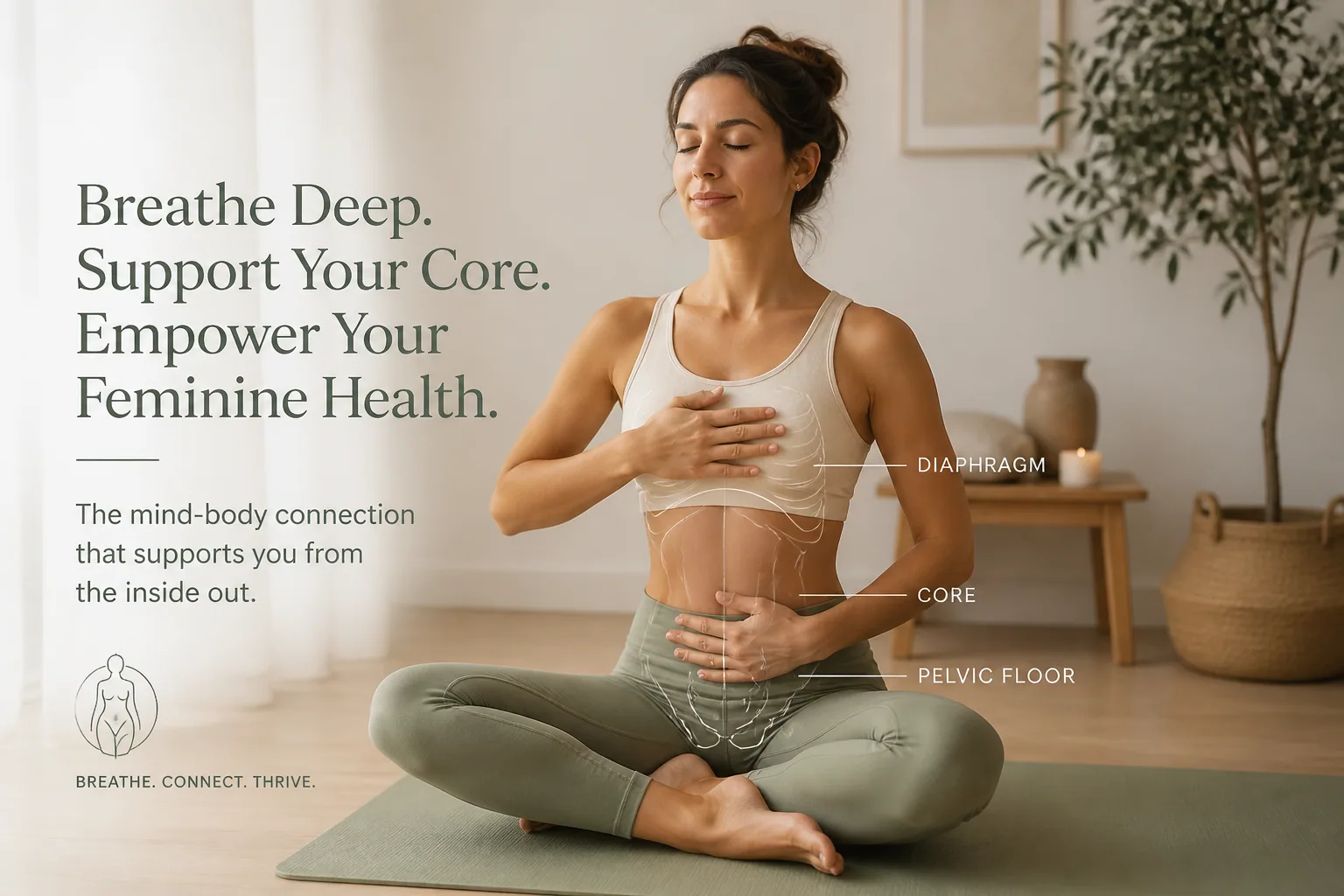
Pelvic Power in Breathwork: How Better Breathing Supports Core Strength, Tension Relief, and Feminine Health
Breathing is something we do all day without thinking, but the way we breathe can quietly shape how our core works, how much tension we hold in our hips and lower back, and how supported our pelvic floor feels from the inside out. When breathing is shallow, rushed, or held too tightly, the body often compensates with extra pressure, bracing, and strain. Over time, that can affect posture, stability, and comfort. When breathing is coordinated and spacious, it can help the diaphragm, deep core, and pelvic floor work together more naturally.
This is why breathwork is so relevant for feminine health, postpartum recovery, foundational strength, and even long-term mobility. It is not a magic fix, and it does not replace pelvic floor muscle training when that is needed. But it can be a powerful support layer. Research suggests that breathing exercises alone are generally less effective than pelvic floor muscle training for issues like urinary incontinence and pelvic organ prolapse, yet some authors still suggest they may help prevent or support treatment when combined with pelvic floor work or used as part of a wider rehab approach. Bø et al. discuss this in their systematic review, “Can you breathe yourself to a better pelvic floor?” https://onlinelibrary.wiley.com/doi/10.1002/nau.25218
Why Breathwork Matters for Pelvic and Core Health
The pelvic floor is not an isolated group of muscles. It is part of a pressure system. Every inhale and exhale changes how the ribs, abdomen, diaphragm, and pelvic floor respond to one another. If the breath is held or forced, pressure inside the abdomen can rise in ways that the body may not manage well. If the breath is easy and well timed, the deep core can respond with more efficiency and less tension.
That matters for several reasons. First, pressure management affects the support system for the bladder, uterus, and bowel. Second, posture is influenced by how the ribs stack over the pelvis. Third, movement quality changes when the core is either over-braced or under-supported. In simple terms, breath is one of the main ways the body regulates internal pressure before and during movement.
A basic concept paper on breathing and the pelvic floor explains that the pelvic floor muscles, thoracic diaphragm, and abdominal wall act together to regulate intra-abdominal pressure, responding to breathing, posture, movement, and strain. Healthy coordination helps manage pressure and reduce stress on the lower back and hips. That is the heart of why breathwork can feel so helpful in everyday life, not just during exercise. https://pmc.ncbi.nlm.nih.gov/articles/PMC9222935/
Understanding the Pelvic Floor, Diaphragm, and Deep Core Connection
A simple way to picture the system is to imagine a pressure chamber. The diaphragm is the top, the pelvic floor is the bottom, and the abdominal wall and deep trunk muscles wrap around the sides. When you inhale, the diaphragm descends and the pelvic floor should generally soften and lengthen. When you exhale, the diaphragm rises and the core can gently organize around that upward movement.
This is why the cue “inhale to release, exhale to lift” is so common in postpartum and pelvic floor rehabilitation. It does not mean squeezing everything hard. It means letting the body coordinate pressure more intelligently. In practice, a good exhale can help recruit the deep core and pelvic floor without the over-gripping that often happens when people try to “pull the belly in” all day.
There is also a two-way relationship between these structures. One study found that contracting the pelvic floor significantly altered diaphragmatic motion and improved pulmonary function metrics like FEV1 and MVV in healthy females. That tells us these tissues are not separate systems doing separate jobs. They influence each other directly. https://pmc.ncbi.nlm.nih.gov/articles/PMC4540829/
Another cross-sectional study of women with pelvic floor dysfunction found that pairing pelvic floor muscle training with diaphragmatic breathing in a crawling position improved synergy between the diaphragm and pelvic floor, and even improved diaphragmatic function after just one week. That is a helpful reminder that breath and strength do not have to compete. They can be trained together. https://www.sciencedirect.com/science/article/pii/S0161475424000058
How Breathing Affects Pressure, Posture, and Alignment
When breathing is efficient, the rib cage can expand and return smoothly, the abdomen can respond elastically, and the pelvis is less likely to be asked to stabilize against chronic bracing. When breathing is restricted, people often compensate by overusing the neck, shoulders, obliques, hip flexors, and glutes. That compensation can show up as a flared rib cage, tucked pelvis, low back tension, or a feeling that the core is never fully resting.
Posture is not about standing rigidly straight. It is about how well the body can stack and adapt. Breathwork helps because breathing changes the pressure inside the torso. If the pressure is managed well, the spine and pelvis do not have to fight constant internal force. If the pressure is unmanaged, the lower back, pelvic floor, and hips may take on more work than they should.
This is one reason some people feel relief from exercises that look simple but are breath-led. The nervous system often downshifts when breathing slows and becomes more regular. Tension in the hips and lower back can ease because the body no longer feels like it must stay in a protective brace. That is especially relevant for people who sit a lot, clench their pelvic floor habitually, or carry stress in the abdomen.
Signs Your Breathing Pattern May Be Contributing to Tension or Weakness
If you are wondering whether your breathing is affecting your core or pelvic floor, there are some common signs to notice. These are not diagnoses, but they can be clues that your pressure system is not working as smoothly as it could be.
You might notice chest-dominant breathing, frequent breath holding, or a tendency to brace your stomach during effort. You may also feel like your ribs stay lifted all the time, or that your belly never fully softens on the inhale. Some people notice leaking with coughing, running, or jumping, while others feel a persistent heaviness, pelvic pressure, or a sense that the pelvic floor is too tight rather than too weak.
Other signs include chronic neck and shoulder tension, low back tightness that returns quickly after stretching, poor core control during movement, or difficulty coordinating breath with exercise. In some bodies, the issue is not a lack of strength but a lack of timing. The muscles may be strong enough, but they are not being recruited in the right sequence.
The key idea is this: breathing patterns can either help the core share load or force the core to overcompensate. If you are always holding your breath or always gripping your midsection, your pelvic floor may never get the chance to move through its full range of support and release.
Diaphragmatic Breathing for Pelvic Floor Support
Diaphragmatic breathing is often the first breathwork pattern used in pelvic health because it restores a more natural relationship between the inhale, the rib cage, the abdomen, and the pelvic floor. It is not about taking the biggest breath possible. It is about breathing in a way that lets the body expand without strain.
A simple version is to lie on your back with knees bent, one hand on the ribs and one hand on the belly. Inhale through the nose and let the ribs widen gently into the hands. Think about the pelvic floor softening and lengthening on the inhale. Exhale slowly through the mouth and imagine the lower belly narrowing gently and the pelvic floor lifting without clenching. This kind of breathing is often used in postpartum care because it is low load and easy to coordinate.
Kaiser Permanente recommends practicing belly breathing one to two times per day for three to five minutes after childbirth, lying on the back or propped up, to support core muscle stability and gently re-engage pelvic floor function. https://healthy.kaiserpermanente.org/health-wellness/health-encyclopedia/he.Pelvic-Floor-Exercises-for-After-Childbirth.acn5187
The most important thing is softness. If your inhale creates tension in the belly or your exhale makes you grip hard, scale back. The goal is coordination, not force. For many people, just a few minutes a day can start to change how the core organizes during the rest of the day.
Rhythmic Breathing to Build Core Control and Stability
Rhythmic breathing adds structure to diaphragmatic breathing. Instead of just “breathing deeply,” you use a repeated cadence that trains timing, control, and calm under effort. This can be especially useful if your core feels unstable during movement or if you tend to hold your breath when lifting, balancing, or exercising.
A simple rhythm is inhale for four counts and exhale for four counts. Another option is inhale for five and exhale for five. The specific count matters less than the consistency. The breath should feel steady rather than strained. Over time, that rhythm helps the nervous system recognize a repeatable pattern of effort and release.
This is also where breathwork can support functional strength. If you practice coordinated breathing during squats, dead bugs, bridges, or walking, the core learns to organize around motion instead of bracing against it. That can improve stability without encouraging the overactive tension pattern many people develop when they think core work has to feel hard all the time.
For some people, breath-led stability work may be more useful than traditional crunch-style core training. The point is not to replace all strength work, but to improve the way the trunk responds to pressure so movement feels safer and more efficient.
Breathwork Exercises for Tight Hips and Lower Back Relief
Tight hips and lower back discomfort often travel together with shallow breathing and pelvic floor tension. When the diaphragm is not moving well, the body may recruit accessory muscles that should not be doing the bulk of the work. That includes the hip flexors, lower back extensors, and deep abdominal bracing patterns.
One helpful exercise is supported 90-90 breathing. Lie on your back with calves on a chair or feet on a wall, knees and hips bent. Inhale slowly through the nose and feel the back body expand. Exhale gently and let the front ribs soften downward. This position can reduce gripping in the low back and make it easier to feel the breath moving into the sides and back of the torso.
Another option is quadruped breathing, or breathing on all fours. This position can be especially helpful because it reduces spinal compression and invites a more natural expansion into the back and sides. It also pairs well with pelvic floor awareness, since the belly does not have to brace against gravity as much.
For people with chronic hip tightness, it can help to think less about stretching and more about re-patterning. If your hips are guarding because your trunk never fully exhales, then breathwork may create the opening you have been trying to force with mobility drills alone.
How Postpartum Recovery Can Benefit from Better Breathing
Postpartum recovery is one of the clearest examples of why breath matters. After pregnancy and birth, the abdominal wall, ribs, pelvic floor, and breathing mechanics all need time to re-coordinate. Some bodies need strengthening. Some need recovery from pressure, strain, or surgical healing. Many need both.
Pelvi Health suggests a 12-week healing plan that prioritizes reconnection over strength, beginning with diaphragmatic breathing cues such as inhaling to release and exhaling to lift before progressing to more intense activation. https://pelvi.health/blog/postpartum-pelvic-floor-exercises/
This approach makes sense because many postpartum bodies do not need immediate intensity. They need control, timing, and trust. A gentle breathing practice can help restore the feeling of connection between the diaphragm and pelvic floor before the body is asked to lift, run, twist, or load heavily again.
A large cohort study of first-time mothers found that at one year postpartum, about 9.4 percent showed worse pelvic floor support and over half reported bothersome pelvic floor symptoms. It also found that early moderate to vigorous activity did not show a simple protective linear relationship with pelvic floor outcomes unless breath and pelvic floor considerations were part of the picture. https://pmc.ncbi.nlm.nih.gov/articles/PMC7855223/
That does not mean postpartum exercise is bad. It means the quality of the return matters. Breathing, pressure management, and pelvic floor coordination should be part of the foundation, not an afterthought.
Using Breath in Daily Movement, Walking, Lifting, and Exercise
The real benefit of breathwork shows up when you use it in motion. Walking is a great place to start. Try matching your breath to your steps in a comfortable rhythm, such as three steps on the inhale and four steps on the exhale. This can reduce unnecessary tension and help the trunk stay organized without effort.
When lifting something from the floor, avoid holding your breath unless a trained professional has given you a specific strategy for a specific task. Instead, gently exhale through the effort phase. For example, inhale to prepare, then exhale as you stand up. This can help distribute pressure more evenly and reduce the urge to over-brace.
In exercise, breath should support the movement rather than fight it. During strength training, a controlled exhale often helps the pelvic floor and deep core respond together. During mobility work, slow breathing can help reduce guarding. During more intense exercise, learning how to keep the breath moving can improve endurance and reduce excessive strain.
The goal is not perfect breathing all the time. The goal is awareness. If you notice yourself clenching, holding, or rushing, that is your cue to reset. Even one smoother breath can change the quality of the next rep, the next step, or the next lift.
Modifications for Pregnancy, Recovery, and Aging Bodies
Breathwork should be adapted to the body you have today, not the body you think you should have. In pregnancy, the rib cage and abdomen are already changing, and pressure management matters even more. In recovery after childbirth, tissues may be healing and coordination may be reduced. In aging bodies, strength, mobility, and connective tissue response can all shift over time.
For pregnancy, use positions that feel comfortable, such as side-lying, seated, or supported standing breathing. Focus on gentle rib expansion and avoid forcing the belly. For postpartum recovery, start with short sessions and keep the exhale soft. If there is pain, heaviness, or worsening symptoms, reduce intensity and get individualized guidance. For aging bodies, practices like yoga that combine breath and movement may be especially helpful. Research in menopausal females found significant improvements in pelvic floor muscle strength following a yoga program with breath-coordinated postures. https://journals.sagepub.com/doi/pdf/10.4103/jdrr.jdrr_63_19?download=true
The big message is that breathwork is scalable. It can be gentle enough for early healing and still meaningful enough to support strength, balance, and body awareness at any age.
Common Mistakes to Avoid When Training the Core and Pelvic Floor
One of the biggest mistakes is treating the pelvic floor like a muscle that should always be held tight. Constant clenching can create more tension, not more support. Another common mistake is sucking the stomach in hard on every exhale, which can increase pressure and make the breath shallow.
People also often brace too early. If every movement starts with a hard inhale-hold, the body loses its ability to respond elastically. That can create more pressure in the low back and pelvis. Over-training the abs without respect for the pelvic floor can also make symptoms worse in some bodies, especially if there is prolapse, leaking, heaviness, or chronic tightness.
Another mistake is assuming that because an exercise feels easy, it is not effective. In pelvic health, gentle coordination work often matters more than intensity. The nervous system and pressure system may need relearning before heavier loading is appropriate.
Finally, do not ignore symptom feedback. If a breathing drill increases pain, heaviness, pressure, or leaking, it needs to be modified. Good breathwork should create more ease, not more strain.
When to Seek Professional Support for Pelvic Discomfort
Breathwork can be a helpful tool, but it is not a substitute for care when symptoms are persistent or significant. You should seek support from a pelvic floor physical therapist, midwife, physician, or other qualified professional if you have ongoing leaking, pelvic heaviness, pain with sex, burning, pressure, constipation, visible bulging, or low back and hip pain that does not improve.
That is especially important after childbirth, after pelvic surgery, during pregnancy, or if you notice symptoms getting worse with exercise. A trained professional can help determine whether you need strength work, relaxation work, pressure management strategies, manual therapy, or a combination of approaches.
Research consistently suggests that the best results usually come from matching the right tool to the right problem. For some people, that means pelvic floor muscle training plus breath coordination. For others, it means learning to relax an overactive pelvic floor before adding intensity. Breathwork is one part of the picture, but it can be a very important one.
If you want a simple way to stay consistent with a daily breathing practice, a guided tool like Just Breathe: Relax Daily can help you follow steady patterns and build the habit more easily: https://findthe.app/just-breathe-ujhm1e
When used well, breathwork is not just about relaxation. It is a practical way to improve pressure control, support the pelvic floor, and help the whole core work with less tension and more intelligence. That is what makes it such a powerful foundation for feminine health, recovery, and lasting strength.