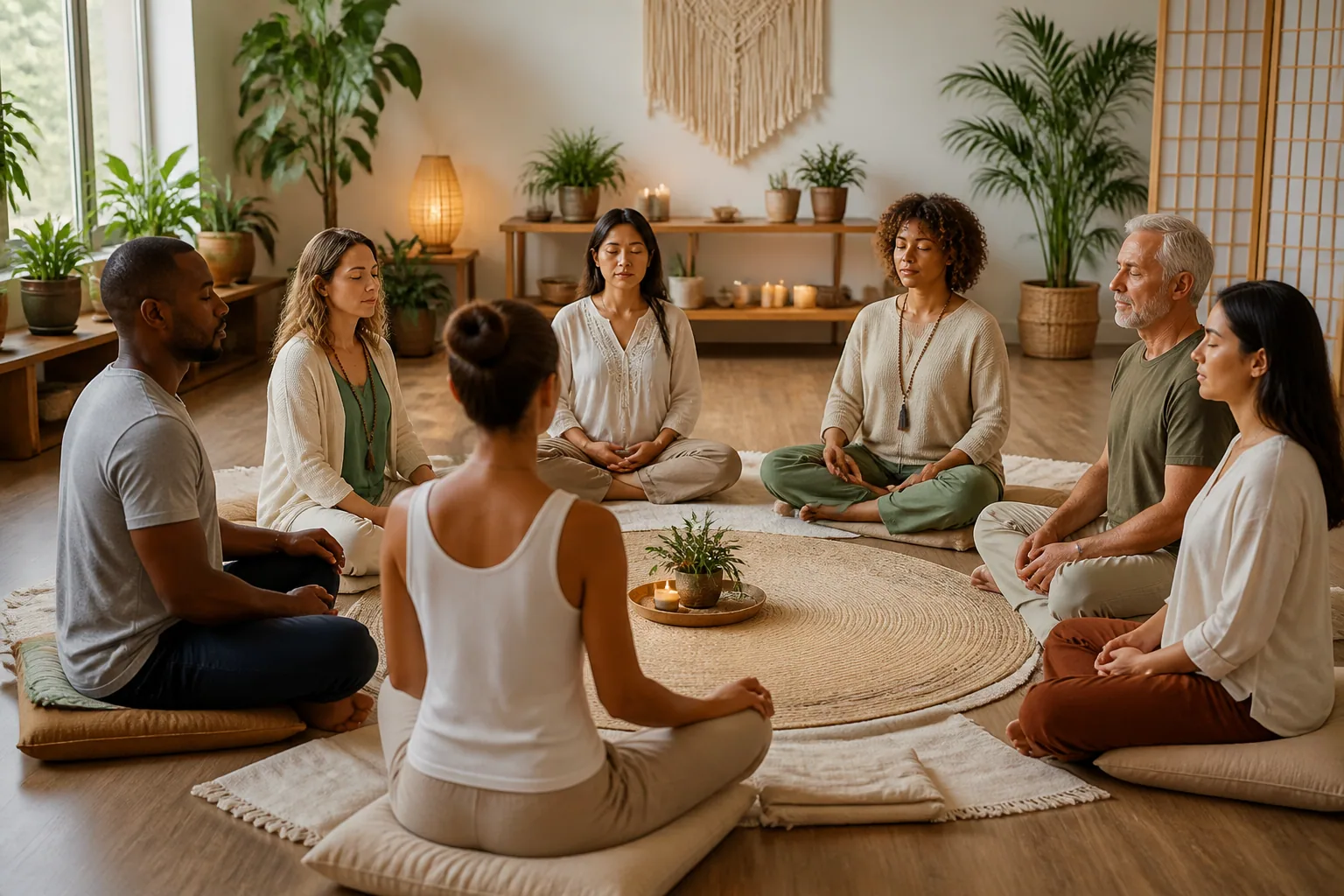
Reframing Breathwork in Groups: How Community Rituals Deepen Healing and Build Consistency
Breathwork can be powerful on your own, but for many people it becomes more sustainable, more grounding, and more emotionally meaningful when it is practiced in community. A shared room, a shared rhythm, and a shared intention can change the entire experience. Instead of feeling like another self-improvement task to check off, breathwork becomes a ritual, one that supports nervous system regulation, emotional release, and a sense of belonging.
That matters because the hardest part of breathwork is often not learning the technique. It is keeping the practice alive long enough for it to actually reshape how you feel. Group settings can help with that by adding structure, accountability, and co-regulation. They can also make breathwork feel less isolated, especially for people who are healing stress, grief, burnout, or trauma.
Why Breathwork Feels Different in a Group
Breathing alone is quiet and personal. Breathing with others adds a visible rhythm, a container, and a subtle social signal that says, you are not doing this by yourself. That shift can make the practice feel safer and more emotionally accessible. Many people find that the moment they sit in a circle, join a live online session, or breathe alongside a partner, their body settles more quickly than it does in solo practice.
Part of that is psychological. Shared practices often reduce self-consciousness and create a sense of permission. If everyone else is slowing down, turning inward, and letting go, it becomes easier to do the same. Breathwork in groups can also feel more motivating because the structure is already there. You do not need to decide when to start, how long to go, or whether you are doing it right. The group holds the rhythm for you.
There is also something deeply human about doing difficult inner work in the presence of other people. Breathwork can bring up emotion, sensation, memory, and vulnerability. When that happens in a well-facilitated group, the experience can feel witnessed rather than managed in isolation.
The Science of Shared Breathing and Co-Regulation
Breath is not just about oxygen. It is one of the most direct ways we can influence the autonomic nervous system, the system that manages arousal, stress, and recovery. Slow, controlled breathing around 5 to 6 breaths per minute has been shown to increase heart rate variability and respiratory sinus arrhythmia, both of which are markers associated with parasympathetic activity. In practical terms, that means the body is more able to shift into a calmer, more regulated state. A systematic review by Zaccaro et al. describes how slow breathing is linked to lower blood pressure, better emotional regulation, and changes across both central and autonomic systems: https://pmc.ncbi.nlm.nih.gov/articles/PMC6137615/
What makes group breathwork especially interesting is that the benefits may extend beyond the individual body. A 2026 study in Scientific Reports on shared breathing rhythms found that people breathing together can synchronize physiological markers such as heart rate variability, which may support social bonding and alignment of nervous system states: https://www.nature.com/articles/s41598-026-34981-0
That is the essence of co-regulation. When one person is calm, grounded, and present, it can help others settle too. In a breathwork circle, that effect is often amplified by the facilitator, the group rhythm, and the shared sense of attention. The body picks up on cues that say, this is safe enough to soften.
Breath also influences emotion through direct neural pathways. Research on breathing rhythm and pattern notes that the preBötzinger complex in the brainstem connects with regions involved in arousal, emotion, memory, and fear. In other words, changing the way you breathe can change the way you feel and the way you process what you feel: https://pmc.ncbi.nlm.nih.gov/articles/PMC9840384/
This is why a group practice can feel so potent. When breath, rhythm, and social presence line up, the nervous system has more than one signal telling it to regulate.
How Community Improves Consistency and Accountability
Even the most effective breathwork method will not help much if it is rarely practiced. For many people, consistency is where community becomes the difference maker. A scheduled group session creates a commitment that is easier to keep than a vague promise to breathe more someday.
Social accountability works because it reduces decision fatigue. You do not have to negotiate with yourself every morning about whether you feel like practicing. The calendar, the group chat, the recurring class, or the weekly circle does that for you. Over time, that repetition turns the practice into a habit rather than an occasional intervention.
This is one reason ritual matters so much. Research on rituals suggests that repeated, familiar practices can increase belonging, predictability, and social well-being while reducing anxiety. Bhugra and Ventriglio note that even in largely non-religious contexts, ritual participation is associated with a stronger sense of stability and connection: https://journals.sagepub.com/doi/10.1177/00207640241232192
A study on the Sikh practice of Seva also found that more frequent ritual participation was linked to higher social well-being, with sense of community mediating the effect: https://pubmed.ncbi.nlm.nih.gov/28577087/
Breathwork can work in the same way. When a session happens regularly, and when it is experienced with the same people or a familiar facilitator, it begins to feel like an anchor point in the week. That predictability helps the nervous system know what to expect, and that can make it easier to show up consistently.
For people who struggle to maintain a solo practice, group breathwork often removes the hidden barriers. There is less wondering, less procrastination, and less perfectionism. Instead of trying to be a perfect practitioner, you simply join the ritual.
Emotional Healing Through Collective Ritual
Breathwork is often described as a release practice, but release does not always happen in a neat, solitary way. In many cases, emotional processing deepens when it occurs in a shared container. Being around others can normalize tears, trembling, laughter, silence, and rest. That normalization can make it safer for people to feel what they have been holding back.
This is one of the reasons collective ritual can be so healing. It offers a structure where intense feelings do not have to be hidden or explained away. The group witnesses the process without forcing a narrative. That alone can be deeply restorative for people who are used to carrying everything privately.
The HeartMath coherence model emphasizes that slow, deep breathing combined with positive emotional states such as gratitude can create coherent heart rhythm patterns, and that practicing this over time may improve stress, mood, sleep, cognitive performance, and overall physiological regulation. Read more here: https://journals.sagepub.com/doi/full/10.1177/27536130251408821
In a group setting, those positive emotional states can be contagious in the best sense. A room that is intentionally calm, compassionate, and nonjudgmental can help participants access feelings that are harder to access alone. It is not about forcing positivity. It is about creating enough safety for the body to move through what has been stuck.
Trauma-aware group facilitation is especially important here. A trauma-informed curriculum for breathwork facilitators emphasizes co-regulation, helping participants feel safe, seen, and able to attune to others. That approach supports nervous system regulation and emotional release rather than pushing for intensity: https://www.elementalrhythm.com/wp-content/uploads/2025/07/FULL-CURRICULUM-Trauma-Informed-Practices-for-Breathwork-Facilitators-.pdf
Popular Group Breathwork Formats to Explore
One of the nice things about community breathwork is that it is adaptable. You do not need a perfect studio, a big ceremony, or a highly elaborate format to benefit from practicing with others. There are many ways to do it.
Guided group sessions are the most common format. These can happen in studios, retreat spaces, community centers, or online. A facilitator leads the pacing, cues the breathing pattern, and holds the structure. This works well for beginners and for people who want a contained experience without having to think too much about the sequence.
Partner breathwork is simpler and often more intimate. One person breathes while the other offers presence, timing, or gentle counting, then you switch roles. This can be especially powerful for couples, close friends, or family members because it introduces mutual witnessing and trust.
Circles and small-group rituals are another popular option. These often combine breathwork with intention setting, reflection, music, or sharing. They are particularly useful when the goal is not only relaxation but also connection and emotional processing.
Workplace breathwork is becoming more common too. In this setting, the practice is usually framed as a stress-regulation tool rather than a spiritual ritual. It can still be effective, especially if the sessions are brief, consistent, and led by someone who understands psychological safety and boundary setting.
There are also hybrid practices where breathwork is paired with movement, journaling, meditation, or sound healing. The key is not the label. The key is whether the structure supports regular, mindful participation.
Online vs In-Person Breathwork Communities
Both online and in-person breathwork communities can be valuable, and neither is automatically better. What matters is whether the setting supports presence, safety, and repetition.
In-person groups offer physical co-presence, which can strengthen the sense of collective rhythm. Some people find it easier to settle their attention when they are in the same room as others. The shared environment can also reduce distractions and make the ritual feel more distinct from everyday life.
Online communities, on the other hand, are easier to access and often easier to maintain. They can remove barriers like travel time, childcare, cost, or geographic isolation. For many people, this makes consistent practice far more realistic. A strong online facilitator can still create a sense of community through clear pacing, live interaction, and regular attendance.
Interestingly, research suggests that whether breathwork is done in a group or solo does not necessarily predict outcomes if the essential ingredients are preserved. A 2023 systematic review summarized by ONE Retreats noted that stress and anxiety reduction depended more on factors like session duration, guided instruction, and repeated practice than on group versus solo format alone: https://www.oneretreatsjamaica.com/blog/group-breathwork-sessions-vs-solo-practice/
So if the question is whether online breathwork can be meaningful, the answer is yes. The right format is the one you can actually return to.
How to Start or Join a Breathwork Group
If you want to join an existing community, start by looking for facilitators who clearly explain their style, training, and safety practices. A good breathwork group should make it easy to understand what kind of breathing will be used, how long the session lasts, what emotional experiences may arise, and whether the practice is gentle, activating, or trauma-aware.
You can also ask practical questions before joining. Is the group open to beginners? Is there a quieter option for people who need to step out? Are recordings available for online sessions? Is participation required in the sharing circle, or is observing allowed? These details matter because a well-designed practice should reduce pressure, not add it.
If you are starting your own group, keep it simple at first. Choose one breathing pattern, one time, and one clear intention. Consistency is more valuable than complexity. You can meet weekly with friends, begin a family evening ritual, or organize a small workplace pause before the day gets busy.
A useful approach is to decide in advance what the session is for. Is it for stress relief, emotional check-in, focus, sleep, or connection? When the purpose is clear, people are more likely to return.
If you want support for a personal practice that also helps you keep a rhythm between group sessions, an app like Just Breathe: Relax Daily can be a useful companion. It offers guided patterns, visual pacing, reminders, and session tracking, which can help bridge the gap between community practice and day-to-day consistency: https://findthe.app/just-breathe-ujhm1e
Creating Safety, Trust, and Inclusivity in Shared Practice
Not every group is a good group. Because breathwork can bring up strong physical and emotional responses, safety has to be built in from the start. That means clear consent, clear instructions, and clear permission to modify or stop at any time.
Inclusivity matters too. People come into breathwork with different bodies, histories, beliefs, and stress levels. A good community practice does not assume everyone wants the same intensity, the same language, or the same emotional display. It makes room for different needs without making anyone feel like they are doing it wrong.
Trauma-aware facilitation is especially important. Participants should know that grounding options exist, that strong breathwork is not required, and that support is available if sensations become overwhelming. Facilitators should also avoid implying that bigger releases are always better. Sometimes the most healing session is the one where someone simply feels safe enough to breathe slowly and stay present.
Trust grows through repetition, predictability, and respectful boundaries. That is another reason community rituals work so well over time. When people know what to expect, the body can relax into the practice instead of guarding against it.
When Group Breathwork May Not Be the Right Fit
Group breathwork is not ideal for everyone, and it is important not to oversell it. Some people may feel overstimulated in groups, especially if they are processing acute trauma, panic, or complex medical concerns. Others may simply need more privacy to explore their breathing at their own pace.
If you have a history of feeling unsafe in group environments, it may be better to begin with a one-to-one setting or a very gentle guided practice. The same is true if you are drawn to intense breathwork but do not yet have the support system to process what may come up. In those cases, solo practice can be a safer foundation.
The research does not suggest that group practice is inherently superior in every situation. It suggests that breathwork is effective when it is done consistently and well. So the best format is not the most popular format. It is the one that meets your needs without overwhelming your system.
If breathwork regularly leaves you dizzy, distressed, or emotionally flooded, pause and consult a qualified professional. Breathwork should support regulation, not push you into dysregulation.
Turning Breathwork Into a Sustainable Community Ritual
The real opportunity here is to move breathwork out of the category of quick wellness hack and into the category of meaningful ritual. Rituals work because they are repeated, recognizable, and shared. They create continuity in lives that often feel scattered.
To make breathwork sustainable, keep the structure simple and the expectations realistic. Pick a consistent time. Use a familiar breathing pattern. Start with shorter sessions if that makes adherence easier. Let people show up as they are, whether they want to talk, stay quiet, cry, laugh, or simply breathe.
Over time, that consistency can become a source of emotional resilience. The nervous system learns the ritual. The mind learns the pattern. The group learns how to hold one another with more steadiness and less effort. That is where healing often deepens, not in dramatic breakthroughs, but in the ordinary return to a shared practice.
Group breathwork does not replace solo practice. But for many people, it gives breathwork the thing that makes it last: community. And when breath becomes communal, it often becomes more than a technique. It becomes a rhythm you can come home to.