Supporting Breathwork Practice for Neurodivergent People: Accessible, Calming, and Actually Helpful Approaches
Breathwork can be a powerful tool for calming the body, improving focus, and supporting emotional regulation. But for many neurodivergent people, the way breathwork is usually taught can make it harder, not easier, to participate. Sitting still, closing your eyes, following a long verbal script, or keeping up with a group pace may feel stressful, confusing, or even dysregulating.
That does not mean breathwork is off limits. It means the practice often needs to be redesigned. When breathwork is flexible, sensory-aware, and built around consent, it can become much more supportive for people with ADHD, autism, sensory sensitivities, trauma histories, and other neurotypes. In this article, we’ll look at why standard approaches miss the mark, what common triggers look like, and how to make breathwork feel safer, more accessible, and genuinely useful.
Why Traditional Breathwork Doesn’t Work for Everyone
Traditional breathwork classes often assume that everyone can comfortably sit still, stay quiet, close their eyes, and follow verbal cues in real time. For some people, that setup is calming. For others, it creates too much sensory load or demands more self-regulation than they have available in the moment.
This matters especially for neurodivergent people. Research suggests that individuals with ADHD show significantly elevated atypical sensory processing across auditory, visual, tactile, and oral domains, with moderate to large effect sizes compared with neurotypical controls. In autism spectrum disorder, up to 90% of autistic individuals experience clinically significant sensory processing differences, with auditory and tactile differences especially well documented. Source: https://www.frontiersin.org/journals/psychology/articles/10.3389/fpsyg.2026.1871344/full
If a breathwork session is too loud, too bright, too socially demanding, or too rigid, the nervous system may stay in protection mode instead of shifting toward ease. Breathwork is often marketed as a path from fight-or-flight into parasympathetic rest-and-digest states, and that can be true. Cleveland Clinic notes that breathwork can help shift the nervous system toward parasympathetic activity, and that abdominal breathing is especially useful for lowering blood pressure and heart rate. Source: https://health.clevelandclinic.org/breathwork
The key point is that the method has to fit the person. A practice that helps one body settle may overwhelm another if it ignores sensory needs, attention differences, or emotional safety.
What Neurodivergence Can Look Like in Breathwork Practice
Neurodivergence is not one single experience, and it does not show up the same way in every breathwork session. Someone with ADHD may want movement, novelty, and shorter instructions. Someone autistic may need predictability, reduced sensory input, and clear language. Another person may have strong interoception and find breath focus intense, while someone else barely notices body signals and needs more external support.
In practice, this can look like fidgeting, shifting position repeatedly, opening the eyes even when others are told to close them, needing to leave the room, missing verbal instructions, or feeling anxious when a facilitator goes too fast. None of these are signs of failure. They are often signs that the format needs adjustment.
There is also evidence that movement can support attention and regulation. A systematic review and meta-analysis found that mind-body exercise, which combines movement, breathing control, and bodily awareness, significantly improves attention in people with ADHD, though effects on hyperactivity, impulsivity, and executive function were less clear. Source: https://pmc.ncbi.nlm.nih.gov/articles/PMC11663905/
That aligns with what many people already know intuitively: breathing work may land better when it is not forced to be perfectly still. Even research on movement during attention-demanding tasks shows that motion can improve performance and self-efficacy in children with ADHD. Source: https://pmc.ncbi.nlm.nih.gov/articles/PMC11274564/
A breathwork practice can become difficult when it includes triggers that are easy to miss from the facilitator’s side. Some of the most common include long verbal explanations, silence without preparation, intense music, forced eye closure, breath holds, fast-paced rhythms, or instructions that rely heavily on metaphor.
For autistic participants, abstract or poetic language can be harder to process than direct cues. A review of autism-adapted mind-body protocols found that useful changes included less metaphorical language, fewer cognitively loaded prompts such as examining thoughts, more detailed session overviews, shorter sensory-demanding exercises, and accommodations for sensory sensitivity. Participants described those adaptations as helpful. Source: https://pmc.ncbi.nlm.nih.gov/articles/PMC5446600/
For people with ADHD, long periods of stillness can create restlessness or attention drift. For people with sensory sensitivities, a buzzing fan, dim lights that are still too bright, or a speaker’s voice close to the microphone can become the whole experience. For trauma survivors, being told to close their eyes or focus inward can feel unsafe if there is no choice or grounding alternative.
This is why inclusivity is not just about being kind. It is about reducing the mismatch between the practice and the nervous system of the person doing it.
The most helpful breathwork adaptations are often the simplest ones. Start with choices. Offer permission to keep the eyes open, change posture, pause, or opt out. Let people know that they can sit, stand, lean against a wall, lie down, or move gently if that helps them regulate.
Keep instructions short and concrete. Instead of layering on multiple cues at once, guide one step at a time. Say what will happen next before it happens. If a hold is coming, say how long it will last and offer a no-hold option. Predictability lowers stress for many neurodivergent people.
Sensory design also matters. Lowering the volume, reducing background noise, softening lights, and removing unnecessary visual clutter can make a session much more tolerable. A practical guide on neurodiversity and breathwork encourages choices around posture, eye closure, sound, lighting, and music, along with clear, simple instructions and optional participation. Source: https://www.makesomebreathingspace.com/blog/neurodiversity-and-breathwork
Grounding tools can help too. Some people benefit from tactile cues like holding a soft object, placing a hand on the chest or belly, or resting feet against the floor. Others do better with a visual rhythm, a hand signal, or a simple timer. Breathwork can become more effective when it is paired with sensory supports that help with interoception or coordination. Source: https://aane.org/autism-info-faqs/library/restoring-the-autistic-nervous-system-a-gentle-path-to-regulation/
One useful rule is this: if a support helps the person feel more oriented, it probably belongs in the practice. If it makes them feel watched, trapped, or overstimulated, it should be changed.
At home, breathwork can be adjusted in a way that feels more personal and less performative. You do not need a perfect meditation cushion setup or a quiet, empty room to begin. A few small changes can make the experience much easier to sustain.
Try shorter sessions first. For some people, especially children, 5 to 15 minutes is enough. Children’s breathwork guidance from Children’s Hospital of Philadelphia emphasizes that sessions can be brief and adapted to developmental stage and individual needs. Source: https://www.chop.edu/health-resources/therapeutic-breathwork
You can also build in movement instead of fighting it. Rocking, walking slowly, stretching, or even gentle desk movement can make breathwork more accessible for people who struggle with stillness. If sitting still makes your body more anxious, do not treat stillness as the goal.
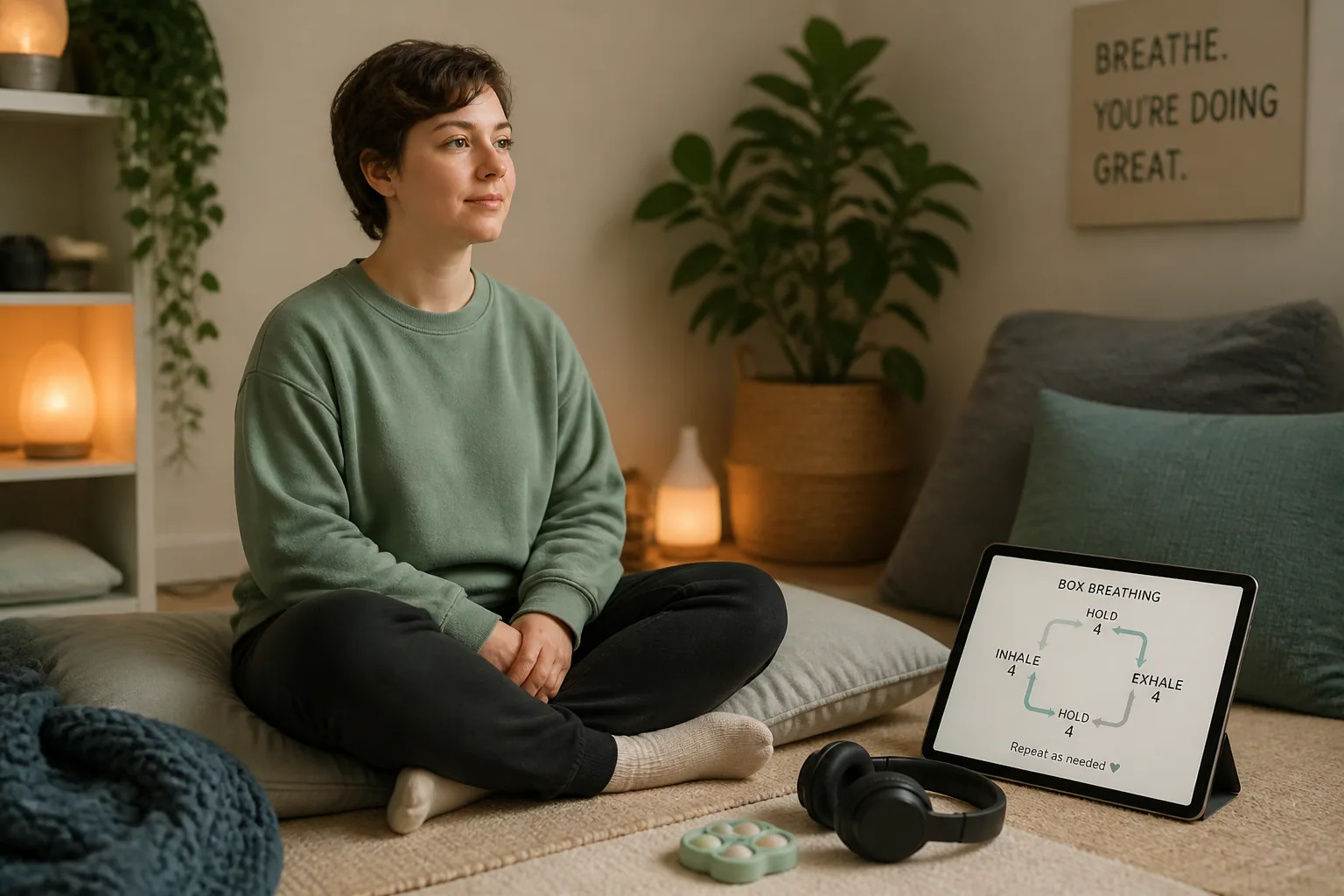
Visual support can be especially helpful. A gentle animation, a simple counting display, or a breathing guide can reduce the need to hold instructions in working memory. For many neurodivergent people, that external structure is what makes the practice possible in the first place.
If you want an easy way to experiment with this at home, a tool like Just Breathe: Relax Daily can be a practical option. It offers guided patterns, visual animations, ambient sounds, and custom rhythms, which can make practice feel more concrete and less cognitively demanding: https://findthe.app/just-breathe-ujhm1e
Language can make the difference between a practice that feels supportive and one that feels demanding. Inclusive cueing is usually plain, direct, and optional. It avoids pressure, assumes choice, and describes sensations without overexplaining them.
Here are some examples of more neurodivergent-friendly cues:
Try: “If it helps, you can keep your eyes open or closed.”
Try: “You can sit, stand, or lie down in the position that feels most steady.”
Try: “We’ll breathe in for three and out for four. If that feels like too much, you can simply notice your breath without changing it.”
Try: “If breath holds do not feel good for your body, skip them and keep breathing normally.”
Try: “You do not have to match the group. Move at your own pace.”
For people who prefer extra structure, it can also help to preview the whole session first: what the practice is, how long it will last, whether there will be silence, whether music will be used, and what options exist if the participant needs to step out or pause. That kind of overview lowers uncertainty and builds trust.
The overall tone should feel invitational rather than corrective. Breathwork works best when participants feel allowed to adapt it, not judged for needing adaptation.
If you lead breathwork professionally, inclusive design starts before the session begins. Share a clear description of what people can expect, including duration, intensity, sensory environment, and any likely transitions. Let participants know what choices they will have. That transparency makes attendance easier for people who need predictability.
It can also help to screen for comfort and readiness in a gentle, non-clinical way. A recent trauma-informed breathwork guide recommends checking CO₂ tolerance or control pause to tailor pacing, and suggests that participants with low tolerance should begin with gentle nasal breathing and an extended exhale, while avoiding fast rhythms, long holds, or intense activation. Source: https://www.elementalrhythm.com/wp-content/uploads/2025/07/FULL-CURRICULUM_-Trauma-Informed-Practices-for-Breathwork-Facilitators-.pdf
Facilitators should be careful not to assume that more intensity is better. For some people, especially those who are already overloaded, activating breath practices can feel destabilizing. In those cases, slower, softer, and more rhythmic practices may be the safer entry point.
Build in opt-outs. Offer alternatives for every potentially challenging element. If the practice includes silence, provide a written version of the instructions. If it includes movement, allow stillness. If it includes group sharing, make it optional or replace it with a private reflection prompt.
The more options people have, the more likely the session is to meet their actual needs.
Online breathwork can be easier for some neurodivergent people because it reduces commuting, unfamiliar social dynamics, and public sensory load. It also lets participants control their own environment more easily. They can adjust lighting, mute sound, use headphones, or take breaks without drawing attention.
At the same time, online sessions can increase cognitive load if the platform is cluttered, the instructions are too fast, or multiple visual and audio elements compete for attention. Keeping the screen simple, using consistent placement of cues, and offering downloadable instructions can help.
In-person breathwork offers different benefits, such as easier body-based grounding, natural community, and more immediate support from a facilitator. But it can also be more difficult for people with sensory sensitivities. Noise, scent, fluorescent lights, seating arrangements, and social proximity all matter.
A good rule for both formats is to prioritize environmental clarity. In person, that may mean dimmable lighting, scent-free policies, and a seating layout with space. Online, it may mean fewer slide changes, clear audio, and a predictable structure. In both settings, it helps to remind participants that they can pause, move, hydrate, or leave the practice when needed.
When breathwork is designed well, the format itself becomes part of the regulation support instead of another source of stress.
Helpful breathwork usually feels more spacious, not more forced. The person may notice a slightly calmer body, clearer attention, less muscular tension, or a better ability to stay present. Over time, they may find that the practice is easier to return to because it feels predictable and non-threatening.
Signs that the practice may need adjusting include increased agitation, dizziness, shutdown, irritation, tearfulness without relief, confusion, or a strong urge to escape. Some people may also feel numb or disconnected, which can be a sign that the practice is too intense or too inward-focused for that moment.
If that happens, the answer is not to push through. It is to simplify. Shorten the session, soften the breath, open the eyes, add movement, or switch to a grounding exercise. For some people, simply noticing the exhale without changing it is a more helpful starting point than any structured technique.
Breathwork should leave the person feeling more resourced, not more managed. If it consistently produces stress, the practice needs redesign, not discipline.
For neurodivergent people, breathwork is most effective when it respects the nervous system instead of trying to override it. That means flexible pacing, sensory support, movement options, clear language, and genuine permission to opt out or adapt.
It also means letting go of the idea that there is one correct way to breathe, sit, or focus. The goal is not perfect performance. The goal is regulation that actually feels regulating. For many people, that starts with smaller steps, simpler instructions, and a practice that is built around consent.
When breathwork is approached this way, it becomes more than a wellness trend. It becomes a tool that can meet people where they are, including the people who have most often been left out of standard mindfulness spaces.