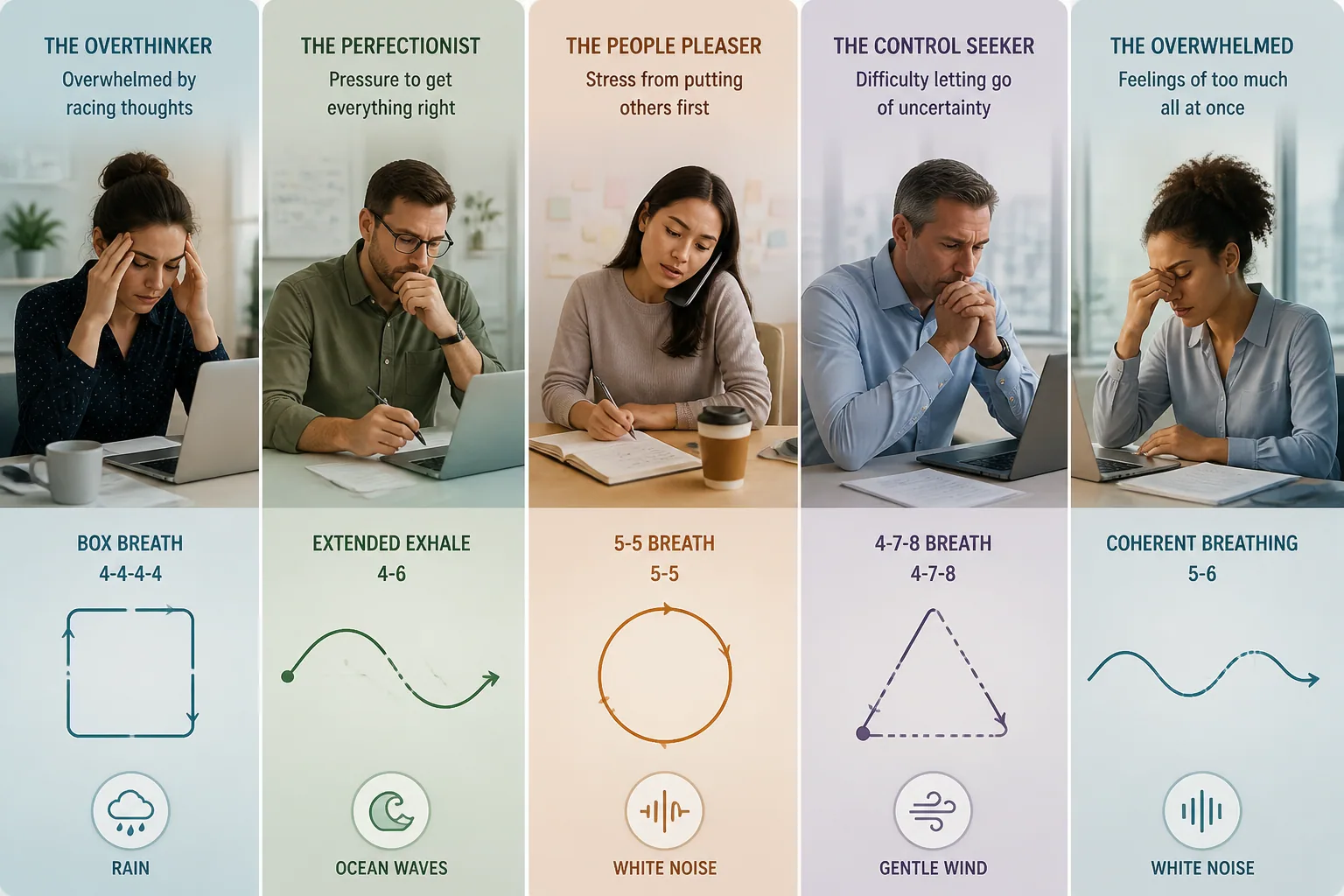
The Breathwork Style That Matches Your Stress Personality: Find Your Perfect Calm
Stress does not show up the same way in every person. For one reader, it feels like a mind that will not stop scanning for problems. For another, it is the tight chest before a presentation, the pressure to perform, or the strange need to turn everything into a project. That is why a one-size-fits-all breathing trend often works for a week, then gets abandoned. The real question is not which breathwork method is best in general. It is which breathwork style fits the way you actually stress.
In this guide, we will match common stress personalities with breathing approaches that are more likely to feel natural, calming, and sustainable. We will also look at session length, how often to practice, and even which animation styles and ambient sounds help each type settle faster. The goal is not to create another wellness rulebook. It is to help you find a ritual you can return to when life gets loud.
Why Your Stress Style Changes What Actually Works
Your nervous system does not only respond to the intensity of stress. It also responds to the shape of the stress. Some people spiral because they need certainty. Others tense up because they feel watched. Some feel best when there is structure, while others need something simple enough to do in the middle of chaos. That is why the same breathing technique can feel amazing to one person and irritating to another.
The most important breathwork methods all help the body move out of a heightened stress state, but they do so in different ways. Coherent breathing, paced around 5.5 breaths per minute, is especially useful for calming and improving autonomic balance, with research linking it to higher heart rate variability and lower anxiety and physiological stress markers. Box breathing, with its equal phases, tends to be especially helpful for acute focus and pressure moments. Slow breathing with a longer exhale, such as 4-7-8 style breathing, is often the most soothing for anxiety, panic, and sleep because the extended exhale supports parasympathetic activation. Sources: https://brizzy.app/en/library/coherent-breathing and https://www.simplypsychology.com/articles/breathwork-types-mental-health
In other words, the best breathwork is not necessarily the trendiest one. It is the one that matches the emotional pattern underneath your stress.
Meet the Main Stress Personalities
Most people are a mix, but usually one stress pattern leads the conversation. Here are the five that show up most often in daily life.
The chronic worrier wants reassurance, certainty, and relief from looping thoughts. The social overthinker gets flooded by anticipation, self-consciousness, and replaying conversations. The perfectionist is often calm on the outside but internally under constant pressure to execute flawlessly. The adrenaline seeker runs hot, moves fast, and may not notice stress until the body is already revved up. The emotional suppressor stays composed by disconnecting from feeling, then eventually crashes or feels numb.
Each of these styles calls for a different entry point. Some need rhythm. Some need structure. Some need quick regulation. Some need gentleness. And some need help feeling safe enough to stay present without being overwhelmed.
The Chronic Worrier: Why Slow, Rhythmic Breathing Feels Safest
If your mind loves worst-case scenarios, you are probably not looking for a breathwork method that feels intense, technical, or highly stimulating. You need something that creates a sense of predictability. That is where coherent breathing is a strong fit. A steady pace, often around 5.5 seconds in and 5.5 seconds out, gives the nervous system a reliable rhythm to hold onto. It can feel like a metronome for an anxious mind.
This style works well because worriers often need to feel that nothing is being forced. The breath is not being held for too long, and the pace is not so slow that it triggers more awareness of discomfort. Instead, the body gets a simple message over and over: stay here, you are safe, nothing urgent is happening right now. Research on coherent breathing has linked it to improved HRV, anxiety reduction, and better autonomic balance, and longer-term practice has been associated with improvements in stress, insomnia, and mood. Sources: https://auralize.app/blog/coherence-breathing-hrv and https://www.coherentbreathing.com/Coherent_Breathing_Volume_3_Issue_10_Coherent_Breathing_Toolkit_2.7.pdf
A helpful session for this type is 10 to 20 minutes daily, especially in the morning or before the hours when worry tends to spike. If a full session feels impossible, even 5 to 10 minutes can work as an acute reset. One practical approach is to do a short coherent breathing session before opening email, and another after work to stop the day from following you home. For an example, a financial analyst who wakes up already mentally rehearsing every possible problem may notice that a guided coherent rhythm gives her mind just enough structure to stop feeding the loop.
For sound, this personality usually does best with gentle, low-eventfulness backgrounds like rain, soft ocean movement, or a simple heartbeat-style guide. Visually, a calm looping animation can help reduce the urge to over-monitor whether they are doing it correctly. The less the practice asks for performance, the better.
The Social Overthinker: Breathwork for a Busy, Self-Conscious Mind
The social overthinker is not just stressed. They are mentally replaying, predicting, editing, and second-guessing. This is the person who leaves a meeting and immediately wonders whether they sounded strange, too sharp, too quiet, or too much. They need a breathwork style that interrupts mental noise without demanding deep introspection in the moment.
Box breathing is a very good match here because its four equal parts create clear boundaries for the mind. Inhale, hold, exhale, hold. The structure gives the brain something simple to follow, which is helpful when internal commentary is running the show. Research and practical references describe box breathing as especially effective for acute stress regulation and focus, making it useful before meetings, presentations, or difficult social events. Sources: https://brizzy.app/en/library/coherent-breathing and https://www.innerquest.app/reference/wellbeing/coherent-breathing
Because the social overthinker often worries about being observed, the practice should be easy to do discreetly. Three to five minutes is often enough. A few rounds in the car before walking into an event, or a short reset in the bathroom after an awkward conversation, can be more realistic than a long formal session. A public-facing designer, for example, may use box breathing for four minutes before a client pitch, then again after the pitch to stop the self-criticism from taking over the rest of the afternoon.
For the best sensory pairing, choose a clean, minimal animation that does not feel childish or overly decorative. The goal is to lower social self-awareness, not increase it. Ambient sound should also stay subtle. Soft bells, quiet wind, or nearly silent guidance often works better than anything too expressive. This type tends to appreciate the feeling of control without feeling trapped by it.
The Perfectionist: Structured Breathing That Doesn’t Add More Pressure
Perfectionists often love breathing methods in theory and then turn them into another performance metric. That is the trap. If the practice becomes something to optimize, it can end up reinforcing the same stress pattern it was meant to soften. The key is to choose a method that has structure, but not so much complexity that it invites self-judgment.
Coherent breathing and box breathing both work here, but for different reasons. Box breathing is useful when the perfectionist is under deadline pressure and needs a quick reset. Coherent breathing is better when they can commit to a daily routine that trains the body toward steadiness over time. Slow breathing approaches with a longer exhale can also be helpful when perfectionism crosses into anxiety or insomnia, because they encourage release instead of control. Research suggests that slow breathing with extended exhalation can reduce anxiety by boosting parasympathetic activation. Source: https://www.simplypsychology.com/articles/breathwork-types-mental-health
The most important rule for perfectionists is to define success as showing up, not doing it perfectly. A five-minute practice every day beats a flawless 20-minute session that only happens once a week. A product manager who keeps rewriting her to-do list at midnight may benefit from a consistent evening coherent breathing routine, paired with a moon-like animation and low, slow ambient sound. Over time, that structure becomes a cue for the body to stop striving.
This is also a good personality for pranayama styles like alternate nostril breathing or ujjayi breathing, which can feel purposeful and balancing without being chaotic. Research has associated these practices with reduced anxiety and improved autonomic regulation, which makes them a strong fit for people who want a sense of order but need relief from overcontrol. Source: https://www.simplypsychology.com/articles/breathwork-types-mental-health
The Adrenaline Seeker: Fast Resets for High-Energy Nervous Systems
Some people do not appear stressed because they are energized, productive, and moving quickly. But underneath that momentum, the nervous system may be running hot. The adrenaline seeker needs practices that can intervene fast, especially in moments when everything feels urgent and the body has already shifted into overdrive.
For this type, the right breathwork often starts with a short reset, not a long decompression. Box breathing is an excellent tool because it can be used in three to five minutes when focus is slipping or stress is peaking. If the goal is to calm the body more deeply after the initial reset, a slower breath with a longer exhale can follow. The mix of quick structure and deeper down-regulation is often what these personalities need most.
A common example is the founder, creative lead, or emergency-style problem solver who gets stuck in constant activation. They may not feel anxious in the usual sense, but they are exhausted by the pace. A pre-call box breathing reset can help bring the system back within range, while a longer coherent breathing session later in the day helps recover from the accumulated load. The quick version keeps the day manageable. The longer version teaches the body that it does not need to stay on alert all the time.
For sound and visuals, this type often responds well to more energetic but still calming cues, such as a sunrise-style animation or a steady pulse that feels organized rather than slow and sleepy. If the breathwork is meant to bring them down, nature soundscapes like waves or forest ambience can help. Research on soundscapes shows that pleasant, low-eventfulness natural sounds can speed physiological stress recovery compared with noisy or urban environments. Source: https://pmc.ncbi.nlm.nih.gov/articles/PMC6266166/
The Emotional Suppressor: Gentle Breathwork That Helps You Feel Without Flooding
The emotional suppressor is often the hardest to spot. This person may say they are fine, stay composed in crises, and keep moving even when a lot is happening internally. But feeling can become unfamiliar, and when emotions finally surface, they may come in waves. For this personality, breathwork should not be forceful or overly intense. It should help the body open gradually.
Gentle practices like slow coherent breathing, alternate nostril breathing, and humming breath are especially useful here. They create a sense of groundedness without pushing too hard into sensation. Humming styles such as bhramari can be soothing because the vibration gives the body a tangible anchor. Research summarized by Simply Psychology notes that pranayama practices including alternate nostril breathing, bhramari, and ujjayi can help reduce anxiety and balance autonomic activity. Source: https://www.simplypsychology.com/articles/breathwork-types-mental-health
For the emotional suppressor, the ideal practice is often shorter at first, around 5 to 10 minutes, then gradually extended as comfort increases. The aim is not catharsis on demand. It is enough contact with the breath to reconnect with the body safely. A caregiver, therapist, or senior manager who has spent years staying composed may find that a humming breath practice in the evening helps soften the internal armor without triggering overwhelm.
This personality usually benefits from moon-like visuals, dark or warm color palettes, and natural soundscapes that feel soft rather than expansive. Gentle rain, distant water, or low forest ambience can create enough safety for sensation to emerge slowly. Interestingly, research on home soundscapes suggests that aesthetic-oriented environments may amplify the positive effects of natural or musical sound, which is useful if your practice space is calm, cozy, and intentionally designed. Source: https://www.sciencedirect.com/science/article/pii/S0360132326000405
How to Pair Breathwork With Animation Styles and Ambient Sounds
Breathwork is not only about rhythm. It is also about context. Visuals and sound can either support regulation or subtly work against it. That is why pairing the right animation and ambient sound with the right stress personality can make a surprising difference.
If you are a chronic worrier, choose a heartbeat or simple steady animation with rain or soft ocean sounds. The predictability helps. If you are a social overthinker, keep the design minimalist so the screen does not feel like another audience. If you are a perfectionist, use a clean visual that gives structure without clutter. If you are an adrenaline seeker, try a sunrise or energizing animation when using a brief reset, then switch to ocean or forest sounds for the longer recovery session. If you are an emotional suppressor, softer moon-like visuals and low, natural ambience can create the safest entry point.
This is not just a preference issue. Research suggests that natural soundscapes accelerate stress recovery more effectively than urban or noisy environments, and digital nature can create similar stress reduction effects to real nature in controlled settings. That means a good breathing app can do more than count the rhythm. It can help build the atmosphere your nervous system needs to settle. Sources: https://pmc.ncbi.nlm.nih.gov/articles/PMC11426060/ and https://pmc.ncbi.nlm.nih.gov/articles/PMC6266166/
If you want one place to experiment with both breathing rhythm and sensory support, Just Breathe: Relax Daily makes that easier with guided patterns, multiple animation styles, and ambient sounds in one practice. You can explore it here: https://findthe.app/just-breathe-ujhm1e
How Long and How Often Each Stress Type Should Practice
The best schedule is the one your real life can sustain. Different stress personalities need different levels of repetition, intensity, and convenience.
For the chronic worrier, daily coherent breathing of 10 to 20 minutes is ideal, with short resets of 5 to 10 minutes during spikes of worry. For the social overthinker, a few minutes before and after events may be enough, especially if the practice is discreet and repeatable. For the perfectionist, a daily fixed routine works well because consistency reduces decision fatigue, but the session should stay simple enough to avoid turning into another task to master. For the adrenaline seeker, 3 to 5 minute box breathing resets can be used multiple times a day, followed by longer cool-down sessions when possible. For the emotional suppressor, shorter daily sessions are often best at the start, with length increased only after the body becomes more comfortable with the practice.
The research on coherent breathing suggests that the most meaningful improvements often come from consistent use over weeks, not from a single dramatic session. The Coherent Breathing Toolkit study with health-care workers found reduced stress, anxiety, depression, and insomnia with daily practice over eight weeks. That is a useful reminder that calming the nervous system is a skill, not a one-time fix. Source: https://www.coherentbreathing.com/Coherent_Breathing_Volume_3_Issue_10_Coherent_Breathing_Toolkit_2.7.pdf
Real-Life Case Studies: Finding the Right Fit Instead of Forcing a Trend
Case one: Maya, a chronic worrier, tried long meditation videos and quit after three days because her mind kept checking whether she was doing it right. When she switched to 12 minutes of coherent breathing with a simple heartbeat guide, she finally felt like the practice was doing the work for her instead of demanding more effort. The rhythm made the experience feel safe enough to repeat.
Case two: Leo, a social overthinker, used box breathing before weekly team meetings. He did not need a long session. He needed a quick anchor that stopped his mind from racing through every possible awkward moment. Four minutes before the meeting became his routine, and the post-meeting spiral started to loosen because his body had a clear exit ramp.
Case three: Priya, a perfectionist, originally approached breathwork like a performance review. Once she stopped tracking whether each inhale was perfect and simply practiced five minutes of coherent breathing each night with a moon animation, she noticed her sleep improved. The structure helped, but only after it became gentle.
Case four: Jamal, an adrenaline seeker, would crash hard after back-to-back calls. He used box breathing between meetings as a quick reset, then shifted to a 15-minute ocean-sound coherent breathing session in the evening. The first practice kept him functional. The second helped him recover.
Case five: Elena, an emotional suppressor, felt uncomfortable with anything that asked her to “go inward” too quickly. She started with alternate nostril breathing for seven minutes, paired with soft rain sounds. Over time, her body stopped bracing so hard, and she began to notice emotions earlier instead of only after she was exhausted.
How to Experiment With Breathwork Without Giving Up Too Soon
Many people quit breathwork because they expect a dramatic change immediately, or they pick a technique that clashes with their stress style. A better approach is to test one method at a time for at least one week, ideally at the same time of day, with the same basic environment. That makes it easier to notice whether the practice is truly helping or simply unfamiliar.
Start by asking three questions. Does this breathing pattern feel physically tolerable? Does it match the moment I am trying to manage? Can I realistically repeat it when I am busy or stressed? If the answer is no to any of those, adjust the method instead of blaming yourself. The point is not compliance. The point is regulation.
It also helps to keep the practice small enough that resistance does not take over. A five-minute box breathing session is more valuable than a perfect routine you never start. Likewise, a 10-minute coherent breathing practice done four times this week is better than a complicated ritual you abandon after one stressful day. Consistency builds trust, and trust is what makes breathwork effective in the long run.
Your Personalized Calm Plan: Start With the Style That Matches You Best
If you are a chronic worrier, begin with coherent breathing and a calm, steady animation. If you are a social overthinker, use box breathing before and after social pressure moments. If you are a perfectionist, choose a simple, structured practice that you can do without performance pressure. If you are an adrenaline seeker, use short box breathing resets during the day and longer recovery sessions later. If you are an emotional suppressor, start with gentle practices like alternate nostril breathing or humming breath and keep the sensory environment soft.
The bigger lesson is that calm is not one personality trait. It is a match between your nervous system and your method. Once you stop trying to force the same technique onto every kind of stress, breathwork becomes easier to keep. It starts feeling less like a wellness chore and more like a personal reset you can actually rely on.