The Case for Breathwork in Neurodegenerative Conditions: How Conscious Breathing Supports People Living with Parkinson’s Disease
Breathwork is getting more attention in Parkinson’s disease for a simple reason: breathing is not just about oxygen. It also supports voice, posture, swallowing, relaxation, endurance, and the nervous system’s ability to respond to stress. For people living with Parkinson’s, those functions can become harder to coordinate over time, which is why conscious breathing is emerging as a practical, low-cost, non-pharmacological support alongside medication, physical therapy, and speech therapy.
This does not mean breathwork is a cure. But it can be a meaningful part of daily care. Recent research suggests that respiratory training may improve respiratory muscle strength, walking capacity, cough, fatigue, dyspnea, and even some autonomic measures in Parkinson’s disease. In other words, breathing exercises may help people feel and function a little better in ways that matter in everyday life.
Why Breathwork Matters in Parkinson’s Disease
Parkinson’s disease affects movement, but it also affects timing, coordination, and automatic functions. Breathing is usually automatic, yet it depends on smooth cooperation between the diaphragm, rib cage, abdominal muscles, airway muscles, and nervous system. When that coordination is disrupted, people may notice subtle but important changes in voice volume, stamina, cough strength, or the ease of taking a full breath.
That is why breathwork matters. It offers a way to train awareness and control around a system that Parkinson’s often makes less efficient. It can also give people a simple daily practice that feels manageable even on low-energy days. For some, it is not about performance. It is about regaining a bit of control, reducing panic around shortness of breath, and creating a steadier baseline for speech and movement.
Breathwork can also be adapted. Some people may tolerate longer sessions, while others benefit from just a few minutes of paced breathing or diaphragmatic breathing. The right dose is often the one you can repeat consistently.
Common Breathing Challenges in Parkinson’s: Voice, Swallowing, Tightness, and Capacity
Breathing changes in Parkinson’s can show up in several overlapping ways. One of the most common is reduced breath support for speech. When the muscles that help control airflow and pressure are less efficient, the voice may become softer, less steady, or more effortful. This can make conversation tiring and frustrating, especially in noisy environments.
Swallowing can also be affected. Breathing and swallowing need to be precisely timed, and Parkinson’s can interfere with that timing. That does not mean everyone will develop swallowing problems, but for some people, coordination challenges may increase the risk of coughing during meals or feeling less confident when eating and drinking.
Chest tightness or a feeling of rigidity is another issue. When the trunk and rib cage move less freely, it can be harder to take deep breaths or expand the chest fully. That can create a sensation of not getting enough air, even if oxygen levels are not the main issue. In early-stage Parkinson’s, one study found that diaphragm thickness and contractile function during tidal breathing were largely preserved compared with healthy controls, but participants still reported more dyspnea and respiratory disability, suggesting that subjective breathing difficulty can appear before more obvious mechanical decline. Source: https://www.sciencedirect.com/science/article/pii/S1569904826000674
More broadly, a meta-analysis found that Parkinson’s disease is associated with a restrictive respiratory pattern, including significantly decreased forced vital capacity, reduced forced expiratory volume in one second, reduced respiratory muscle strength, and ineffective cough, with little evidence of airway obstruction. Source: https://onlinelibrary.wiley.com/doi/10.1111/ene.15743
That matters because a restrictive pattern can make breathing feel shallow or effortful, and a weaker cough can reduce airway clearance. So breathwork in Parkinson’s is not only about relaxation. It is also about supporting the muscles and patterns involved in speaking, swallowing, clearing secretions, and daily endurance.
What Recent Research Says About Respiratory Training and Breath-Based Interventions
The research is still developing, but the direction is encouraging. Studies on inspiratory muscle training, expiratory muscle training, combined respiratory training, and structured breathing programs suggest measurable benefits in Parkinson’s disease.
For example, inspiratory muscle training at about 50% of maximal inspiratory pressure over roughly 8 weeks improved 6-minute walk distance, upper extremity functional capacity, cough strength, fatigue, dyspnea scores, and autonomic function in people with Parkinson’s. Source: https://pubmed.ncbi.nlm.nih.gov/41392483/
Another study found that inspiratory muscle training improved maximal exercise capacity, inspiratory and expiratory pressures, respiratory muscle endurance, peripheral muscle strength, physical activity level, and quality of life in people with preserved pulmonary function. Source: https://pubmed.ncbi.nlm.nih.gov/41420055/
A high-intensity combined inspiratory and expiratory muscle training program, done at home for 8 weeks, improved respiratory muscle strength, inspiratory endurance, dyspnea, exercise capacity, fatigue, and quality of life, with some gains maintained at follow-up. Source: https://pubmed.ncbi.nlm.nih.gov/41933952/?fc=None&ff=20260404070327&v=2.19.0.post6+133c1fe
Preliminary studies of expiratory muscle strength training have shown increased maximum expiratory pressure and better initiation of lung volume for speech, along with more normalized respiratory patterns during speech breathing. Results for utterance length and loudness have been mixed, which is a good reminder that breathing support can help, but it does not automatically fix all voice symptoms. Source: https://pmc.ncbi.nlm.nih.gov/articles/PMC5945060/
There is also evidence that multicomponent training programs, including stretching, strength work, stationary cycling, inspiratory muscle training, and abdominal exercises, can increase both inspiratory and expiratory pressures in mild to moderate Parkinson’s disease. Source: https://www.sciencedirect.com/science/article/abs/pii/S1360859224005308
A 12-week program that included device-based resistance training and thorax exercises also improved peak expiratory flow, maximal inspiratory pressure, and maximal expiratory pressure compared with controls in stage II to III Parkinson’s disease. Source: https://www.kci.go.kr/kciportal/ci/sereArticleSearch/ciSereArtiView.kci?sereArticleSearchBean.artiId=ART003207862
Finally, respiratory muscle training over about 3 months has been associated with improvements in pulmonary function, inspiratory and expiratory pressures, autonomic cardiovascular measures such as heart rate variability and deep breathing response, and even UPDRS motor and non-motor scores. Source: https://pmc.ncbi.nlm.nih.gov/articles/PMC7074532/
Taken together, the evidence suggests that respiratory training can be a useful supportive strategy. The strongest studies point to structured, repeated practice rather than occasional deep breaths taken only when symptoms are severe.
How the Autonomic Nervous System Connects Breath, Stress, and Symptom Burden
Breathwork is often discussed as a calming tool, but there is a physiological reason for that. Breathing has a direct relationship with the autonomic nervous system, which regulates stress responses, heart rate, blood pressure, digestion, and many other automatic functions.
When stress rises, breathing often becomes faster and shallower. That can intensify muscle tension, make speech feel harder, and increase the sense of shortness of breath. In Parkinson’s disease, where movement and automatic regulation can already be less efficient, that stress loop can become especially noticeable.
Slow, steady breathing may help shift the body toward parasympathetic activity, sometimes described as the rest and digest state. This does not erase symptoms, but it can reduce the background load of tension and help the person feel more regulated. That matters because stress itself can worsen tremor, fatigue, voice strain, sleep, and perceived breathlessness.
Some research supports this connection. Respiratory muscle training has been linked with improved autonomic cardiovascular measures, and that is one reason paced breathing and cardiac coherence have drawn interest in Parkinson’s care. When breathing becomes more regular, the nervous system may also become more stable.
Diaphragmatic Breathing: A Foundational Practice
Diaphragmatic breathing is one of the simplest places to start. The goal is not to force huge breaths. The goal is to let the diaphragm do more of the work, so breathing becomes smoother, more efficient, and less effortful.
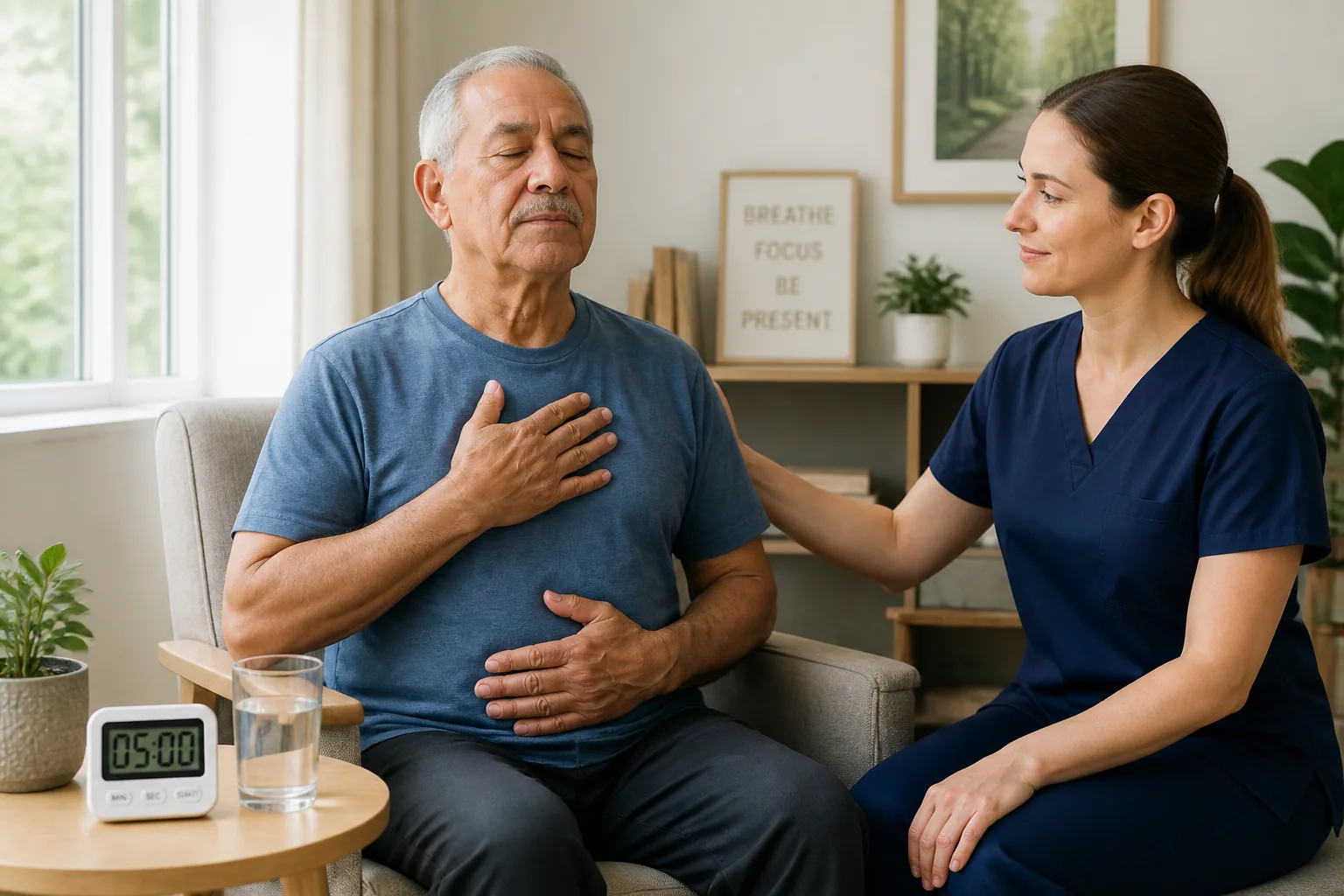
To begin, sit or lie in a comfortable position. Place one hand on the upper chest and one on the belly. Inhale gently through the nose and notice whether the lower hand rises more than the upper hand. Exhale slowly and let the body soften without collapsing. The movement should feel easy, not exaggerated.
For some people with Parkinson’s, lying flat may be uncomfortable, so a reclined position or seated practice is often better. If rigidity makes the rib cage feel tight, it can help to think about breathing into the sides and back of the lower ribs rather than only into the belly.
The early-stage research showing largely preserved diaphragm function suggests that this muscle may still be available for training even when people feel breathless or limited. But the later-stage findings, where diaphragm function drops with advancing Hoehn and Yahr stage and correlates with voice quality, postural stability, and lung function, show why early and ongoing support may be useful. Source: https://pmc.ncbi.nlm.nih.gov/articles/PMC8733584/
A simple starting routine could be 3 to 5 minutes once or twice a day. Consistency matters more than intensity. If the breath feels strained, shorten the practice, slow it down, or return to a more neutral resting breath.
Paced Breathing and Cardiac Coherence for Calm and Regulation
Paced breathing means breathing at a steady rhythm, usually with the inhale and exhale matched or the exhale slightly longer. Cardiac coherence is a specific form of paced breathing often practiced at around 5 to 6 seconds in and 5 to 6 seconds out. This is the style used in many relaxation and heart-rate regulation protocols.
For people living with Parkinson’s, paced breathing can be helpful when symptoms are amplified by anxiety, fatigue, or overstimulation. A predictable rhythm may reduce the sense of being overwhelmed and can make it easier to settle before meals, speech practice, sleep, or physical therapy.
The point is not to chase a perfect pattern. It is to create a repeatable breathing rhythm that the body recognizes as safe. If a 6-second cycle feels too long, start with 4 seconds in and 4 seconds out. If breath-holding increases discomfort, avoid it.
This is also where a guided tool can make practice easier. Something like Just Breathe: Relax Daily can be useful because it offers guided breathing patterns such as cardiac coherence, box breathing, relaxation breath, and energizing breath, along with visual animations and reminders to help people stay consistent. You can learn more here: https://findthe.app/just-breathe-ujhm1e
Adaptations for Fatigue, Tremor, Postural Changes, and Mobility Limits
Breathwork in Parkinson’s should be adaptable, not demanding. That is important because symptoms fluctuate. A person may feel steady in the morning and much more fatigued or rigid later in the day. A good breathing practice should survive those changes.
If tremor makes the hands hard to rest comfortably on the body, the practice can be done without hand placement at all. If sitting upright is tiring, leaning back slightly with support may be better than forcing a tall posture. If neck stiffness interferes with smooth breathing, gently lengthening the exhale may be more useful than trying to inhale more deeply.
For postural changes, it can help to think about alignment before breath depth. A supported seated position, feet grounded, shoulders soft, and jaw unclenched often makes breathing easier without needing effortful correction. If standing is difficult, do not stand for the sake of the exercise. Breathing can be done in bed, in a chair, or during a brief pause in the day.
Mobility limits can also affect whether structured training is realistic. In that case, very short practices repeated across the day may be more sustainable than one long session. Even 1 to 2 minutes of paced breathing before transitions, meals, or bedtime can become a useful anchor.
The bigger goal is to reduce strain, not add another task that feels punishing.
Safety Guidelines: When to Modify, Pause, or Ask a Clinician
Breathwork is generally gentle, but it is still worth using common sense and medical guidance. If breathing exercises cause dizziness, chest pain, significant shortness of breath, faintness, or panic, stop and return to normal breathing. If symptoms are severe or new, seek medical attention.
People with swallowing problems, significant lung disease, heart disease, orthostatic hypotension, or advanced mobility limitations should check with a clinician before starting more intensive respiratory training. This is especially true if a program uses resistance devices or higher-intensity protocols.
It is also wise to modify if there is a history of hyperventilation. In that case, keeping the breath soft and natural is usually safer than trying to breathe deeply. For people who get lightheaded easily, longer breath holds are not a good idea.
A useful rule is this: breathwork should leave you feeling steadier, not more strained. If a practice increases symptoms, shorten it, slow it down, or switch to a gentler pattern.
How Breathwork Can Complement Medication, Physical Therapy, and Speech Therapy
Breathwork works best as part of a broader care plan, not as a substitute for it. Medication may help reduce motor symptoms, making it easier to move and practice. Physical therapy can improve posture, thoracic mobility, gait, and overall conditioning. Speech therapy can address loudness, articulation, swallowing, and breathing coordination for communication.
Breathwork can support each of these. Before speech work, a few minutes of calm diaphragmatic breathing may help reduce tension and improve breath availability. Before physical therapy, paced breathing may help settle anxiety and improve body awareness. After exercise, gentle recovery breathing may help the body downshift more smoothly.
It can also be paired with movement. Some people find that doing breathing practice before stretching or walking makes the body feel more open. Others prefer to breathe after movement, when the nervous system is already more regulated. There is no single correct order, only the one that fits the person’s symptoms and schedule.
Importantly, the respiratory studies in Parkinson’s suggest that breathing training may improve not only respiratory outcomes but also walking distance, fatigue, and quality of life. That makes it a plausible bridge between symptom management and daily function, rather than a stand-alone wellness trend.
Simple Ways to Build Breathwork Into Daily Routines
One of the most practical ways to make breathwork stick is to attach it to something already happening. That way, you do not have to remember one more separate task.
Try breathing for 2 to 3 minutes after waking, before a meal, before medication, after a walk, or when sitting down to rest. Pair it with routines like brushing your teeth, waiting for water to boil, or preparing for sleep. The aim is repetition, not perfection.
You can also use breathwork as a transition tool. Parkinson’s symptoms often feel harder during transitions, such as moving from sitting to standing, preparing to leave the house, or shifting from activity to rest. A brief breathing pause before these moments can help reduce rush and tension.
If reminders are helpful, digital tools can make a difference. A guided app like Just Breathe: Relax Daily can support regular practice with reminders, trackable sessions, and customizable patterns, which is especially useful when consistency is the real challenge. Again, the link is here: https://findthe.app/just-breathe-ujhm1e
How to Measure Progress: Voice, Endurance, Relaxation, and Adherence
Progress in breathwork does not always show up as dramatic physical change. It often appears as small, functional improvements that accumulate over time.
One useful marker is voice. Does speaking feel a little less effortful? Is it easier to project at the table, on the phone, or in a noisy room? Another marker is endurance. Can you walk a bit farther, recover faster after activity, or cough more effectively? Research on inspiratory training suggests these kinds of outcomes may improve in Parkinson’s.
Relaxation is another sign. You might notice fewer moments of breathing-related panic, less chest tension, better sleep onset, or a calmer response to stress. If paced breathing is working, you may feel more settled after the practice than before it.
Adherence matters too. A breathing routine you actually do is more valuable than an ideal routine that never happens. Tracking sessions, mood, and notes can show patterns over time, such as whether practice is easier at certain times of day or whether specific techniques help more than others.
It can help to keep measurements simple: voice strength, breathlessness, fatigue, cough quality, and how often you practice each week. Those practical markers often matter more than abstract numbers.
A Realistic Take: What Breathwork Can and Cannot Do
Breathwork has promise, but it should be viewed realistically. It may support respiratory muscle strength, cough, dyspnea, autonomic regulation, speech readiness, and general calm. It may also help people feel more connected to their body in a condition that often creates a sense of disconnection.
What it cannot do is replace core Parkinson’s treatments or reverse neurodegeneration. Breathwork will not stop disease progression, and it will not solve every symptom. Some breathing changes are structural, some are neurological, and some may require medical or therapy-based interventions.
Still, the evidence suggests that breath-based practices deserve a place in Parkinson’s care. They are low-cost, adaptable, and often accessible even when mobility is limited. They can be gentle enough for daily use, while still meaningful enough to support function and comfort.
In a condition where so much can feel out of control, breathwork offers something simple and useful: a small amount of agency, repeated regularly. That alone can matter more than it sounds.