The Science Behind Breath Holds: When They Help, When They Hurt, and Gentler Alternatives That Last
Breath holds have become one of the most talked-about parts of modern breathwork. You see them in pranayama, in performance training, in cold exposure circles, and in viral breathing methods that promise focus, energy, or emotional release. For some people, they really do feel powerful. For others, they can feel unsettling, intense, or outright wrong.
That difference matters. Breath retention is not just a mindset exercise. It changes the balance of oxygen and carbon dioxide in the body, it can influence blood pressure and heart rate, and it may either support calm or push the nervous system into a stress response depending on the person, the timing, and the way it is practiced. Understanding that physiology makes breathwork safer, more inclusive, and far more sustainable.
Why Breath Holds Are Trending in Breathwork Right Now
Breath holds are trending because they create a strong internal experience. People often notice a sharp sense of presence, a dramatic urge to breathe, a feeling of control, or a temporary “high” after the hold ends. In a culture that often looks for fast results, that intensity can be very appealing.
Part of the popularity also comes from modern breathwork communities that blend yogic tradition, sports performance, and self-optimization language. Retention is sometimes presented as a shortcut to resilience, better focus, or nervous system regulation. The problem is that a technique can be effective in one setting and inappropriate in another. Breath holds are not automatically good or bad. They are simply more demanding than many people realize.
This is why a more nuanced view is helpful. If your goal is calm, steadiness, or long-term regulation, you may not need retention at all. In many cases, gentler patterns can offer similar benefits with less risk.
What Actually Happens to CO2 and O2 During a Breath Hold
The basic physiology is straightforward. During a breath-hold, oxygen levels decrease while carbon dioxide accumulates. According to WebMD, these shifts are what create breathlessness and the strong urge to breathe: https://www.webmd.com/a-to-z-guides/is-it-safe-to-hold-your-breath
Carbon dioxide is often misunderstood as a waste gas, but it is also a key signal. Rising CO2 tells the brain that it is time to breathe. When CO2 climbs, the sensation of air hunger becomes stronger. That is why even a fairly short retention can feel uncomfortable or urgent, especially if someone is already anxious or sensitized.
Oxygen, meanwhile, drops as the hold continues. If the hold is extended or if a person starts from a low-CO2 state after hyperventilation, the warning signs can become less reliable. Breathhold.co notes that hyperventilation before a breath-hold lowers CO2, delays the urge to breathe, but can lead to hypoxic blackout because oxygen can fall below safe levels without warning: https://breathhold.co/resources/science-behind-wim-hof-breathing
That combination is important. A reduced urge to breathe does not necessarily mean the body is safe. It may only mean the alarm signal has been muted.
Breath Holds, Vagal Tone, and the Stress Response
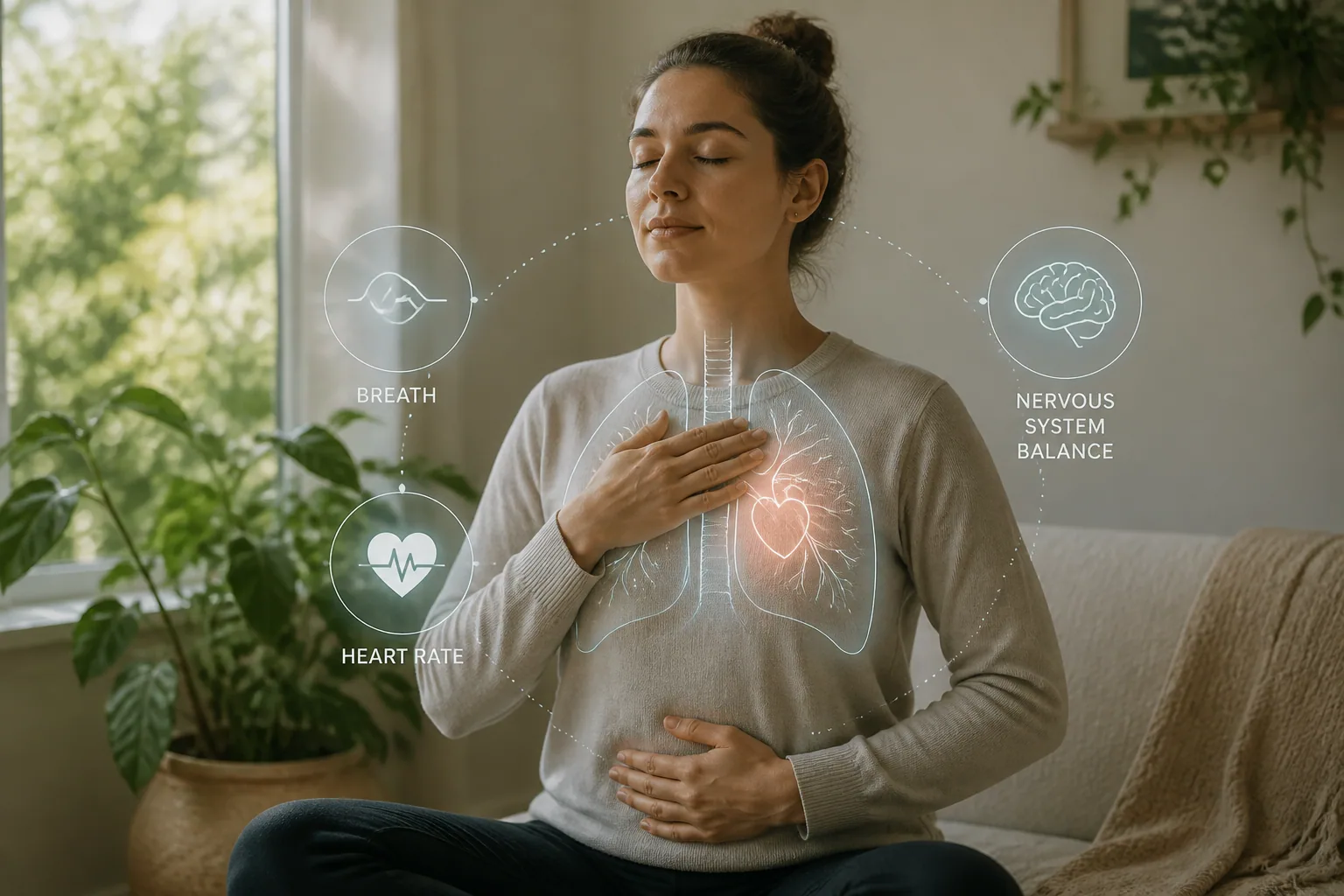
Breathwork is often discussed in terms of vagal tone, parasympathetic activation, and calm. There is a real basis for that discussion. Slow breathing patterns can support heart rate variability, emotional regulation, and a more settled autonomic state. But retention changes the picture because it introduces a deliberate challenge.
A breath hold can activate the parasympathetic system in some contexts, especially if it is brief, voluntary, and followed by slow exhalation. At the same time, the growing CO2 load and the physical discomfort of the hold can also stimulate stress pathways. In other words, the same practice can create both regulation and strain, sometimes within the same session.
That is why context matters so much. If you begin from a grounded state, have a tolerant nervous system, and use retention sparingly, the technique may feel centering. If you begin from overwhelm, panic, trauma activation, or respiratory restriction, the same technique can feel like a threat.
The body is not being difficult in those moments. It is giving feedback.
Why Intense Retention Can Feel Good but Still Be Too Much
One reason breath holds are so alluring is that intensity can masquerade as effectiveness. The body feels the pressure, the mind becomes highly focused, and the release afterward can produce relief, expansion, or even euphoria. That contrast can be deeply reinforcing.
But intensity is not the same as suitability. A practice that creates a dramatic sensation may still be too much for daily use, especially if it repeatedly pushes the nervous system toward overactivation. Some people interpret discomfort as proof that the method is working, when in reality the discomfort may simply mean the load exceeds their current capacity.
The current popularity of breath retention can also blur a key distinction between training and regulation. A training stimulus is meant to challenge the body. A regulation practice is meant to help it settle. Those are not always the same thing. If you are trying to calm anxiety, improve sleep, or support trauma recovery, the best technique is often not the most intense one.
Potential Risks for Anxiety, Panic, Trauma, and Nervous System Sensitivity
Breath holds can be especially complicated for people with anxiety, panic history, trauma sensitivity, or a highly reactive nervous system. For these individuals, the sensation of air hunger may resemble the bodily pattern that appears during panic. That can create a feedback loop where the practice triggers the very state it was supposed to ease.
For trauma-sensitive bodies, retention can also feel too close to loss of control. The inability to inhale immediately may register as unsafe, even if the person knows cognitively that they are in no danger. In that case, the nervous system is not reacting to logic. It is reacting to sensation and memory.
This is one reason some breathworkers prefer no-retention methods for people with a history of panic or trauma. The goal is not to avoid all challenge forever. The goal is to choose a dose that supports regulation instead of activation.
If breathwork makes you dizzy, shaky, numb, panicky, or emotionally flooded, that is a sign to simplify. The right practice should leave you more resourced, not less.
When Breath Holds May Be Useful, and When to Avoid Them
There are situations where breath holds may be useful. Trained apnea work, advanced pranayama, and specific performance protocols may include retention as part of a broader method. Some practitioners use it to build tolerance to CO2, improve breath awareness, or train composure under mild stress.
Even then, it should be introduced carefully and progressively. The person should be stable, well-informed, and able to stop without pushing through distress. A breath hold is more appropriate when the goal is adaptation than when the goal is calm.
Breath holds are generally less appropriate when someone is already dysregulated, sleep-deprived, recovering from illness, or trying to use breathwork as an emergency anxiety tool. They are also not a great default choice for beginners who have not yet learned how their body responds to slower, simpler techniques.
If you are unsure, it is usually wiser to start with non-retention breathing and only consider retention later, if ever.
Special Considerations for Pregnancy, Cardiovascular, and Respiratory Conditions
Certain groups need extra caution, and in some cases, medical guidance. Breath holds can be a poor fit for people with cardiovascular disease, uncontrolled hypertension, pregnancy, glaucoma, epilepsy, and respiratory conditions such as asthma. Trauma sensitivity and panic history are also important considerations, according to guidance summarized by Simply Psychology and School of Breath Science: https://www.simplypsychology.com/articles/breathwork-types-mental-health and https://schoolofbreathscience.com/wp-content/uploads/2025/06/Contraindications-to-Breath-Hold-Training.pdf
This matters because breath holds can do more than feel intense. In one study of deep inspiratory breath-holds, systolic blood pressure rose substantially even in healthy, untrained individuals, increasing from about 133 mmHg to about 175 mmHg, and in some cases reaching 200 mmHg. That kind of spike is a reminder that retention is not a neutral practice for everyone.
If you are pregnant, have heart or vascular concerns, experience elevated blood pressure, or have a respiratory condition, breath retention should not be treated casually. The safest choice may be to avoid holds entirely and work with gentler patterns that support relaxation without adding strain.
Signs Your Body Is Asking for a Different Approach
Sometimes the body gives a very clear answer. If breath holds lead to dizziness, chest tightness, racing heart, tingling, trembling, nausea, fear, dissociation, or a lingering sense of depletion, the practice is probably not serving you in its current form.
Other warning signs are more subtle. You may notice that you dread the practice before you start, feel braced during the hold, or become more emotionally raw afterward. You may also find that the practice helps in the moment but leaves you more activated later in the day.
Those patterns do not mean you are weak, unfit, or doing breathwork wrong. They mean your nervous system is providing data. In breath practice, data is useful. The goal is not to force a technique because it is popular. The goal is to match the tool to the state of the body.
Gentle Breathwork Alternatives That Support Calm and Clarity Without Retention
The good news is that you do not need breath holds to get meaningful benefits. In fact, research strongly supports slow breathing, resonance breathing, and extended-exhale patterns that do not rely on retention.
A meta-analysis of 31 studies with 1,133 participants found that slow-paced breathing without breath delays or holds significantly reduced systolic blood pressure, increased HRV measures such as RMSSD and SDNN, and lowered heart rate. That is a strong case for the simpler option. The study is available here: https://link.springer.com/article/10.1007/s12671-023-02294-2
Another line of research suggests that slow, resonant breathing, around 5 to 6 breaths per minute, reliably increases HRV and improves emotional regulation while reducing symptoms of anxiety and depression in both healthy and clinical populations, again without large retention phases: https://pmc.ncbi.nlm.nih.gov/articles/PMC12341363/
If you want something very practical, cyclic sighing is a strong option. In a study, five minutes daily of a double inhale through the nose followed by an extended exhale through the mouth produced greater mood improvement and greater reductions in resting respiratory rate than equivalent durations of mindfulness meditation or breathing with equal inhale and exhale times. The research is here: https://pmc.ncbi.nlm.nih.gov/articles/PMC9873947/
Extended-exhale breathing is another gentle choice. A pattern such as 4 in and 8 out emphasizes the exhale, which can support parasympathetic activation while avoiding the strain of retention. It is often a better fit for people who want calm but do not like the sensation of breath holds.
A wearable-guided pilot also found that a screen-free, haptic, slow resonant breathing practice led to an average drop of about 7.4 bpm in resting heart rate, a 28.6% increase in HRV, and reduced perceived stress over four to six weeks. That suggests consistent gentle practice can create real change over time without dramatic intervention: https://www.medrxiv.org/content/10.64898/2026.06.08.26355230v2
If you want a simple way to stay consistent, a guided tool can help. Something like Just Breathe: Relax Daily makes it easier to practice cardiac coherence, box breathing, relaxation breath, or custom no-retention rhythms with visual guides and reminders, and you can explore it here: https://findthe.app/just-breathe-ujhm1e
How to Tailor Breath Practice to Your Own Nervous System
A personalized breath practice starts with honesty. Ask yourself what state you are in before you begin. Are you trying to downshift from stress, sharpen focus, process emotion, or train tolerance? Different goals call for different tools.
If your system is already activated, choose practices that reduce load rather than increase it. That often means longer exhales, slower pacing, softer effort, and no retention. If your goal is performance training and you are medically appropriate for it, breath holds may be introduced later and only in a structured way.
It can also help to track your response instead of relying on theory alone. Notice your heart rate, mood, dizziness, sleep, and emotional stability after each session. The best breath practice is not the one that sounds most advanced. It is the one your body can tolerate consistently.
A useful rule of thumb is this: if the breath is helping you become more available to your life, it is likely a good fit. If it is making you more guarded, irritable, or depleted, simplify it.
A Safer, More Sustainable Breathwork Routine for Long-Term Benefits
For most people, the most sustainable breathwork routine is not built around dramatic retention. It is built around repetition, safety, and nervous system trust. That means choosing practices you can do regularly without bracing, chasing intensity, or worrying that the technique might tip you over the edge.
You might start with three to five minutes of slow breathing in the morning, a few minutes of extended exhale breathing during the day, and a calming session before bed. You could use box breathing only if it feels grounding rather than constrictive. You could keep notes on what helps, what overwhelms, and what changes with sleep, stress, hormones, or illness.
Over time, that kind of practice can improve calm, clarity, heart rate variability, and emotional resilience in a way that fits real life. And that is the key point. Breathwork should not be a performance. It should be a support.
Breath holds have a place, but they are not the center of the story. For many people, the safer path is also the more sustainable one, and it often works better in the long run.