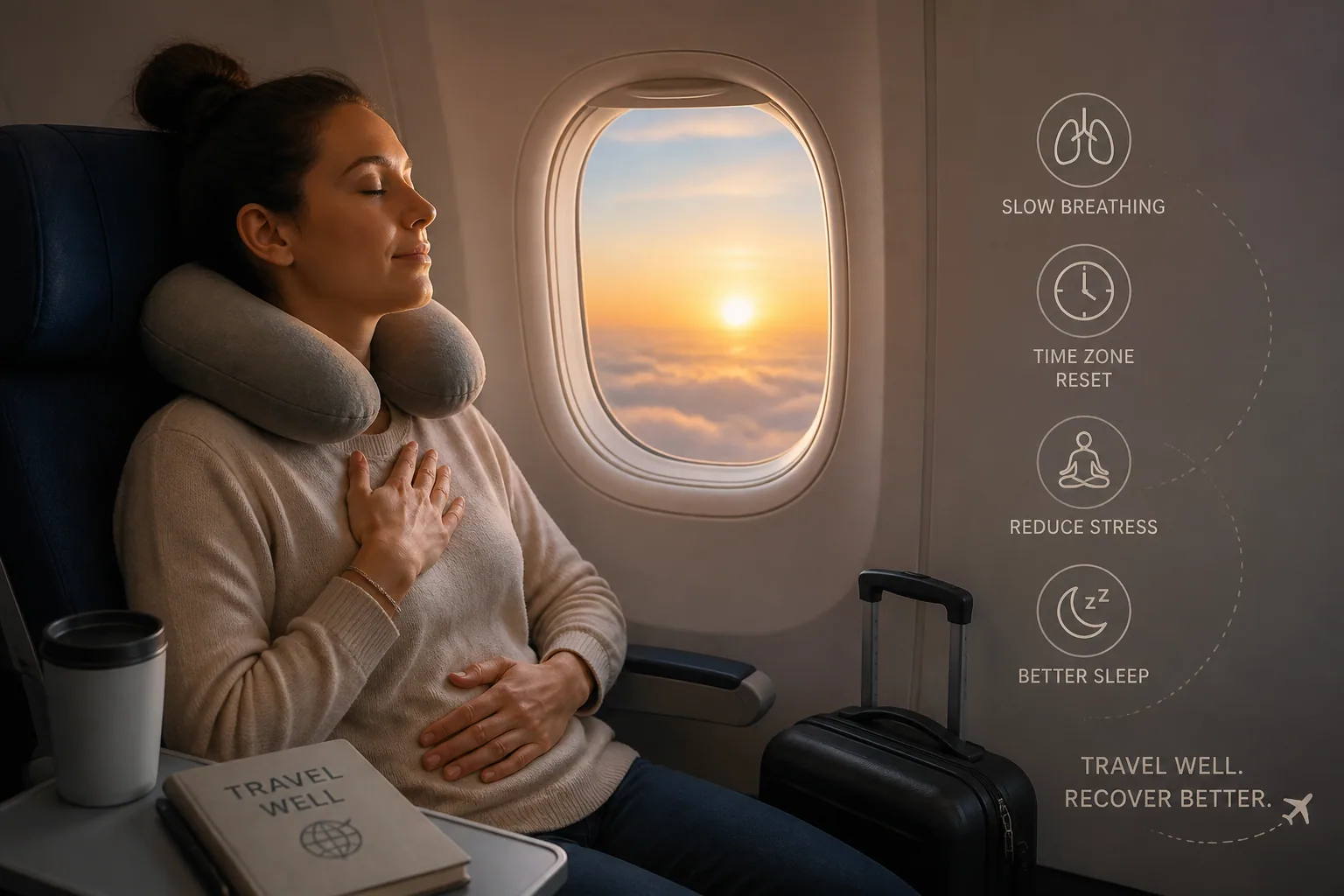
Travel Breathing Rituals: Breathwork for Jet Lag, Flying Anxiety, and Time Zone Recovery
Travel can be exciting, but it can also be hard on your body in ways people do not always expect. A long flight can leave you tense before you even board, dry and restless in the air, and strangely wired or exhausted after landing. When you add airport stress, cramped seating, cabin pressure, disrupted sleep, and rapid time zone changes, it is no surprise that breathing patterns get thrown off too.
The good news is that breathing is one of the few tools you carry with you everywhere. A simple breathwork routine can help you calm pre-flight nerves, steady yourself during turbulence or delays, support comfort in the cabin, and make the transition into a new time zone easier. This is not about perfect technique. It is about having practical breathing rituals you can actually use at the gate, in your seat, and in a hotel room at 2 a.m.
Why Travel Disrupts Breathing, Stress, and Sleep
Travel places your nervous system under several types of stress at once. You may be moving fast, sleeping badly, drinking less water, sitting for long stretches, and anticipating delays or logistics problems. Even if the trip is enjoyable, your body often reads the experience as effortful and unfamiliar. That can show up as shallow chest breathing, a higher heart rate, muscle tension, and difficulty winding down later.
Air travel adds another layer. According to the CDC Yellow Book, cabin pressure on commercial flights is typically equivalent to an altitude of about 1,830 to 2,440 meters, or 6,000 to 8,000 feet, which lowers the partial pressure of oxygen. Cabin humidity is often only 10 to 20 percent, which can dry the nose, throat, and eyes. For many travelers that is just uncomfortable, but for some people it can be more taxing, especially if they already have cardiovascular, pulmonary, or hematologic conditions. Source: https://www.cdc.gov/yellow-book/hcp/travel-air-sea/air-travel.html
Then there is the circadian side. Your internal clock likes regular light, meal timing, and sleep timing. Crossing time zones can scramble all of that, which is why you can feel sleepy at the wrong time, alert when you want to rest, and mentally foggy for a day or more. Breathwork will not erase jet lag, but it can reduce the stress response that makes it feel worse.
The Science of Cabin Pressure, Dry Air, and Circadian Confusion
Breathing well at cruising altitude is less about forcing big breaths and more about staying relaxed enough to breathe efficiently. If anxiety makes you overbreathe, you can end up feeling lightheaded or more uncomfortable, even if the air around you is fine. Gentle, slow breathing helps you avoid that spiral while also signaling safety to the nervous system.
The evidence on breathwork is encouraging. A meta-analysis of 12 randomized controlled trials, with a total of 785 participants, found that breathwork had a significant small-to-medium effect on reducing self-reported stress, with similar effects for anxiety and depressive symptoms. Source: https://www.nature.com/articles/s41598-022-27247-y
For sleep, slow breathing is especially relevant after travel. A systematic review found that breathing at roughly 4 to 10 breaths per minute before bedtime can improve self-reported sleep quality and sleep duration. Objective sleep measurements were less consistent, but the subjective benefit is useful when you are trying to settle into a new bed after a long journey. Source: https://www.sciencedirect.com/science/article/pii/S1087079226000560
There is also promising sleep research showing that a 30-minute slow-breathing session before bed increased heart rate variability and deep sleep EEG delta power in a pilot randomized crossover trial. In that study, the effect was more favorable than a control night and was comparable in some ways to relaxing music. Source: https://www.nature.com/articles/s41598-020-64218-7
Pre-Flight Breathwork to Ground Your Nervous System
The best time to calm your system is before it spikes. If airports make you tense, do not wait until you are already overwhelmed at the gate. Start with a short grounding session before you leave for the airport, again while you are waiting to board, and once more after you are seated.
A simple pre-flight pattern is diaphragmatic breathing with a long, easy exhale. Try breathing in through the nose for 4 seconds and out for 6 seconds for at least 5 minutes. That ratio is gentle enough for most people and long enough to be meaningful. Research on breathing practices for stress and anxiety reduction suggests that sessions shorter than 5 minutes often are not effective, while longer, repeated practices tend to work better. Source: https://pubmed.ncbi.nlm.nih.gov/38137060/
If you prefer a more structured rhythm, box breathing can be a good choice before boarding. Inhale, hold, exhale, hold, each for a comfortable count of 4. It is simple, repeatable, and useful when you want focus as much as calm. Many travelers find that using a breathing app or visual guide helps them stay consistent, especially in noisy terminal spaces. One option is Just Breathe: Relax Daily, which offers guided breathing patterns such as cardiac coherence, box breathing, relaxation breath, and energizing breath: https://findthe.app/just-breathe-ujhm1e
Breathing Rituals for the Airport: Delays, Crowds, and Rising Anxiety
Airports are full of triggers for dysregulated breathing. There is noise, urgency, crowds, bright lights, and constant uncertainty. Even if nothing is actually wrong, the body can start acting as if something is wrong. That is why the airport is the perfect place for a low-profile breathing ritual.
If you feel your chest getting tight in line or you start checking the time every few seconds, shift your attention to your exhale. You do not need a dramatic technique. A steady inhale through the nose and a slightly longer exhale through the nose or mouth can slow the mental spin. You can also pair breathing with a simple cue like relaxing your shoulders on each exhale or softening your jaw.
For stronger anxiety, diaphragmatic breathing has real support. A scoping review of breathwork interventions for anxiety disorders found that diaphragmatic breathing and HRV-assisted or capnometry-guided respiratory therapies were effective in reducing anxiety, especially when slow diaphragmatic breathing was used. Source: https://pmc.ncbi.nlm.nih.gov/articles/PMC9954474/
That does not mean you need a clinical protocol in the terminal. It means that slow, belly-led breathing is not just a wellness trend. It is a legitimate way to interrupt the stress response when your body starts preparing for turbulence, delays, or a difficult travel day.
In-Flight Breathwork You Can Do in Any Seat
Once you are in the air, the goal is to stay subtle, comfortable, and consistent. You do not want anything too forceful. Aim for breathing patterns that are quiet enough to do in any seat and gentle enough to prevent tension from building.
A good in-flight default is 4 seconds in and 6 seconds out for 5 to 10 minutes. This is easy to memorize and does not draw attention. If your body likes structure, you can count 10 to 15 rounds and then rest normally. If you are sleepy, keep the breath soft and the exhale longer than the inhale.
If you are cramped, check whether you are accidentally breathing into the upper chest. Rest one hand lightly on your abdomen and one on your ribs. Try to let the lower hand move more than the upper one. That small shift can make the breath feel less effortful and can reduce the sensation of being trapped in your seat.
Exhale-Focused Patterns for Turbulence, Panic, and Overstimulation
When turbulence starts or you feel panic building, the exhale becomes your anchor. In moments like that, do not try to out-breathe the plane. Instead, lengthen the out-breath just enough to tell your body that you are not in danger.
One helpful pattern is 4 in and 8 out, or even 3 in and 6 out if that feels easier. You can also use a gentle sigh on the exhale. The point is to reduce the sense of pushing and to bring the nervous system down from hypervigilance. This is especially useful if you are sensitive to motion, noise, or feeling confined.
If panic spikes quickly, remind yourself that the feeling is real even if the threat is not. Then make the exhale longer, relax your hands, and keep your gaze on a stable point in front of you. Breathwork works best when it is combined with simple grounding, not when you fight the sensation as hard as possible.
Micro-Breaths and Gentle Breath Holds for Long-Haul Comfort
On long-haul flights, the challenge is often not a major panic episode but cumulative discomfort. Hours of sitting can make the breath shallower and the body stiffer. In these situations, micro-practices are your friend.
Every 30 to 60 minutes, take 3 to 5 slow breaths and then notice whether your shoulders have crept upward. On the exhale, drop them. If you have room, gently lengthen your spine and let the ribs expand on the inhale. You are not trying to breathe deeply all the time. You are trying to avoid getting stuck in a tense pattern for hours.
Some people also like very brief, comfortable breath holds after the exhale, but these should always stay mild. The goal is calm regulation, not strain. If breath holds make you anxious, skip them. A simple long-exhale practice is more than enough for most travelers.
How to Breathe for Better Energy and Oxygenation at Cruising Altitude
A common mistake at altitude is to take bigger and bigger breaths because the cabin feels dry or unfamiliar. Unless you have a medical issue that requires specific guidance, bigger is not always better. Overbreathing can make you feel worse by lowering carbon dioxide too much and making the breath less comfortable.
Instead, aim for calm efficiency. Breathe through the nose when possible, keep the breath quiet, and avoid gulping air. If you feel short of breath, first check posture. Sitting slumped can compress the diaphragm and make breathing feel harder. Then slow the pace rather than increasing the size of each breath.
Hydration matters too, but the breathing strategy is simple: steady, soft, and unforced. Think of breath as maintenance, not performance.
Post-Flight Breathwork to Reset Your Body Clock
After landing, breathwork shifts from calming travel stress to helping you transition into local time. The most important thing is to pair breathing with daylight, movement, meals, and sleep timing. Breath alone will not reset your circadian rhythm, but it can help you tolerate the transition more gracefully.
If you arrive during the day and need to stay awake, use a slightly more energizing breathing pattern for a few minutes, such as a comfortable nasal breathing rhythm with a natural upright posture. Keep it gentle. You are not trying to create anxiety; you are trying to feel alert enough to get through the day without crashing into a long nap.
If you arrive at night, switch to slow, longer exhales and settle into a low-stimulation routine as soon as possible. Your breath can become a bridge between the overstimulated travel state and the quieter state you need for sleep.
Using Breath and Daylight Together to Ease Time Zone Shift
Light is one of the strongest signals for circadian timing. A study on post-flight light exposure found that after westward travel across six time zones, people exposed to bright white light for 3 hours on the first two evenings delayed their melatonin phase more than those exposed to dim red light, with about 2.59 hours versus 1.58 hours of delay. The improvement in jet lag severity was modest, but it shows that light timing matters. Source: https://pubmed.ncbi.nlm.nih.gov/12398256/
A systematic review of non-pharmacological jet lag interventions found that many proposed strategies did not show clear benefit, likely because of study quality issues, but combining scheduled light and dark exposure with attention to travel fatigue looks promising. Source: https://pubmed.ncbi.nlm.nih.gov/30529430/
A practical approach is to use breathing as the internal piece and daylight as the external piece. Breathe slowly in the morning if you need to be calm and grounded, then get outside in the correct light window for your direction of travel. At night, reduce bright light, use slower breathing, and let your body understand that the day is ending.
Breathwork for Sleeping in Hotels, Transit Stops, and Unfamiliar Beds
Sleeping away from home can be surprisingly difficult. Different pillows, strange noises, new temperatures, and the general feeling of being out of place can keep the nervous system alert. This is exactly where slow breathing before bed can help.
The best pre-sleep travel routine is simple: dim the lights, put away screens, and breathe at a pace of about 4 to 10 breaths per minute for 10 to 20 minutes if you can. The evidence suggests this kind of slow breathing may improve perceived sleep quality and duration. If you only have a few minutes, that is still worth doing, but the research suggests longer sessions are more reliable than very short ones. Source: https://www.sciencedirect.com/science/article/pii/S1087079226000560
You can make the practice more effective by stacking it with other sleep cues. Lie on your side, loosen your jaw, and keep the exhale longer than the inhale. If your mind keeps replaying the travel day, simply return to counting the breaths. In a strange bed, repetition helps more than perfection.
Quick Emergency Routines for Panic Spikes During Travel
Sometimes you do everything right and still get hit with a wave of panic. That can happen in a security line, on takeoff, in a taxi, or at 3 a.m. in a hotel room. In those moments, you need a routine that is short, memorable, and physically calming.
Try this: inhale through the nose for 4, exhale for 6, and repeat for 10 rounds. If that is still too activating, shorten the inhale to 3 and keep the exhale gentle and longer. Press your feet into the floor or seat, relax your hands, and focus on making the next breath easier than the last.
If you want a tool that can guide you through these moments without having to remember the counts, a breathing app with visual pacing can be very useful. Just Breathe: Relax Daily includes guided options like cardiac coherence, box breathing, relaxation breath, and energizing breath, which makes it easy to switch between calm, focus, and sleep modes depending on the travel moment: https://findthe.app/just-breathe-ujhm1e
Research-Backed Breathing Ratios That Actually Help
Not every breathing pattern is equally useful for travel. The most reliable options are usually slow, rhythmic, and easy to sustain. Based on the research, a few patterns stand out.
For anxiety and general stress, diaphragmatic breathing with a longer exhale is a strong default. The broader evidence base suggests it can reduce anxiety, especially when practiced consistently and for at least 5 minutes. For bedtime, 4 to 10 breaths per minute appears to be the sweet spot in many studies. For focus or emotional steadiness during the day, box breathing can be a practical choice because it is simple and familiar to many people.
The key is consistency. The systematic review on breathing practices for stress and anxiety reduction found that shorter than 5-minute sessions tended not to be effective, while more structured and taught practices did better than purely self-guided ones. That is a useful reminder for travelers: a quick breath count is nice, but a real routine works better. Source: https://pubmed.ncbi.nlm.nih.gov/38137060/
There is also evidence that breathwork can create meaningful emotional shifts when used in a more intensive format. In an online Conscious Connected Breathwork program, six weekly 90-minute sessions were linked to large reductions in anxiety symptoms. That does not mean you need a long session in an airport, but it does reinforce the idea that breath is a real intervention, not a gimmick. Source: https://www.sciencedirect.com/science/article/pii/S0165032725020075
For a short trip, keep it very simple. Use 5 minutes of slow breathing before you leave, a few rounds of long exhales in the airport, and 10 minutes before bed on the first night. That alone can make travel feel less chaotic.
For a long-haul flight, use a layered plan. Start with a grounding session before the airport, repeat a calming pattern while waiting to board, breathe slowly during the flight whenever you notice tension rising, and use a sleep-focused routine after landing. Then pair that with daylight at the right time, regular meals, movement, and low-stimulation evenings.
If you remember only one thing, make it this: travel breathing is not about breathing harder. It is about breathing with more intention. The more your breath becomes a steady signal of safety, the easier it is for your nervous system to stay flexible, your sleep to recover, and your trip to feel manageable from takeoff to arrival.