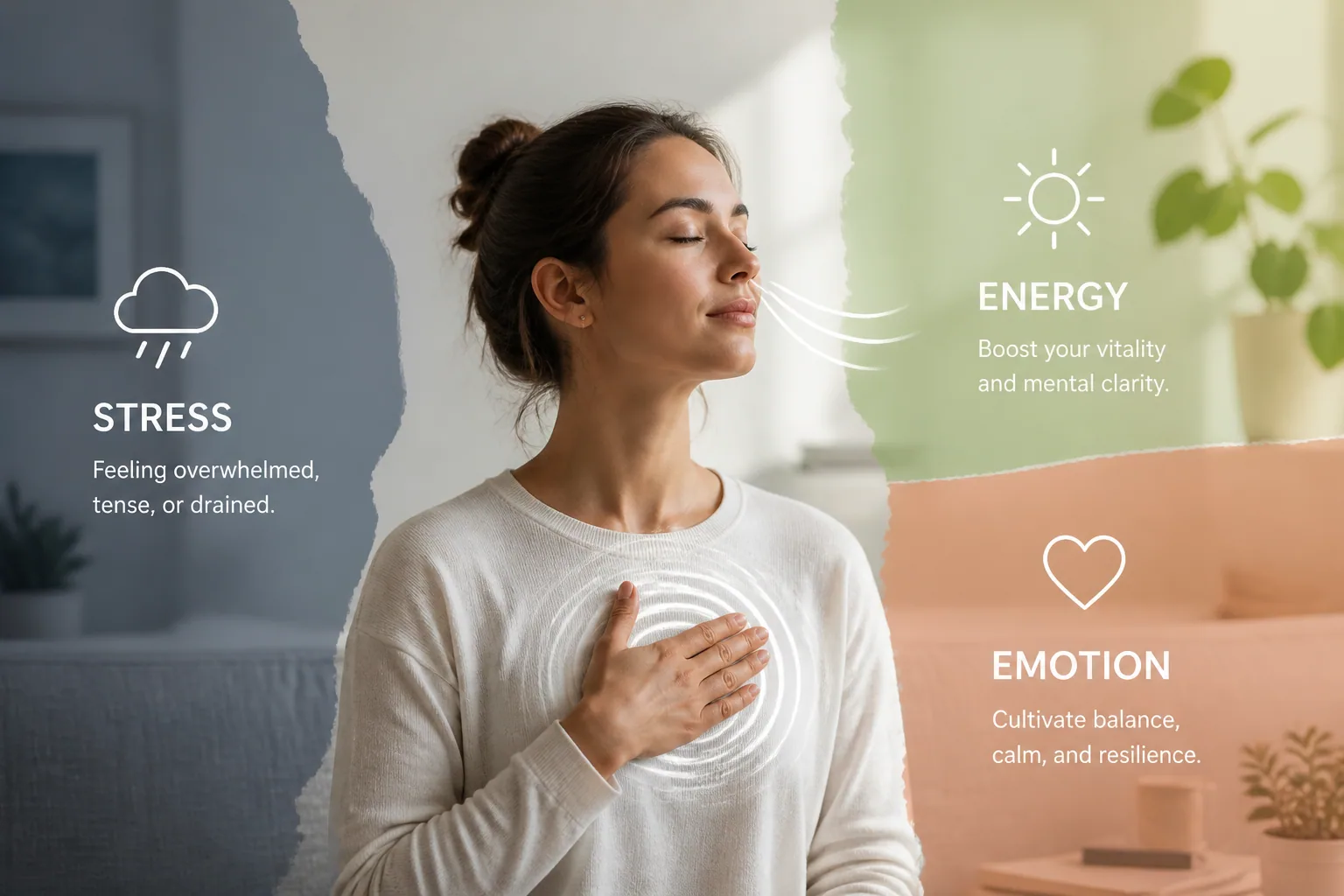
Uncovering Your Breath’s Signals: What Everyday Breathing Reveals About Stress, Energy, and Emotion
Most of us think about breathing only when we are exercising, anxious, sick, or trying a formal breathwork exercise. But your everyday breath is always doing something more subtle than simply moving air in and out. It is constantly reflecting what is happening in your body and mind in real time. The way you breathe while working, scrolling, commuting, talking, recovering, or falling asleep can offer clues about stress load, emotional tension, energy level, and even how well you are recovering.
That does not mean every breath pattern has a single meaning. Breath is not a perfect diagnostic tool, and context matters a lot. Still, when you learn to notice the basics, shallow chest breathing, breath holding, mouth breathing, rapid breathing, sighing, and irregular patterns, you start to build a simple feedback loop with yourself. Over time, that awareness can help you choose the right response, whether that means doing nothing, softening your pace, or using a gentle breathing practice to shift the pattern.
Why Your Everyday Breath Matters More Than You Think
Breathing is one of the few bodily functions that happens automatically and under conscious control at the same time. That makes it uniquely useful. Your breathing can shift before you fully notice stress, fatigue, or frustration. In that sense, it acts like a live signal from your nervous system.
When the body senses strain, breathing often changes shape. The Department of Veterans Affairs Whole Health Library notes that shallow chest breathing, which relies more on the intercostal muscles than the diaphragm, is strongly associated with higher stress, anxiety, and psychological arousal. In other words, if your breath starts staying high in the chest, it may be reflecting that your system is braced, alert, or overwhelmed rather than relaxed. Source: https://www.va.gov/WHOLEHEALTHLIBRARY/tools/diaphragmatic-breathing.asp
This is why breath awareness is so practical. You do not need a special setting to observe it. You can check in with your breathing while answering emails, sitting in traffic, waiting in line, or having a difficult conversation. Those ordinary moments often reveal more than a formal relaxation session because they show you what your body does under real-life pressure.
Breath as a Mirror of Stress, Energy, and Emotion
Breathing patterns often cluster around a few broad themes. Stress and tension tend to push breathing higher, faster, or more guarded. Fatigue and low energy can make the breath feel shallow, muted, or reduced in expansion. Emotional states can also show up as breath holding, sighing, or irregular rhythm.
Research on the human ventilatory response to stress shows that during short-term stressors such as pain, cold, heat, or panic, people often increase minute ventilation in a way that favors rapid, shallow breathing rather than deeper lung expansion. That means stress does not always show up as obvious heavy breathing. Sometimes it appears as quick, tight breaths that barely move the lower ribs at all. Source: https://pmc.ncbi.nlm.nih.gov/articles/PMC5577533/
Emotion and breathing influence one another in both directions. A tense situation can alter your breath, and a changed breath can reinforce the tense state. That is why simply noticing your breathing can already be useful. Observation creates a pause between stimulus and reaction, and that pause can make it easier to respond with more clarity.
How to Spot Common Breath Patterns in Daily Life
The easiest way to learn your breath is to observe it in different contexts. Try checking in during moments that have a natural emotional or physical tone. For example, notice your breathing when you are focused at your desk, walking up stairs, waiting for a message, exercising, sitting in a meeting, or unwinding in the evening.
Instead of trying to judge whether your breath is good or bad, ask simple questions. Is it high or low in the body? Fast or slow? Smooth or irregular? Is there a pause before the inhale or after the exhale? Are you breathing through your nose or your mouth? Do you notice sighs, yawns, or little resets? These small observations often tell you more than trying to force a specific pattern right away.
It can also help to notice whether your breath changes with context. A breath pattern that looks concerning during a stressful phone call may be completely normal during a hard workout. Likewise, a shallow breath in the middle of deep concentration may simply reflect focus, while the same pattern at rest may suggest tension or low recovery. Context is everything.
What Shallow Breathing Often Signals
Shallow breathing usually means the breath is staying mostly in the upper chest rather than expanding through the ribs and diaphragm. In daily life, this often shows up when someone is busy, stressed, guarded, or mentally overloaded. It may also appear when a person is trying to stay quiet, keep control, or avoid fully feeling something uncomfortable.
Because shallow chest breathing is associated with higher stress and anxiety, it can be one of the first patterns worth noticing when you feel off but cannot quite explain why. You might see it while answering work messages, rushing between tasks, or sitting in a tense conversation with your shoulders up and your jaw tight. The breath becomes smaller as the body prepares for effort or defense.
The important thing is not to jump to conclusions. Shallow breathing does not automatically mean there is a major problem. It may simply mean your nervous system is working hard. But if you repeatedly notice it during ordinary moments of the day, it can be a useful reminder to slow down, lengthen the exhale, and soften the body a little.
What Breath Holding Can Reveal
Breath holding is one of the most revealing breathing habits because people often do it without realizing it. It commonly appears during anticipation, concentration, stress, fear, or emotional tension. You might hold your breath while reading something intense, typing out a delicate message, lifting something heavy, or waiting for news.
Research has linked breath holding to emotional tension and threat states, and chronic breath holding has been associated with higher arterial pressure in people with emotional disorders. Breath-holding duration tasks have also been studied as markers of distress tolerance and self-regulatory capacity, with shorter durations often seen in people with higher anxiety sensitivity. Sources: https://jamanetwork.com/journals/archneurpsyc/article-abstract/651439 and https://pmc.ncbi.nlm.nih.gov/articles/PMC3725515/
In everyday life, breath holding can feel like bracing. It may show up as a small freeze in the body, a paused inhale, or a locked abdomen. If you notice it, that is already useful information. Sometimes the best response is simply to exhale and resume breathing naturally. You do not always need a technique. Often, the act of noticing is enough to break the pattern.
Mouth Breathing vs. Nasal Breathing: Why It Matters
Whether you breathe through your nose or mouth can also shape how you feel. Nasal breathing is generally the more efficient and regulating option for everyday rest, because it helps condition and filter incoming air and is often linked with better pacing. Mouth breathing, on the other hand, can appear when the body is stressed, congested, physically exerted, or simply not paying attention.
Research suggests nasal breathing can enhance cognitive functions such as fear discrimination and memory, while oral breathing tends to reduce performance on emotional recognition tasks. Another study found that mouth breathing increases oxygen load in the prefrontal cortex compared with nasal breathing, changing brain hemodynamic responses in healthy adults. Sources: https://pmc.ncbi.nlm.nih.gov/articles/PMC5148230/ and https://pubmed.ncbi.nlm.nih.gov/24169579/
That does not mean mouth breathing is always bad. During exercise, nasal congestion, or certain recovery states, mouth breathing may be completely expected. But if mouth breathing becomes your default while sitting, working, or sleeping, it may be worth paying attention to whether stress, posture, or airway habits are contributing. A gentle return to nasal breathing can sometimes support a calmer, more stable rhythm.
Fast, Irregular, and Sighing Breath Patterns Explained
Fast breathing can mean different things depending on its depth and context. When rapid breathing is shallow and driven beyond metabolic need, it can resemble hyperventilation. In that case, carbon dioxide levels drop, blood pH rises, and symptoms like lightheadedness, tingling, and increased arousal or panic can appear. Source: https://bio.libretexts.org/Workbench/Human_Physiology%3A_A_Students_Open_Path_to_Understanding_the_Body/17%3A_The_Mechanics_of_Breathing-_Pressure_Flow_and_Ventilation/17.03%3A_17.3_How_Breathing_Works-_Pressures_Volumes_and_Airflow
Irregular breathing can happen when the nervous system is shifting between states. You may notice this during emotional conversations, while multitasking, or when you are physically tired. Sometimes the breath becomes uneven because attention is scattered. Other times it becomes uneven because the body is trying to process stress.
Sighing is another pattern people often overlook. On average, people sigh about 12 times per hour, and sighs help reinflate collapsed alveoli and maintain lung compliance. They may also act as a resetter for respiratory variability, creating more structure in breathing after a period of randomness. Sources: https://www.healthline.com/health/sighing and https://pubmed.ncbi.nlm.nih.gov/19744538/
Emotionally, increased sighing can correlate with anxiety, pain, or sadness, though excessive sighing can sometimes contribute to hyperventilation and more stress. Source: https://health.clevelandclinic.org/i-sigh-a-lot-what-does-that-mean
How Context Changes the Meaning of a Breath Pattern
One of the biggest mistakes in breath awareness is interpreting a single pattern without context. The same breathing pattern can mean very different things in different settings. Fast breathing during a sprint is normal. Fast breathing during a quiet meeting may point to stress. Breath holding during a lift is functional. Breath holding while reading a tense email may reflect emotional bracing.
This is why observation should be curious rather than judgmental. The question is not, What is wrong with my breath? The better question is, What is my breath responding to right now? That shift keeps you from overreacting and helps you identify patterns that matter. You begin to see that your breathing is not random. It is often paired with workload, emotions, posture, environment, or recovery state.
Over time, you may notice your breath has different personalities. It may be fuller in nature, tighter during deadlines, shorter when scrolling late at night, or more open after a walk. That kind of pattern recognition can be incredibly informative because it turns breathing into a daily self-check instead of a vague wellness concept.
Simple Exercises to Start Listening to Your Breath
You do not need a complicated routine to begin. Start with a 30-second observation. Sit or stand comfortably and notice your breath exactly as it is. Watch the inhale and exhale without changing them. See whether the breath is high, low, fast, slow, smooth, or hesitant. Then notice what else is happening in your body, such as jaw tension, shoulder position, or a tight belly.
Next, try a gentle body scan during a real-life moment. During work, ask whether your breath gets smaller when your focus increases. During a commute, notice whether you are unconsciously holding your breath in traffic. During exercise, ask whether you are breathing efficiently or trying to avoid discomfort by shallow breathing. During a hard conversation, see whether you freeze before answering.
If you want a slightly more structured practice, pair observation with one small change. For example, lengthen the exhale a little, relax the tongue, or shift toward nasal breathing for a few breaths. The goal is not perfect control. It is learning how your breath responds when you create just a little more space.
When to Observe and When to Use Breathwork
Observation alone is often enough when the breath pattern is temporary, clearly linked to a situation, or naturally resolves once the moment passes. For example, breath holding during concentration or faster breathing during exercise may not need intervention at all. In many cases, simply recognizing the pattern helps your system settle.
Gentle breathwork can help when the pattern feels stuck, repetitive, or disproportionate to the situation. If you notice shallow chest breathing at rest, habitual mouth breathing when you are not exerting yourself, or rapid breathing that is feeding anxiety, a simple practice like slower exhalations, box breathing, or cardiac coherence may support regulation. If you are looking for an easy way to build that habit, Just Breathe: Relax Daily is a helpful companion for guided sessions and reminders: https://findthe.app/just-breathe-ujhm1e
The key is to match the tool to the moment. If you are overwhelmed, a calming pattern may help. If you are sluggish or foggy, a more energizing breathing rhythm may be better. If you are already regulated, it may be more useful to simply notice and continue. Breathwork works best when it is personalized rather than forced.
How Breath Awareness Improves Every Breathwork Practice
Formal breathwork becomes more effective when you already know your baseline. If you can recognize how you breathe when you are calm, tired, tense, or focused, you can choose a practice that actually fits what you need. That makes breathwork less generic and more responsive.
For example, someone who tends to hold their breath under pressure may benefit most from practices that emphasize ease and continuous exhale. Someone who breathes shallowly throughout the day may need help reconnecting to the diaphragm and lower ribs. Someone who feels overstimulated may do better with slower, quieter breathing. Someone who is low energy may prefer a gently activating rhythm instead of overly sedating breathwork.
Awareness also helps you notice what changes after the practice. Did your shoulders soften? Did the breath become quieter? Did the mind feel less scattered? Did your mood shift? These observations turn breathwork from a one-size-fits-all exercise into a personal feedback loop.
Building a Daily Habit of Noticing Your Breath
The most useful breath awareness practice is the one you actually repeat. You do not need long sessions to make progress. A few check-ins a day can be enough to build a clearer relationship with your breathing. Try linking breath observation to existing routines, such as opening your laptop, starting the car, waiting for coffee, finishing a meal, or lying down at night.
You can also use small triggers in emotionally charged moments. Before answering a difficult text, notice whether you are holding your breath. Before a meeting, notice whether the breath is in your chest or belly. After scrolling for a while, notice whether your breathing has become shallow or irregular. These tiny pauses create more self-awareness than you might expect.
In the end, everyday breathing is less about perfection and more about information. Your breath can tell you when you are braced, tired, overstimulated, recovering, or settling. Once you start listening, you gain a practical tool that is always available, always honest, and always connected to the present moment.