Unlocking Relief: How Breathwork Can Support Trauma and PTSD Recovery Safely
Breathwork has become increasingly popular in trauma recovery conversations, and it is easy to understand why. When someone is living with PTSD, CPTSD, or ongoing traumatic stress, the body can feel stuck in a state of alarm, shutdown, or constant scanning for danger. Because breathing is one of the few bodily functions we can influence both consciously and automatically, it can offer a practical entry point for regulation. But this is also why breathwork must be approached carefully. For trauma recovery, the goal is not to push harder or breathe more dramatically. The goal is to create enough safety and steadiness for the nervous system to soften, little by little, while breathwork remains a complement to therapy, not a replacement for it.
Why Breathwork Is Gaining Attention in Trauma Recovery
The renewed interest in breathwork is not just a wellness trend. It reflects a growing understanding that trauma lives not only in memory and emotion, but also in physiology. Many people with trauma histories notice changes in breathing before they even recognize stress in their thoughts: shallow breaths, chest tension, sighing, breath holding, or a sense that breathing feels difficult to control. In that context, breathwork can feel appealing because it is accessible, free or low-cost, and something many people can practice in small doses at home.
What makes breathwork especially interesting in trauma recovery is that certain patterns appear to influence measurable markers of stress regulation. Some practices may reduce sympathetic activation, improve baroreflex sensitivity, and lower blood pressure. That matters because trauma can keep the body in a prolonged survival state, with a system that is primed to react rather than rest. The challenge is choosing techniques that support regulation instead of intensifying activation.
What Current Research Says About Breathwork and PTSD
The evidence base is encouraging, but still developing. One randomized controlled study in pre-hypertensive veterans with PTSD found that 15 minutes of device-guided slow breathing at about 5 breaths per minute significantly reduced systolic blood pressure, diastolic blood pressure, mean arterial pressure, and muscle sympathetic nerve activity. It also improved sympathetic baroreflex sensitivity compared with sham breathing at about 14 breaths per minute. You can read the study here: https://pubmed.ncbi.nlm.nih.gov/29652544/
That is an important finding because it suggests slow breathing may help reduce a physiological stress load that is often elevated in trauma survivors. At the same time, this does not mean all breathwork is equally helpful or equally safe. The details matter: pace, intensity, duration, posture, and whether the practice helps someone feel grounded or overwhelmed.
Research is also emerging on gentler, more structured patterns. In Stanford Medicine research from 2023, five minutes per day for 30 days of cyclic sighing, which is a double inhale through the nose followed by a slow extended exhale through the mouth, reduced anxiety and negative mood in healthy adults. The cyclic sighing group also showed the greatest improvement in positive affect and a lasting decrease in resting respiratory rate. More on that study is available here: https://med.stanford.edu/news/insights/2023/02/cyclic-sighing-can-help-breathe-away-anxiety
These results are promising, especially because the practice was brief and simple. Still, healthy adults are not the same as people recovering from trauma, so the findings are best understood as supportive evidence rather than proof of a universal protocol.
How Breathing Affects the Nervous System After Trauma
To understand why breathwork can help, it helps to think about the autonomic nervous system. This system includes the sympathetic branch, often associated with fight or flight, and the parasympathetic branch, often associated with rest and digest. After trauma, some people become chronically sympathetic, meaning their bodies feel keyed up, alert, tense, or ready to react. Others swing into shutdown, dissociation, or numbness when the nervous system is overwhelmed. Many people move between both states.
Breathing is closely linked to this system. Faster and more forceful breathing can increase activation, while slower and more rhythmic breathing may support parasympathetic activity and improve overall regulation. Some slow-breathing approaches may also influence blood pressure and baroreflex sensitivity, which are part of the body’s ability to sense and adjust to internal change. In simple terms, breath can become a bridge between mind and body, helping the system notice that danger is not necessarily happening right now.
That said, trauma survivors often have very sensitive systems. A technique that calms one person may trigger another. This is why the best breathwork for trauma recovery is usually gradual, choice-based, and easy to stop.
When Breathwork Helps, and When It Can Feel Too Activating
Breathwork tends to help when it creates a sense of orientation, stability, and return. You may notice your shoulders loosening, your thoughts slowing, your breathing becoming less effortful, or your body feeling a little more present after practice. The breath may not erase pain, but it can reduce the intensity enough for you to stay with yourself.
Breathwork can feel too activating when it asks the nervous system to do too much too fast. That often happens with long breath holds, very rapid breathing, overly forceful inhalations or exhalations, or any method that pushes you beyond your current window of tolerance. For trauma recovery, intensity is not the goal. Capacity is.
The broad review in Neuroscience & Biobehavioral Reviews from 2023 notes that high ventilation breathwork can affect sympathetic activation, blood flow, neuronal excitability, and blood gas balance, and it may have emerging benefits for trauma, affective, and somatic disorders. But the same review also emphasizes that rigorous clinical trials and clearer safety protocols are still needed. You can find the review here: https://www.sciencedirect.com/science/article/pii/S0149763423004220
Understanding High Ventilation Breathwork: Benefits, Risks, and Cautions
High ventilation breathwork includes practices such as holotropic breathing and conscious connected breathing. These methods often use strong, continuous, or rapid breathing patterns that can substantially change body chemistry and arousal. For some people, this can produce catharsis, emotional release, altered states, or a feeling of breakthrough. For others, it can lead to panic, dizziness, numbness, or a sense of being flooded.
Because high ventilation breathwork can be powerful, it should be treated as a more advanced and potentially activating method, not the first place to start. In trauma recovery, the key question is not whether a technique is dramatic or popular. It is whether the practice helps the person stay within a manageable range of activation and return to baseline afterward.
It is also important to know the contraindications commonly listed for high-ventilation breathwork. These include cardiovascular disease, uncontrolled hypertension, epilepsy, pregnancy, glaucoma, detached retina, bipolar disorder, schizophrenia, and active psychosis. Trauma-aware practitioners usually screen for these risks before recommending any intensive method. More guidance on trauma-informed screening is available here: https://breathskills.com/articles/trauma-informed-breathwork-training.html
What Trauma-Informed Breathwork Looks Like in Practice
Trauma-informed breathwork is built around safety, choice, pacing, and titration. That means the person practicing gets to decide the intensity, can pause at any time, and is encouraged to use methods that feel doable rather than challenging. The breath is not used to force emotional release. It is used to support regulation.
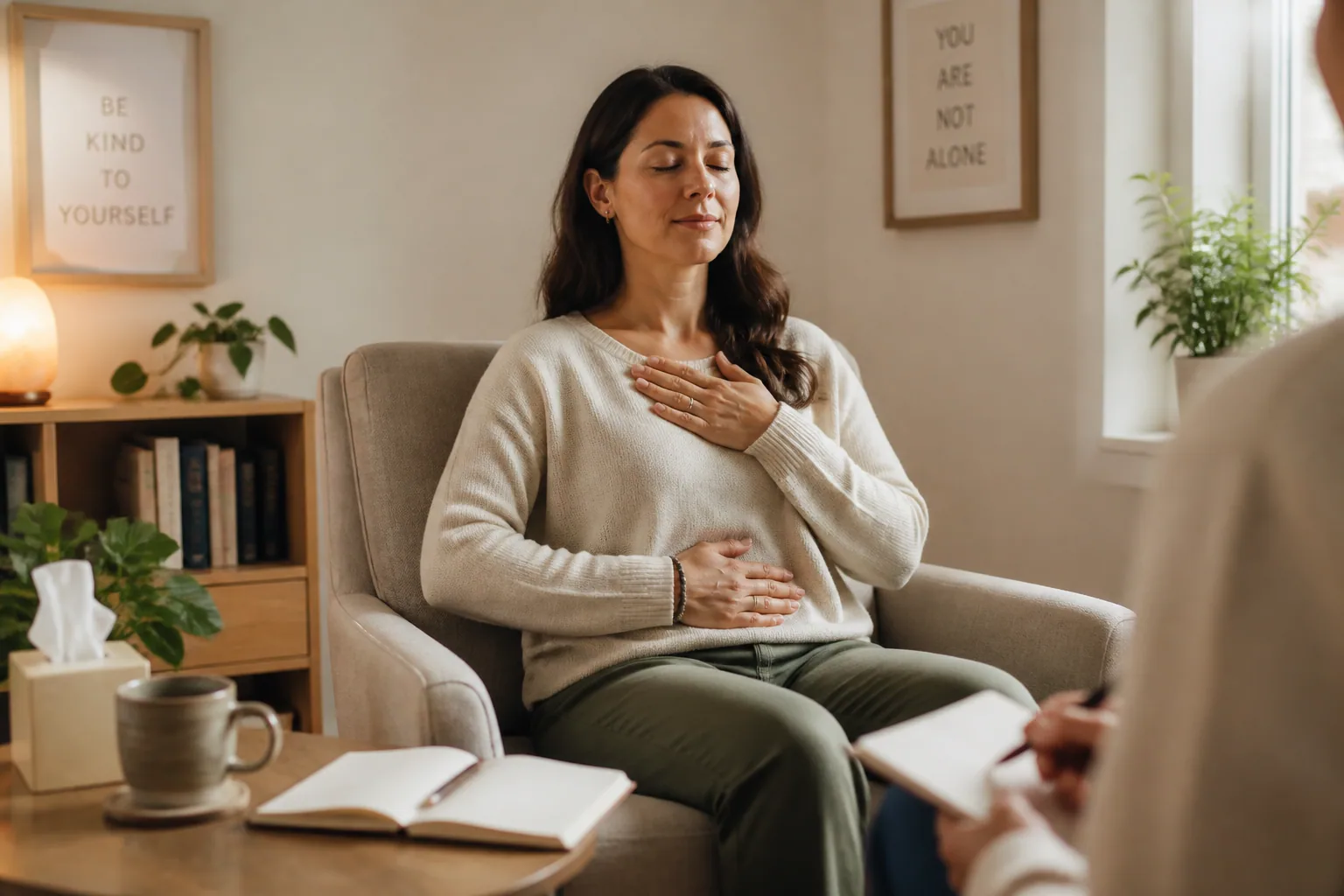
In practice, this usually means starting with lower-risk patterns like slow rhythmic breathing, gentle nasal breathing, slightly longer exhalations, or simple coherence-based patterns. The practice should be predictable, brief enough to stay manageable, and paired with cues that help the person stay oriented to the room and to their body. Some people do better with eyes open, a hand on the chest or belly, or a sense of touching the floor while breathing.
A trauma-informed approach also recognizes that progress may look very small. A better breathwork session is not necessarily the one that feels profound. It may simply be the one that leaves you a little steadier than before.
Signs a Breathing Technique Is Supporting You
Supportive breathwork often feels subtle at first. You might notice a slight slowing of the mind, less tension in the jaw or shoulders, warmer hands, softer facial muscles, or a more even breath rhythm. Emotionally, you may feel calmer without feeling sedated, more present without feeling exposed, or more able to think clearly after the practice.
Another useful sign is that you can stop and return to normal breathing easily. If a technique helps you come back to yourself, rather than pulling you further away from yourself, that is a strong indicator it is a good fit for now. Breathwork should leave you with more choice, not less.
Some people also notice that a supportive practice improves sleep onset, lowers baseline tension, or makes day-to-day stress feel slightly less overwhelming. These changes can be especially meaningful when they accumulate over time.
Signs a Breathing Technique May Be Too Much Right Now
Warning signs matter, especially for trauma survivors. Physical red flags can include sharp chest pain, severe dizziness, fainting, or persistent physiological agitation that does not settle after stopping. Emotional red flags can include dissociation, panic, overwhelming emotional flooding, or the feeling that you cannot reorient without outside help.
The most important question is how you feel after the practice ends. If you are more activated, more foggy, or more disconnected, the technique may be too intense or too long for your current state. Some people can tolerate a method on calm days but not during times of stress, poor sleep, conflict, or heightened symptoms. That does not mean you failed. It means your nervous system gave you useful information.
If you repeatedly feel worse after breathwork, it is worth stepping back and choosing a gentler method, shorter duration, or additional support from a clinician or trauma-informed practitioner.
Low-Risk Breathwork Techniques to Try First
If you are new to breathwork, the safest place to begin is usually with simple, low-effort methods. Slow breathing, extended-exhale breathing, and gentle cyclic sighing are common starting points because they do not rely on force or breath retention. They also allow you to keep a stable sense of control throughout the practice.
A helpful principle is to choose patterns that reduce effort rather than add it. If you are already tense, breathwork should not feel like another performance. It should feel like an invitation to soften.
For many trauma survivors, short practices done consistently are more useful than long sessions done occasionally. A few minutes of gentle breathing, repeated daily, often creates more trust than a single intense session.
How to Practice Slow Breathing Safely at Home
Slow breathing at home works best when it is simple. Sit or lie down in a position that feels supported. Keep your breath light and unforced. Try breathing through the nose if that is comfortable, and let the exhale be a little longer than the inhale. You do not need to take deep breaths. In fact, overly deep breathing can become uncomfortable for some people.
A useful starting point is to aim for a calm, easy rhythm rather than a specific perfect count. If a paced count helps, many people use a gentle tempo around 5 to 6 breaths per minute, but it is fine to adapt based on comfort. If slowing down starts to feel stressful, reduce the pace or stop entirely. The goal is regulation, not endurance.
It can also help to keep the practice brief at first, perhaps one to three minutes, and then notice the effect. Ask yourself whether your body feels clearer, calmer, or more agitated. That feedback is part of the practice.
Using Cyclic Sighing and Exhale-Focused Patterns for Regulation
Cyclic sighing can be a useful option for people who benefit from a slightly more structured pattern without long holds or intense exertion. The version studied at Stanford used a double inhale through the nose followed by a slow extended exhale through the mouth. It is simple, memorable, and brief enough to use as a daily reset.
This kind of pattern may work well because the longer exhale naturally supports downshifting. Many people also find that the slight reset created by the second inhale prevents the practice from feeling overly flat or restrictive. If you try it, keep the breaths gentle rather than big. More air is not better here.
Other exhale-focused patterns can be equally useful. For example, you can inhale for a comfortable count and exhale for a slightly longer count, or simply let the exhale take up more time than the inhale while staying relaxed. If any pattern makes you feel air hungry, dizzy, or tense, stop and return to normal breathing.
Modifying Breathwork for Hypervigilance, Panic, or Dissociation
People with hypervigilance often do best with practices that feel grounding and orienting. Keeping the eyes open, focusing on one stable object in the room, and breathing with a small amount of effort can help prevent drifting into overload. For some, placing a hand on the chest or belly adds reassurance.
For panic-prone systems, the best modifications are usually simplicity and permission. Use shorter sessions, avoid long breath holds, and choose patterns that do not increase the feeling of being trapped. If a technique makes you monitor your breath obsessively, scale back. Breathwork should reduce the sense of danger, not amplify it.
For dissociation, the emphasis is often on staying connected to external reality. Try breathing while seated upright, with feet on the floor, and pause often to name what you see, hear, or feel. If you start to feel far away, reduce intensity immediately. Some people need very little breathwork and much more grounding before breathing exercises are useful.
How to Work With a Therapist or Support Person Around Breathwork
Breathwork is often most useful when it is integrated with therapy or another trusted support system. A therapist can help you notice patterns, track triggers, and decide whether a breathing exercise is regulating you or simply numbing you out. This is especially important if you have a history of panic, dissociation, medical concerns, or complex trauma.
If you are exploring more active breathwork, doing so with a trauma-informed practitioner and proper screening is far safer than trying to push through on your own. As the research and clinical guidance suggest, some methods require more caution than others, especially when there are medical or psychiatric contraindications.
You can also ask a support person to stay nearby during a new practice, not to manage the experience for you, but to help you stay oriented and safe. Sometimes simply knowing that someone is present lowers the intensity of the practice.
Building a Gentle Breathwork Routine for Long-Term Healing
For long-term recovery, consistency usually matters more than complexity. A gentle routine might include one short breathing practice in the morning to orient the day and another in the evening to help the body unwind. The routine should be flexible enough to skip on difficult days without guilt.
This is where a simple tool can be helpful. An app like Just Breathe: Relax Daily, available at https://findthe.app/just-breathe-ujhm1e, can make it easier to practice guided patterns such as cardiac coherence, box breathing, or relaxation breathing with visual cues, ambient sounds, and reminders. For someone trying to keep breathwork gentle and consistent, that kind of support can reduce friction and make it easier to stay with low-risk patterns.
Even with a good routine, it helps to track how each practice affects you. Notice not only whether you completed the exercise, but whether it helped your body settle, your sleep improve, or your mood become more stable. In trauma recovery, the small data points matter.
Final Takeaway: Breathwork as One Tool in a Bigger Recovery Plan
Breathwork can be a meaningful support for trauma and PTSD recovery when it is used carefully, gradually, and with respect for nervous system limits. Research suggests that slow breathing and gentle exhale-focused practices may reduce stress activation and support physiological regulation, while more intensive methods like high ventilation breathwork require much greater caution and stronger safeguards. The difference is not just technique. It is approach.
If you are recovering from trauma, the safest path is usually to start with low-risk breathing patterns, watch your responses closely, and stop if the practice becomes activating rather than calming. Breathwork works best when it feels choice-based and grounding, not forced.
And perhaps most importantly, breathwork should be one tool in a broader recovery plan. Therapy, peer support, medical care when needed, and other trauma-informed healing modalities still matter. Used that way, breathwork can become a gentle daily ally: not a cure-all, but a steady way to help your system practice feeling safer over time.