Unplug & Exhale: How Breathwork Helps You Detox From Digital Overload
If your day starts with notifications and ends with one more scroll before bed, you are not imagining the mental fog. Digital life can leave your brain feeling saturated, your body tense, and your attention fractured. For remote workers, heavy phone users, and anyone living under a constant stream of alerts, breathwork can become the missing link in a real digital detox. It does not require a full retreat from technology. It simply gives your nervous system a way to step down from overstimulation and return to a calmer baseline.
That matters more than ever. Remote work in the U.S. rose from about 7% of workers in 2019 to 28% in 2023, and research has linked that shift with increased isolation, worse mental well-being, and more frequent use of mental health services, especially for people living alone (https://doi.org/10.1126/science.aec7671). In a large meta-analysis of teleworkers, more than half reported poor sleep quality, while 28.4% reported high stress and 23% reported significant anxiety (https://www.mdpi.com/2071-1050/16/18/8278). In other words, digital overload is not just a productivity problem. It is a nervous system problem.
Why Digital Overload Leaves Your Brain Feeling Full
Digital overload is not only about screen time in the abstract. It is about the way screens fragment your day into tiny interruptions. Every ping, tab switch, message preview, and short-form video asks your brain to reorient. Over time, that constant reorientation can make focus feel harder to access and harder to hold. You may sit down to work and feel busy without feeling clear. You may try to relax and still feel mentally “on.”
What makes this especially draining is that the body often does not distinguish between urgent work and urgent stimulation. A calendar alert, a social media notification, and a message from a coworker can all trigger a similar surge of alertness. That is why many people feel wired even when they are technically resting. The mind keeps receiving signals to stay available.
For adolescents, the pattern is even easier to see. Among U.S. teens ages 12 to 17, those with 4 or more hours of daily non-school screen time are nearly twice as likely to experience anxiety or depression symptoms as those with less screen time, according to CDC data from the National Health Interview Survey-Teen (https://www.cdc.gov/nchs/products/databriefs/db513.htm). While adults are not teens, the trend reinforces a broader point: too much screen exposure can correlate with emotional strain, especially when it crowds out sleep, movement, and recovery.
What Screen Time Does to Attention, Stress, Sleep, and Breathing
The effects of screen time often show up in four places at once: attention, stress, sleep, and breathing. First, attention gets scattered. Rapid switching trains the brain to expect novelty, not depth. That makes slower tasks feel harder, especially after hours of multitasking and scrolling.
Second, stress rises. Even when you are sitting still, your nervous system may stay in a state of low-grade readiness. The telework research is useful here because it shows how common stress and anxiety have become in heavily digital work environments. If your workday is mostly virtual, your brain may spend far less time in true recovery mode than it used to.
Third, sleep suffers. In children and adolescents, excessive screen time has been associated with higher odds of anxiety and depression, with sleep duration and regular bedtimes acting as key mediators (https://www.nature.com/articles/s41599-026-06609-1). That is important because sleep and digital habits tend to reinforce each other. Late-night scrolling delays bedtime, and poor sleep makes the next day’s screen habits feel harder to regulate.
Fourth, breathing changes. When we are stressed, focused, or overstimulated, breathing often becomes shallow and chest-centered. Research on breathing exercises shows that specific practices can increase tidal volume, reduce respiratory rate, and shift the breath toward diaphragmatic, abdominal patterns over thoracic, chest-dominant patterns (https://pmc.ncbi.nlm.nih.gov/articles/PMC4311599/). That shift matters because shallow, fast breathing can keep the body in a more activated state, while slower diaphragmatic breathing tends to support calm.
Why Breathwork Works as a Reset for the Nervous System
Breathwork works because breathing is one of the few body functions that is both automatic and voluntarily adjustable. That means you can use it as a bridge between conscious choice and involuntary physiology. When you slow the breath down, lengthen the exhale, or create a steady rhythm, you send the body a signal that the immediate threat has passed.
This is where the autonomic nervous system comes in. Stress and anxiety tend to activate the sympathetic branch, the classic fight or flight response. Breathwork can help recruit parasympathetic activity, which is associated with rest, digestion, recovery, and emotional settling. A scoping review of breathwork interventions for adults with clinically diagnosed anxiety disorders found significant improvements in anxiety symptoms, along with better emotional regulation, increased heart-rate variability, and enhanced parasympathetic activity (https://pmc.ncbi.nlm.nih.gov/articles/PMC9954474/).
The science also supports slower breathing as a practical reset. In a 2026 randomized controlled trial involving student paramedics, a diaphragmatic breathing protocol reduced stress, anxiety, and depression while improving resilience, with medium to large effect sizes (https://pubmed.ncbi.nlm.nih.gov/41787752/). And for sleep, a review in Sleep Medicine Reviews found that slow breathing before bedtime improved self-reported sleep quality and duration in 7 out of 9 studies, even though objective measures were mixed (https://www.sciencedirect.com/science/article/pii/S1087079226000560).
In simple terms, breathwork gives your system a different instruction than your screens do. Screens often say “stay alert.” Breathwork says “you can soften now.”
The Best Breathwork Techniques for Stepping Away From Screens
The best breathwork practices for digital detox moments are the ones you can actually remember when you are already overloaded. You do not need a perfect meditation setup. You need a quick, reliable reset that works in real life.
Box Breathing
Box breathing is one of the simplest techniques for moving from stimulation to steadiness. Inhale for four counts, hold for four, exhale for four, hold for four, then repeat. This creates a predictable rhythm that can be especially helpful after intense screen use, because it gives the mind a structure to follow instead of more input to process.
This technique is often used for focus and composure because it balances attention with regulation. If you tend to feel scattered after checking messages or bouncing between tabs, box breathing can help you re-enter your day with more control.
The Physiological Sigh
A physiological sigh is a double inhale through the nose, followed by a long exhale through the mouth. It is one of the fastest ways to create a sense of release. Research on sighing found that after a sigh, markers of respiratory and autonomic regulation improve, and subjective relief increases significantly, especially in people with high anxiety sensitivity (https://pubmed.ncbi.nlm.nih.gov/27404329/).
This makes it a strong choice for those moments when you have just closed your laptop, put your phone down, or finished a stressful thread of emails and need to come back into your body quickly.
Grounding Breath
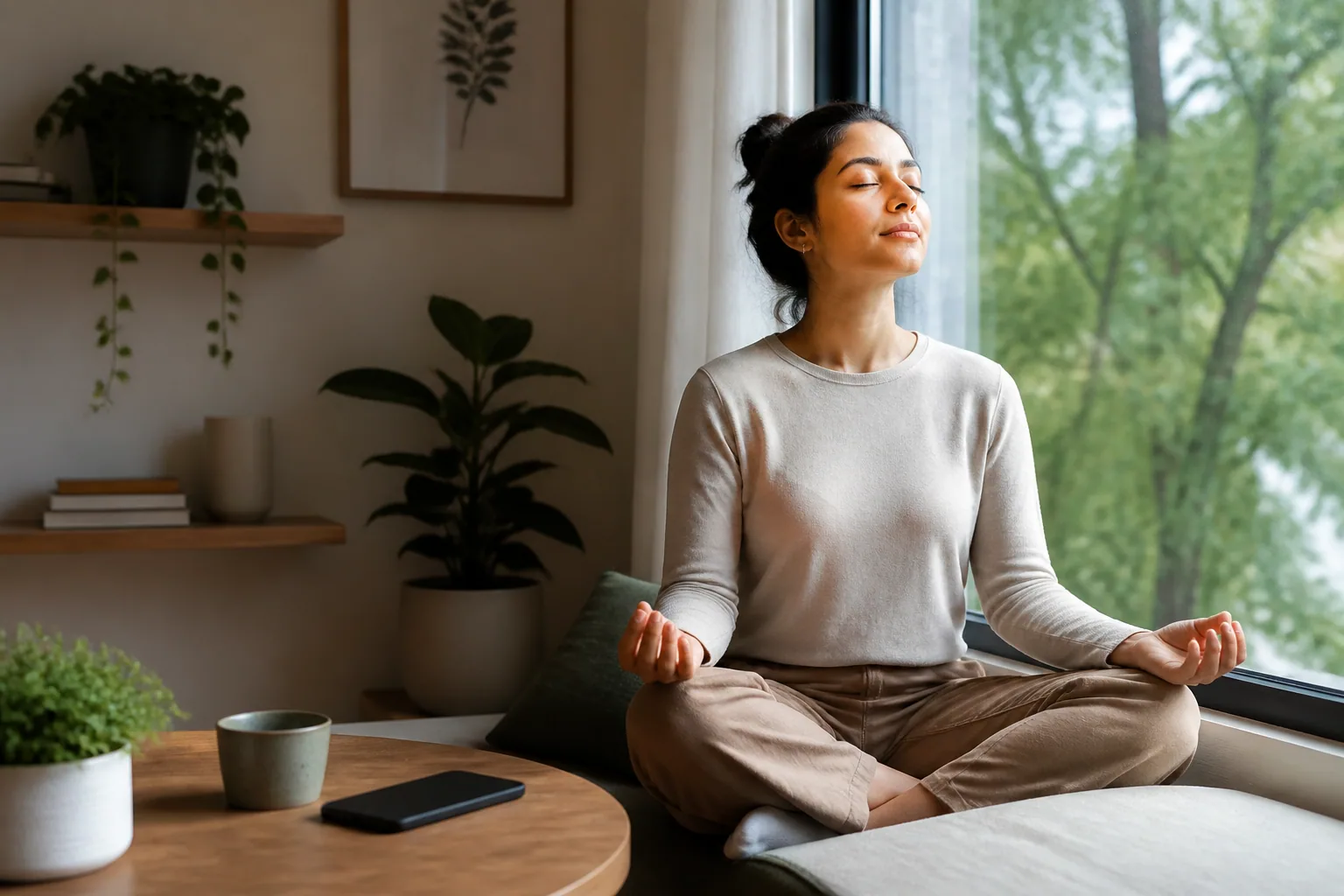
Grounding breath is less about counting perfectly and more about reconnecting with your body. Sit still, place one hand on your chest and one on your belly if it feels comfortable, and breathe slowly into the lower hand. Let the exhale be slightly longer than the inhale. This helps move attention away from the digital environment and back into physical sensation.
That simple shift can be powerful if your workday has been mostly mental. It reminds your system that you are not just a mind attached to a screen.
Relaxation Breath for Evening
For bedtime, a slower pattern can be especially helpful. The research on slow breathing before sleep suggests that breathing at 10 breaths per minute or slower may support better sleep quality. A smooth inhale and extended exhale can help take the edge off post-scroll overstimulation and prepare the body for rest.
If you want guided support for these patterns, a simple tool like Just Breathe: Relax Daily can make the practice easier to stick with, especially if you like visual pacing and reminders. You can explore it here: https://findthe.app/just-breathe-ujhm1e
A 1-Minute Post-Scroll Reset You Can Do Anywhere
One of the best ways to use breathwork for digital detox is to pair it with the exact moment you stop scrolling. That transition is where many people get stuck. You close the app, but your attention is still full. You leave the feed, but the nervous system stays activated.
Try this 1-minute reset:
First, put the phone face down or lock the screen. Second, inhale through the nose twice in one smooth cycle, then exhale slowly through the mouth. Repeat that two more times. Third, take three slower breaths, letting the exhale last longer than the inhale. Fourth, look at one object in the room and name it silently. This helps your brain reorient from digital novelty to real-world presence.
The point is not to eliminate stimulation completely. The point is to create a deliberate landing zone after stimulation. Just one minute can be enough to interrupt the “carryover” effect that makes scrolling bleed into the next task.
Breathwork Routines for Before Work, After Work, and Before Bed
The easiest habits are the ones attached to moments you already have. If you want breathwork to support a digital detox, tie it to clear transitions instead of treating it like another task on your to-do list.
Before work, do three rounds of box breathing before opening your inbox. That helps you start the day in a regulated state rather than reacting to the first notification you see. If you work from home, this can be a powerful replacement for the commute, since it creates a symbolic boundary between personal time and work mode.
After work, use two or three physiological sighs before picking up your phone again. This can help prevent the common pattern where work stress turns directly into passive scrolling. Instead of switching from one screen to another, you create a small gap that lets the body downshift.
Before bed, try slow breathing in a darkened room for five minutes. Keep the pattern gentle and comfortable. You are not forcing relaxation. You are inviting it. Studies on slow breathing before bedtime suggest that this can improve perceived sleep quality and sleep duration, making it a useful part of an evening wind-down routine.
How to Build Digital-Free Zones Where Calm Comes First
A digital detox does not have to mean banning all devices everywhere. It can start with one or two zones where calm is the priority. Common choices are the bedroom, the dining table, or the first 15 minutes after waking up. In these spaces, breathwork becomes a replacement behavior, not just a relaxation add-on.
For example, if you keep the phone out of the bedroom, you can pair that boundary with three minutes of slow breathing before sleep. If the dining table is screen-free, you can take one grounding breath before meals. If your morning routine usually begins with email, you can create a no-screen first 10 minutes and fill that space with box breathing, gentle stretching, or quiet sitting.
This matters because digital boundaries are easier to sustain when they feel positive instead of punitive. Breathwork gives those boundaries a calming purpose. You are not just avoiding your devices. You are choosing a better state of mind.
The Real Benefits: Better Sleep, Less Anxiety, Clearer Thinking
The benefits of using breathwork after screen time are not vague or mystical. They are practical and measurable. Better sleep is one of the clearest wins. Since remote work and telework are so often linked with poor sleep quality and elevated stress, anything that improves evening regulation can have a real ripple effect the next day.
Less anxiety is another major benefit. Breathwork interventions have been shown to improve anxiety symptoms and emotional regulation, and sigh-based techniques can create a noticeable sense of relief. That is useful for people who feel tense after constant messaging, social comparison, or endless news consumption.
Clearer thinking follows from both of those changes. When sleep improves and stress comes down, focus tends to sharpen. You may find it easier to begin tasks, finish tasks, and stop checking your phone reflexively. Breathing also gives you a moment of pause before reaction, which can reduce impulsive replies and emotional spirals.
In a hyperconnected world, this is a real advantage. Breathwork does not just help you feel calmer for a minute. It can help restore the conditions that make clear thought possible in the first place.
How to Make Breathwork a Habit in a Hyperconnected Life
The best breathwork habit is the one you repeat. That usually means keeping it short, attaching it to a cue, and making it easy to remember. If you try to build a 30-minute practice from scratch, it may compete with all the other demands on your attention. If you start with one minute after each scroll session, it is much more doable.
Start with one anchor habit. For example, every time you close a social app, do one physiological sigh. Every time you open your laptop in the morning, do one minute of box breathing. Every time you get into bed, do five slow breaths with a longer exhale. These small repetitions teach your nervous system that transitions are not emergencies.
Smart reminders can also help, especially when your digital habits are automatic. A gentle prompt can nudge you back into practice before stress builds up. Tracking your sessions, noticing how you feel afterward, and linking breathwork to a daily rhythm can turn it from an occasional rescue tool into a sustainable part of your day.
In the end, breathwork is not about becoming perfectly calm or perfectly offline. It is about making room to exhale. When digital life gets loud, your breath is one of the fastest ways back to yourself.