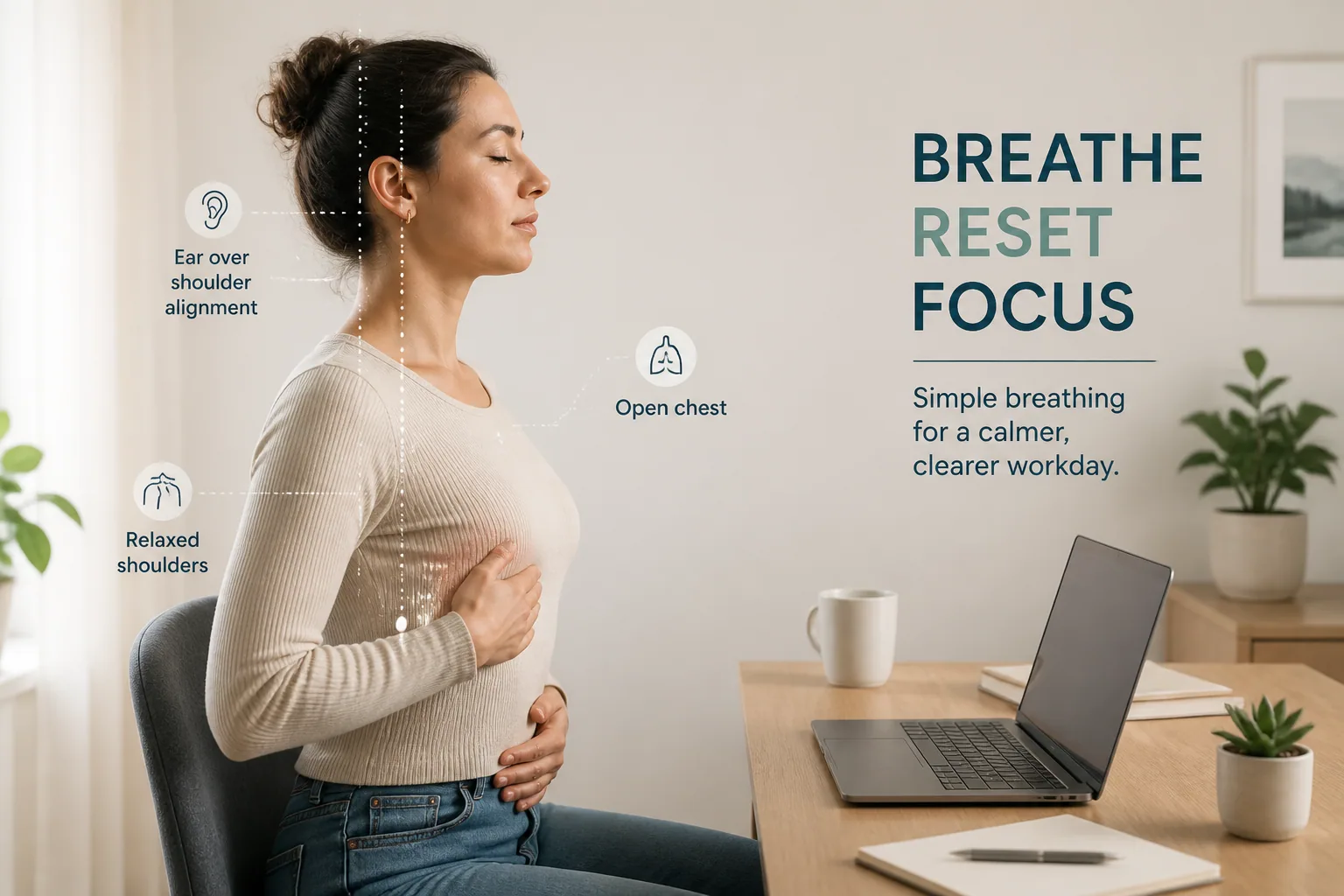
Working Breathwork Into Your Posture Routine: Why Alignment and Diaphragmatic Breathing Work Better Together
If you spend long hours at a desk, study for extended stretches, or simply notice that your neck feels tight by the end of the day, your breathing pattern may be part of the problem. Posture and breathing are not separate systems. They constantly influence each other. When your breathing becomes shallow and chest-dominant, your body often recruits the wrong muscles, your ribcage loses ideal movement, and your upper body starts working harder than it should. Over time, that can contribute to forward head posture, rounded shoulders, stiffness, and that familiar heavy feeling through the neck and upper back.
The good news is that posture does not have to be corrected with brute force. In many cases, it responds better when you combine alignment work with diaphragmatic breathing. Breathing well can help restore ribcage position, improve trunk support, and increase body awareness, which makes it easier to hold better posture without excessive tension. This is where a breath-first posture routine becomes useful: simple drills, slow breathing, and a few minutes of daily practice that help your body feel stacked, supported, and less strained.
Why Your Breathing Habits May Be Sabotaging Your Posture
Most people think about posture as a matter of sitting up straight, but posture is also a reflection of how efficiently your body organizes pressure, support, and movement. Breathing is one of the biggest players in that system. When breathing is smooth and diaphragm-led, the ribcage can expand and settle in a balanced way, the abdomen contributes naturally, and the spine is supported without unnecessary gripping. When breathing becomes shallow, fast, or upper-chest dominant, the body often compensates by tightening around the neck, shoulders, and upper chest.
That compensation matters because the muscles that help you breathe are also connected to the way you hold yourself. If your breathing pattern is constantly reinforcing tension, your posture will usually follow that same pattern. This is why someone can keep doing stretches for the neck and shoulders and still feel stiff by mid-afternoon. The underlying breathing mechanics may still be pulling the upper body into a stressed position.
What Shallow Chest Breathing Does to the Neck, Shoulders, and Spine
Shallow chest breathing relies more heavily on accessory muscles such as the sternocleidomastoid and scalenes instead of allowing the diaphragm to do most of the work. Research on breathing interventions for forward head posture and chronic neck pain notes that thoracic-dominant breathing increases accessory muscle use and can raise neck and shoulder tension, while reducing diaphragm contribution. In practical terms, that means your body may be living in a state of low-level upper-body effort just to breathe normally. Source: https://pmc.ncbi.nlm.nih.gov/articles/PMC12467365/ and https://pmc.ncbi.nlm.nih.gov/articles/PMC5300799/
This pattern often shows up with forward head posture, rounded shoulders, and a ribcage that feels stuck in an elevated or flared position. The upper chest lifts, the chin drifts forward, and the back of the neck works overtime to keep the head from falling further out of alignment. Over hours, that extra work can feel like stiffness, burning, or fatigue around the base of the skull and across the shoulders.
Forward head posture can also affect breathing capacity itself. Studies have found that FHP constricts lower thoracic expansion and reduces forced vital capacity, expiratory and inspiratory reserve volumes, FEV₁, and peak flow compared to a more neutral head position. In other words, poor posture can limit how well your lungs and ribcage function, which then reinforces even more shallow breathing. Source: https://pmc.ncbi.nlm.nih.gov/articles/PMC6348172/ and https://pmc.ncbi.nlm.nih.gov/articles/PMC4755989/
How Diaphragmatic Breathing Supports Alignment and Core Stability
Diaphragmatic breathing changes that pattern by encouraging the lower ribs, abdomen, and trunk to work together. Instead of breathing only into the top of the chest, you allow the diaphragm to descend so the lower ribcage can expand more freely. That does not mean forcing the belly out aggressively. It means letting the breath spread 360 degrees through the lower torso so the body can stay more organized and less tense.
This is one reason diaphragmatic breathing is often paired with posture training. Better breathing mechanics can improve awareness of ribcage position, help reduce neck dominance, and create a more stable base for the spine. It can also support core control. Research on core exercise training found that diaphragmatic breathing combined with core stabilization improved pulmonary function measures, abdominal fitness, and movement efficiency more than traditional abdominal exercises. Source: https://pmc.ncbi.nlm.nih.gov/articles/PMC4668176/
That matters for posture because the core is not just about abs. It is the pressure system around your trunk. When breathing is coordinated with that system, the body can resist collapse more efficiently and maintain alignment with less muscular effort. This is especially helpful for people who get tired quickly from sitting upright, standing still, or holding themselves in a corrected position for too long.
The Link Between Breath, Ribcage Position, and Postural Fatigue
If you have ever felt like good posture is exhausting, ribcage position may be part of the reason. Sitting slumped, rotated, or flexed changes chest wall mechanics. Research on posture and chest-wall motion shows that slumping and thoracolumbar flexion alter ribcage configuration, reduce ribcage displacement, lower tidal volume and minute ventilation, and increase the abdominal contribution to breathing. Source: https://www.sciencedirect.com/science/article/pii/S156990481000193X
In simple terms, when the torso collapses, breathing becomes less efficient, and the body has to work differently to keep oxygen moving. Over time, that can contribute to postural fatigue. You may start the day upright enough, but as the hours pass, the combination of poor ribcage mechanics, reduced breath quality, and muscle fatigue can make you sink deeper into the shoulders and neck.
This is why postural work feels better when it includes breathing. The goal is not just to hold a shape. The goal is to build a posture that your breathing can support. When the ribcage is better positioned and the diaphragm can move more freely, sitting tall stops feeling like a strain and starts feeling more natural.
What Recent Research Says About Breathing and Forward Head Posture
Current research is increasingly supportive of combining breathing re-education with posture interventions. A randomized controlled trial found that diaphragmatic breathing re-education combined with shoulder stabilization exercises produced better improvements in forward head posture, shoulder height balance, neck pain, and function than shoulder stabilization alone in people with upper crossed syndrome. Source: https://pubmed.ncbi.nlm.nih.gov/38541838/
Another randomized controlled trial in people with non-specific chronic neck pain reported that combining cervical manual therapy, diaphragm manual therapy, and breathing re-education led to significantly greater improvements in cervical range of motion and posture alignment measures than conventional physiotherapy. Source: https://pmc.ncbi.nlm.nih.gov/articles/PMC12295102/
There is also useful evidence on recovery and stability. In sedentary adults after core fatigue, diaphragmatic breathing restored postural stability, measured by center of pressure velocity and displacement, much more effectively than passive recovery and nearly as well as active trunk-stability exercises. Source: https://pubmed.ncbi.nlm.nih.gov/40263381/
Taken together, the research suggests something practical: posture changes stick better when breathing is part of the training. Breathing appears to influence cervical alignment, ribcage mechanics, shoulder balance, and even recovery from fatigue. That makes it a smart addition for desk workers, students, and anyone who spends too much time in one position.
Best Breathing and Posture Combos for Desk Workers and Students
The simplest way to make progress is to pair one breathing cue with one posture cue. This keeps the practice easy to repeat and prevents you from overthinking every detail at once. For desk workers and students, the best combinations are usually the ones that open the ribcage, reduce neck tension, and reinforce a neutral head-and-torso relationship.
A very useful pairing is diaphragmatic breathing with a chin tuck. The chin tuck gently brings the head back over the shoulders, which can reduce forward head posture when done without strain. At the same time, the breath cue helps you avoid bracing the neck or lifting the chest too high. Think of the head moving back while the ribs stay soft and wide.
Another effective combination is wall alignment with slow breathing. Standing with the back of the head, upper back, and pelvis near a wall gives you a clear reference for stacked alignment. Once you are in position, slow nasal or relaxed breathing helps you feel where the ribs flare, where the shoulders creep up, and whether the chin is drifting forward. The wall is not there to force posture. It is there to give you feedback.
Core stability work also pairs well with breath training. Dead bugs, marching variations, bird dogs, and supported planks all become more useful when you keep breathing without holding tension in the neck or lower back. The point is not to create a rigid trunk. The point is to keep pressure and support coordinated while the limbs move.
Try These Exercises: Chin Tucks, Wall Drills, and Core Work With Breath
Chin tucks are a classic posture drill for a reason. They are simple, low-load, and easy to repeat throughout the day. To do one, gently glide the head backward as if making a subtle double chin, then pause while keeping the jaw relaxed. Now match that position with slow breathing. Inhale through the nose, allow the ribs to expand, and exhale slowly without collapsing the chest. If you feel tension in the front of the neck, you are likely pushing too hard.
Wall drills add a whole-body reference point. Stand with your back near a wall, feet a comfortable distance forward, and let the back of the head lengthen upward rather than jutting forward. Exhale gently and feel the lower ribs soften. Inhale and notice whether one shoulder lifts or whether the lower back arches too much. This drill teaches awareness more than perfection, which is exactly what many posture routines need.
For core work, the best strategy is to keep the breath flowing. During dead bugs or bird dogs, exhale during the effort phase and inhale on the return. The exhale can help the ribs stack and the trunk organize itself without over-gripping. This makes the exercise more useful for posture because it teaches the body to stay stable while still breathing naturally.
If you want a slightly more restorative option, try a supported 90-90 breathing position with feet on a chair or wall. That position can help reduce rib flare and make it easier to feel the diaphragm and lower ribs working together. It is especially helpful after a long sitting block when your upper chest feels tight and your lower back feels compressed.
A Simple Daily Breathwork and Posture Routine You Can Actually Stick To
The best routine is the one you will actually repeat. You do not need a long session to get benefits. A realistic daily practice can be as short as 5 to 10 minutes, especially if you build it into moments you already have, such as before work, after lunch, or at the end of the day. A simple structure might look like this:
Start with 1 to 2 minutes of diaphragmatic breathing in a supported position. Focus on a slow inhale through the nose and a longer, relaxed exhale. Then spend 1 minute on chin tucks, keeping the breath smooth. Move into 1 to 2 minutes of wall alignment, using the wall as a cue for head, ribs, and pelvis position. Finish with 2 to 3 minutes of core work, such as dead bugs or bird dogs, coordinating each repetition with your breathing.
If that feels like too much, cut it in half. The routine should lower friction, not create another stressful task on your list. Even a few focused minutes done consistently can be more helpful than an ambitious plan that falls apart after three days.
How Often to Practice and What Reminders Help Most
Frequency matters more than perfection. For most people, a brief daily practice plus a few posture check-ins during the day is a better strategy than doing one intense session every now and then. If you sit for long hours, try to pair the breathing routine with a natural transition point, such as when you open your laptop, after lunch, or before you shut down your workday.
Reminders help because posture and breathing are easy to forget when your attention is elsewhere. A gentle phone alarm, calendar block, or smartwatch nudge can be enough to bring you back to your body. The goal is not to constantly self-correct. It is to create repeated moments of awareness so your nervous system has a chance to learn the pattern.
This is also where consistency tools can help. If you like structure, a product like Just Breathe: Relax Daily can support the habit with guided breathing patterns, smart reminders, and visual animations that make it easier to stay on rhythm: https://findthe.app/just-breathe-ujhm1e
Using Visual Guides and Animations to Cue Better Breathing and Alignment
Many people struggle with breathwork because they are not sure whether they are doing it correctly. Visual guides remove some of that uncertainty. A slow animation can help you match inhale and exhale timing, which is especially useful when you are trying to breathe more slowly and avoid chest-dominant patterns. This is helpful at a desk, where it is easy to rush and lose the rhythm.
Animations can also make the practice feel less abstract. If the goal is to slow your breathing, soften the shoulders, and stack the ribs over the pelvis, a gentle cue on screen can keep you focused without requiring constant mental effort. That is one reason guided breathing tools can be so effective for beginners and for busy people who need a simple structure to follow.
You can also use visual cues outside of an app. A sticky note on your monitor, a small timer, or a posture reminder on your desktop background can work. The key is to make the cue visible enough that it interrupts autopilot without becoming annoying.
Common Mistakes to Avoid When Mixing Breathwork With Posture Training
One common mistake is trying to hold perfect posture all the time. That usually backfires. If you lock yourself into a rigid position, breathing gets harder and tension rises. Good posture should feel organized and adaptable, not braced and frozen.
Another mistake is overdoing the inhale. Some people try to force a huge belly breath, lift the chest aggressively, or flare the ribs. That can create more tension instead of less. A better approach is a calm, balanced breath that allows expansion without strain. Let the breath be smooth rather than dramatic.
A third mistake is forgetting the exhale. Many people focus only on breathing in, but the exhale is often what helps the ribs settle and the neck relax. Slow exhales can be especially helpful before posture drills because they reduce excess tone and make alignment easier to find.
Finally, do not expect instant transformation. If your breathing and posture have been reinforcing each other for years, they will usually improve gradually. Small, repeated sessions work better than occasional perfection. That is the real advantage of a breath-first approach: it builds a routine your body can learn from every day.
Final Takeaway: Build a Breath-First Posture Habit for Less Tension
If your neck is tight, your shoulders feel rounded, or your back gets tired from sitting, it is worth looking at breathing before blaming posture alone. The way you breathe can either support alignment or quietly undermine it. Shallow chest breathing tends to recruit the neck and shoulders, reduce ribcage movement, and reinforce the very patterns that make good posture feel difficult.
Diaphragmatic breathing does the opposite. It supports ribcage motion, helps the trunk organize itself, and makes posture work feel less effortful. When you pair breathwork with chin tucks, wall drills, and core stability exercises, you give your body a clearer message: stay stacked, stay relaxed, and stop compensating in the upper body. That message is backed by research, and it is practical enough to use in real life.
So keep it simple. Practice a few minutes a day. Use reminders. Lean on visual cues if you need them. And build a routine that helps your breathing and posture work together instead of against each other. Over time, that combination can mean less tension, better awareness, and a body that feels easier to live in.