Your Breath’s Fingerprint: How Breathing Patterns Reveal and Shift Emotional States
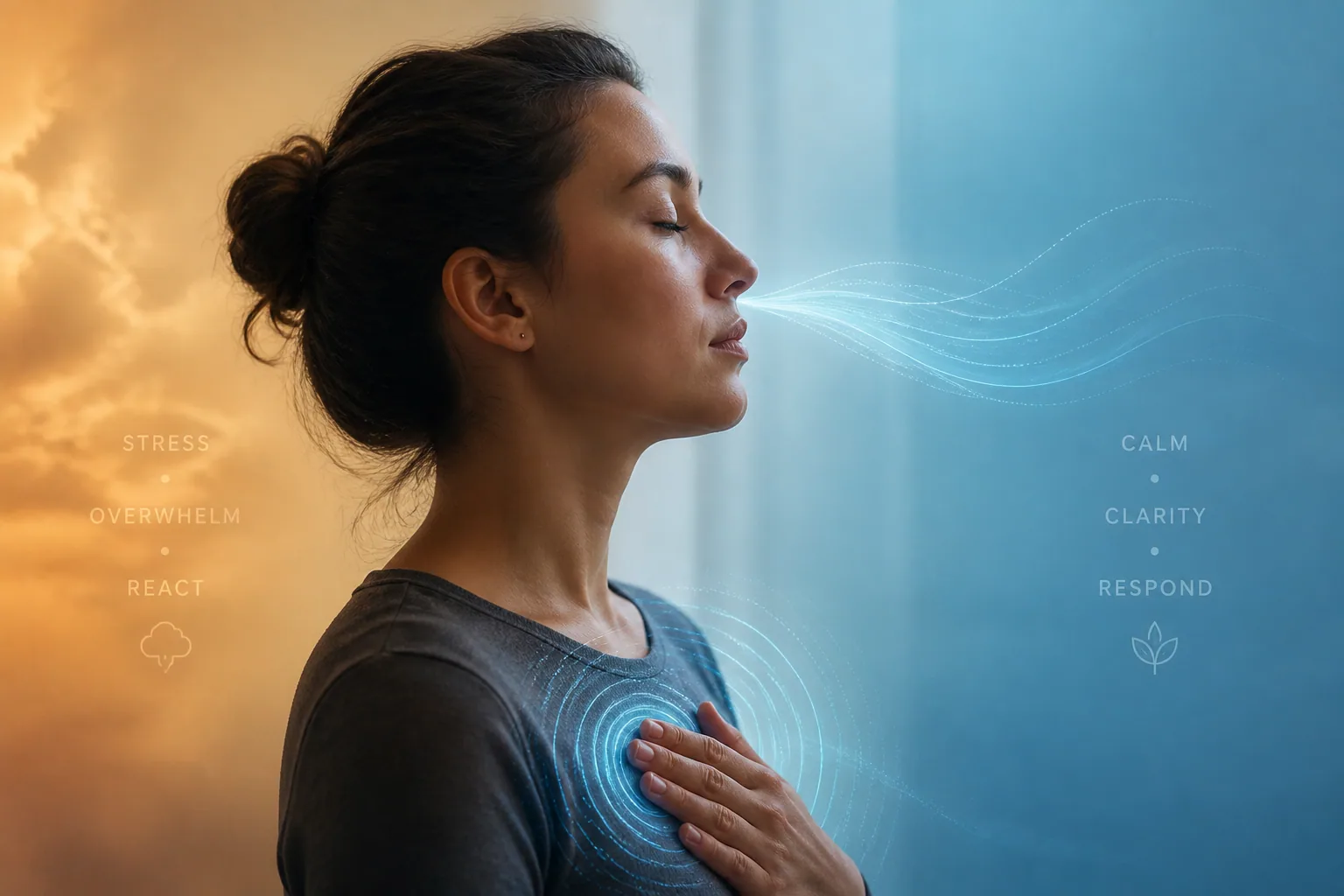
Your breathing is doing more than keeping you alive. It is also giving you clues about what your nervous system is handling in real time. Before your mind has fully named the feeling, your breath often changes first. It may become faster, shallower, held, irregular, or shifted toward mouth breathing. In calmer states, it can settle into a slower, smoother, more even rhythm. That is why breath can feel like an emotional fingerprint. It does not always tell the whole story, but it often reveals the shape of what is happening underneath.
This is where breath becomes especially interesting for wellness-curious readers. You do not need to become an expert in physiology to notice your own patterns. You just need to learn what to watch for: tempo, depth, rhythm, holds, and route. And while the science does not give us a perfect emotion-to-breath translation chart, it does strongly suggest that breathing and emotional state are deeply linked. The practical takeaway is simple. If you can read your breath more accurately, you can choose a better reset when stress, frustration, anxiety, or low energy shows up.
Why Your Breath Changes Before Your Mind Catches Up
Breathing is partly automatic, but it is also highly responsive to what your body senses. That means it reacts fast. A tense email, an awkward conversation, a performance moment, or even a subtle internal worry can shift your breathing before you consciously think, “I am stressed.” The body often begins the response first, then the mind catches up and explains it later.
This is one reason breath is such a useful self-awareness tool. It gives you an observable signal when emotions are still in motion. For some people, that signal appears as a quickened upper-chest breath. For others, it shows up as a held breath, a sigh, a deep gulp, or a switch to mouth breathing. These are not random habits. They are often part of a larger regulation pattern, even if the pattern is not always obvious in the moment.
Early literature has long pointed to core respiratory features that reflect emotional dimensions, including rate, amplitude, rhythm, and the balance between passive and active coping. In other words, the breath is not just moving air. It is participating in how you adapt to the moment.
The Building Blocks of a Breathing Signature: Tempo, Depth, Rhythm, and Route
If you want to notice your own breathing signature, start with four variables. First is tempo, or how fast you are breathing. Second is depth, or how much air each breath seems to contain. Third is rhythm, meaning whether the pattern is smooth and regular or irregular and interrupted. Fourth is route, which is whether the breath is mostly through the nose or the mouth.
Tempo often changes the most obviously under stress. Faster breathing can accompany urgency, anxiety, agitation, or mental overload. Depth matters too. Shallow breathing is common when the body is bracing, guarding, or trying to stay small and controlled. A deeper breath can sometimes signal relaxation, but it can also show effort, preparation, or a deliberate attempt to regain control.
Rhythm is where emotional patterns become especially noticeable. Even breathing often suggests more stability, while erratic breathing may accompany uncertainty, frustration, or inner conflict. Breath holds can signal concentration, anticipation, suppression, or fear. Route matters because nasal and mouth breathing are not interchangeable from a physiological standpoint, even though many people switch between them without noticing.
What Anxiety, Frustration, Calm, Focus, and Energy Can Look Like in the Breath
Anxiety often shows up as speed, lightness, and tightness. The breath may become rapid, shallow, and high in the chest, with more noticeable pauses or involuntary sighs. Some people also begin mouth breathing when anxious, especially if they feel air hunger or congestion, or if they are speaking more quickly than usual.
Frustration can look similar to anxiety, but with more force and abruptness. The breath may become sharper, louder, or more pressurized. Exhales can sound more audible, and there may be short breath holds or clipped breathing as the body braces against what feels difficult or irritating. The key difference is that frustration often carries more muscular tension and a sense of pushback.
Calm usually looks slower, smoother, and more even. The inhale and exhale tend to feel less urgent. The body often uses less visible effort to breathe, and the breath may settle lower in the torso. That does not mean calm always equals very slow breathing, but it often means the respiratory rhythm is less erratic and less reactive.
Focus can create a very interesting signature because it is not always the same as calm. Some focused states are steady and quiet, while others involve mild breath holding, especially when concentration is intense. Think of someone reading closely, aiming carefully, or waiting for a precise moment. The breath may become intentionally smaller or more controlled as attention narrows.
Energy can show up as a fuller, more awake breath pattern. The pace may increase a little, but the breath may also feel more open and available rather than frantic. In some cases, energy is paired with a natural tendency toward deeper inhales and more active exhales. The difference between energized and anxious often lies in whether the rhythm feels organized or scattered.
What the Science Actually Says About Breath and Emotional State
The science is stronger than the folklore, but it is still evolving. Research consistently suggests that breathing patterns and emotional states influence one another. Slow-paced breathing around 6 breaths per minute, which is about 0.1 Hz, is associated with increased heart rate variability, a marker often linked to better autonomic balance and lower stress. A recent review in ScienceDirect reported that this pace can reduce negative and positive activation more broadly, while even slower breathing around 0.05 Hz appears to target reductions in negative affect more specifically: https://www.sciencedirect.com/science/article/pii/S0301051126000475
There is also meaningful evidence that training people to modify breathing rate and depth can reduce symptoms of depression, anxiety, stress, and pain while improving mood, visceral function, and learning. In one review, this was framed as more than a relaxation trick. It was presented as a real intervention that can alter how the body and brain respond to emotional strain: https://pmc.ncbi.nlm.nih.gov/articles/PMC9840384/
Slow-paced breathing also has meta-analytic support. A review of 31 studies involving about 1,133 nonclinical participants found moderate to large positive effects on emotional well-being, including reductions in anxiety and negative affect, along with improvements in heart rate and cardiovascular function: https://link.springer.com/article/10.1007/s12671-023-02294-2
Nasal breathing has been studied in its own right as well. Research suggests that inhaling through the nose is linked to stronger synchronization of neural activity in limbic areas such as the amygdala, hippocampus, and insula, and may support fear discrimination, memory retrieval, emotional processing, and autonomic regulation: https://pmc.ncbi.nlm.nih.gov/articles/PMC13023532/
Where the Research Is Still Murky: Limits, Gaps, and Pattern Myths
It would be convenient if every breathing pattern had one exact emotional meaning. But that is not where the evidence stands today. There is no fully standardized map that links each respiratory signature to one specific emotion. Many studies use small samples, different measurement methods, and overlapping breathing variables, which makes singular attribution difficult. A recent review points to these limits clearly: https://www.mdpi.com/2076-328X/16/3/467
That matters because breath reading can become too simplistic very quickly. A fast breath does not always mean anxiety. It can also mean exertion, excitement, pain, heat, caffeine, or simply talking a lot. A breath hold does not always mean suppression. It can also reflect concentration, anticipation, or habit. The point is not to force a rigid interpretation. The point is to notice patterns in context.
So the healthiest approach is probabilistic, not absolute. Treat breath as a clue, not a verdict. Ask what else is happening in your body, your environment, and your thoughts before you decide what your breathing pattern means.
How to Notice Your Own Micro-Patterns in Real Time
The most useful breath skill is not changing your breathing immediately. It is noticing it early enough to make a choice. Start by checking in at ordinary moments, not only during stress. Ask yourself a few simple questions: Is my breath fast or slow? Is it shallow or full? Is it smooth or choppy? Is there a pause at the top or bottom? Am I breathing through my nose or my mouth?
Try to observe without correcting right away. The goal is to build a personal baseline. You may discover that your breath tightens when you are overcommitted, becomes held when you are trying to perform, or shifts to mouth breathing when you are tired or irritated. These micro-patterns can become surprisingly reliable once you start looking for them.
You can also pair breath awareness with emotional labeling. For example, “My breath is short and high, and I think I am feeling rushed.” Or, “My breath is paused and tight, and I may be bracing.” This helps connect body signals with emotional awareness in a practical way, without overcomplicating the process.
Nasal vs Mouth Breathing: When It Matters and When It Doesn’t
Nasal breathing is generally the more supportive default for everyday life. The nose filters, humidifies, and warms inhaled air, and it also helps generate nitric oxide, a molecule linked to vasodilation and cardiovascular and immune health. Cleveland Clinic also notes that nasal breathing supports emotion regulation in ways mouth breathing does not: https://health.clevelandclinic.org/breathe-mouth-nose//
That said, mouth breathing is not always a moral failure or a crisis. If you are exercising hard, temporarily congested, or recovering from a moment of intense exertion, mouth breathing may happen for a reason. The issue is more about chronic habit than occasional use.
In emotional terms, mouth breathing can be a useful signal. If you notice yourself defaulting to it during low-grade stress, it may be pointing to overload, fatigue, or a body that has slipped out of its quieter regulation mode. Returning to nasal breathing can often feel like a small but meaningful way to re-anchor the system.
How Breathwork Can Shift Physiology and Support Self-Regulation
The reason breathwork gets so much attention is that it works in both directions. Breath reflects emotion, but it can also help shift emotion. Slow, intentional breathing influences the autonomic nervous system, which is the same system that governs fight-or-flight and rest-and-digest responses. That is part of why controlled breathing can lower stress signals and create more stability in the body.
Breathing at around 6 breaths per minute is often used for regulation because it tends to increase HRV, which is associated with greater autonomic flexibility. Going even slower, near 0.05 Hz, may produce distinct effects and can be especially useful when the main goal is easing negative affect. In practice, that means different breathing speeds may be better for different emotional goals.
This is where a tool like Just Breathe: Relax Daily can be helpful. If you want guided patterns without having to count everything manually, it offers cardiac coherence, box breathing, relaxation breath, energizing breath, and custom patterns, plus visual pacing and reminders. You can explore it here: https://findthe.app/just-breathe-ujhm1e
Choosing the Right Breath Reset for the Mood You’re In
If you are anxious, the best reset is often one that lengthens the exhale, slows the pace, and reduces urgency. Cardiac coherence style breathing or slow paced breathing can help the body move out of alarm. If your state is more frustration than fear, a similarly steady pattern can be useful, but it may help to emphasize softness and longer exhalation so the body can release some of that pushy energy.
If you feel scattered or mentally overloaded, box breathing can be useful because it gives attention a structure to follow. Its equal counts create a clear rhythm, which can help organize racing thoughts. If you feel dull, foggy, or underpowered, a more energizing breath pattern may be a better fit than a deeply calming one. The wrong kind of breathwork can sometimes make a state worse if it does not match what the body actually needs.
That is an important principle. Don’t choose a breath practice because it sounds good in theory. Choose it based on your current state. A calming pattern for panic. A focusing pattern for chaos. An energizing pattern for sluggishness. Matching the tool to the state is what makes breathwork feel practical instead of generic.
Fast In-the-Moment Breath Interventions for Stressful Situations
When stress hits in real time, you usually do not need a 20-minute protocol. You need something short, discreet, and easy to remember. One of the simplest options is to extend the exhale a little more than the inhale for a few cycles. That alone can signal safety to the nervous system and reduce the feeling of being braced or trapped.
Another option is a counted pattern such as 4 in, 4 hold, 4 out, 4 hold, especially if you are in a situation where your attention needs structure. This can be useful before speaking, presenting, or entering a tense conversation. If you are more activated than anxious, a slightly longer exhale or slower pace may work better than a rigid hold-based practice.
If the situation allows it, shift your breathing back through the nose. Even that small change can help your body move toward a calmer baseline. The goal is not to force relaxation instantly. The goal is to interrupt the stress pattern long enough for your system to regain some flexibility.
Why Breath Is Becoming a Wellness and Workplace Performance Metric
Breath is no longer just a meditation topic. It is increasingly used as a metric for resilience, recovery, stress load, and performance. In wellness spaces, people track breathing sessions alongside mood, sleep, and heart rate. In workplaces, breathing is often part of broader conversations about burnout prevention, focus, and emotional self-management.
That makes sense because breath sits at the intersection of body and behavior. It can reflect how pressured someone feels during the workday, how well they recover after meetings, and whether they are able to reset between tasks. It is also a measure people can engage with directly, which makes it more actionable than many abstract wellness indicators.
Still, it is worth keeping the metric in perspective. Breath data can be useful, but it is not destiny. Its value is in helping you notice trends, build consistency, and spot when your baseline is shifting. Used wisely, it supports awareness rather than perfection.
Creating a Personal Breath Map You Can Use Every Day
A personal breath map is simply your own version of an emotion-breath guide. You do not need a universal chart to create one. Start with a few common states in your life: rushed, calm, frustrated, tired, focused, and energized. Then note the breathing features that tend to show up with each one.
For example, you may discover that rushed feels high and quick, calm feels smooth and nasal, frustration feels clipped and forceful, focus feels held, and fatigue feels open but slow. Over time, you will learn your own patterns better than any generalized list can teach you. That is the real value of breath awareness.
If you want a practical way to turn that awareness into a habit, pair observation with a daily guided session, then track how you feel afterward. Whether you use a simple breathing timer or a more structured app, the best breath practice is the one you will actually repeat. Consistency is what turns breath from a passing clue into a useful personal tool.